
It’s time to move beyond just the pretty look of the botanical-method aquarium, and venture into a deeper stage of understanding how our aquariums function as miniature ecosystems.
Part of the whole “game” of the botanical method aquarium is understanding how, why and what happens to terrestrial materials when they’re placed in water.
Nature has been working with terrestrial materials in aquatic habitats for eons.
She works with just about everything you throw at her!
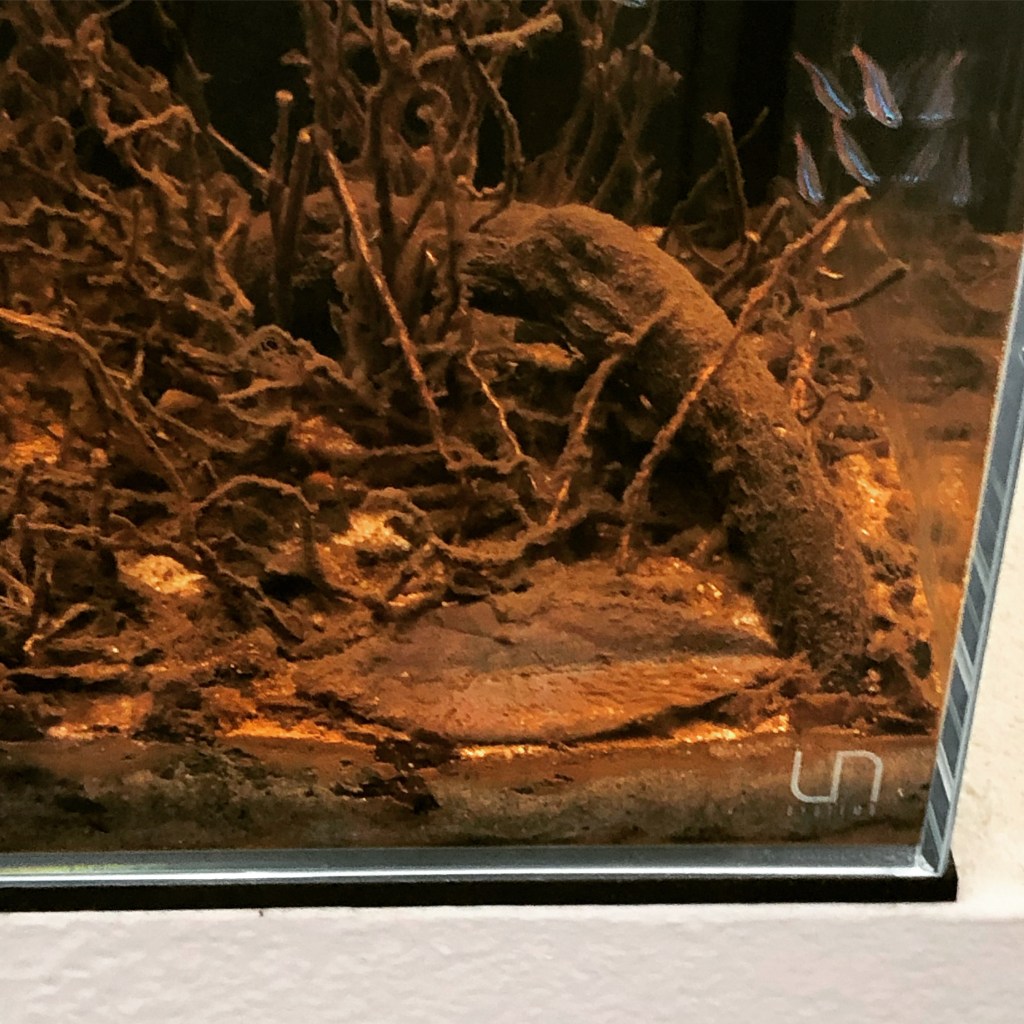
She’ll take that seemingly “unsexy” piece of wood, seed pod or bunch of dried leaves, and, given the passage of time, the action of gravity and water movement, and the work of bacteria, fungi, and algae- will mold, shape, evolve them into unique and compelling pieces, as amazing as anything we could ever hope to do…
Yeah, one thing that’s very unique about the botanical method approach is that we tend to accept the idea of decomposing materials accumulating in our systems. We understand that they act, to a certain extent, as “fuel” for the micro and macro fauna which reside in the aquarium, and that they perform this function as long as they are present in the system.
Our aquariums, much like the wild habitats we strive to replicate, are constantly evolving, accumulating new materials, and creating new physical habitats for fishes to forage among. New food sources and chemical/energy inputs are important to the biological diversity and continuity of the flooded forests and streams of the tropics, and they play a similar role in our aquariums.
We add leaves and botanicals periodically, not just for an aesthetic “refresh”, but for a “re-charge” of the biome within our tanks. This is a fascinating aspect of the botanical method aquarium. It facilitates the cycle of growth, nutrient accumulation, and decomposition. It becomes not only part of our practice, but it’s part of the “operating system” we are trying to facilitate.
Because of the very “operating system” of our tanks, which features decomposing leaves, botanicals, soils, roots, etc., we are able to create a remarkably rich and complex population of creatures within them.
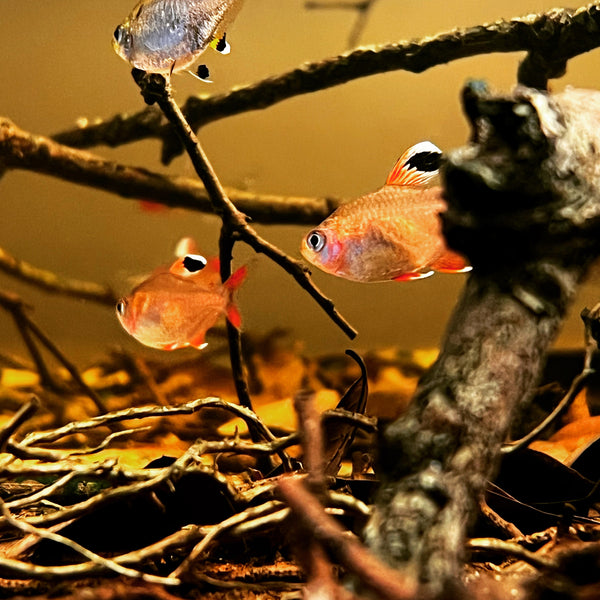
This is one of the most interesting aspects of a botanical method aquarium: We have the opportunity to create an aquatic microcosm which provides not only unique aesthetics- it provides some supplemental nutritional value for our fishes, and perhaps most important- nutrient processing- a self-generating population of creatures that compliment, indeed, create the biodiversity in our systems on a more-or-less continuous basis.
Decomposition: How Nature Gets to Work
If there is one aspect of our botanical method aquariums which fascinates me, it’s the way they facilitate the natural processes of life- specifically, decomposition.
We use this term a lot in the botanical method aquarium world-…What, precisely does it mean?
de·com·po·si·tion- dēˌkämpəˈziSH(ə)n –the process by which organic substances are broken down into simpler organic matter.
A very apt description, if you ask me!
Decomposition is an amazing process by which Nature processes materials for use by the greater ecosystem. It’s the first part of the recycling of nutrients that were used by the plant or organism from which the material came from. When biological material decays, it is broken down and converted into more simple organic forms, which become food for all kinds of organisms at the base of the ecosystem.
For our purposes, we’ll focus on the way botanical materials decompose.
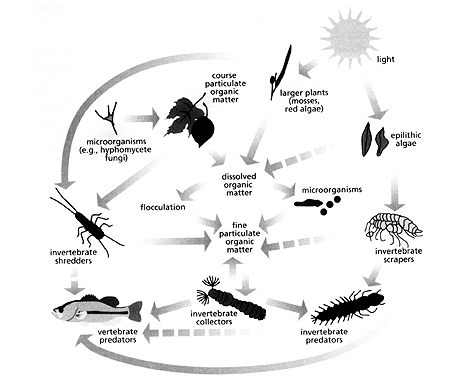
In aquatic ecosystems, much of the initial breakdown of botanical materials is conducted by detritivores (organisms which feed on dead organic material, especially plant detritus)- specifically, fishes, aquatic insects and invertebrates, which serve to begin the process by feeding upon the tissues of the seed pod or leaf, while other species utilize the “waste products” which are produced during this process for their nutrition.
In wild aquatic habitats, such as streams and flooded forests, a variety of species work in tandem with each other, with various organisms carrying out different stages of the decomposition process.
The process is broken down into three distinct phases identified by ecologists.
It goes something like this:
A leaf falls into the water.
After it’s submerged, some of the “solutes” (substances which dissolve in liquids- in this instance, sugars, carbohydrates, tannins, etc.) in the leaf tissues are released rather quickly. Interestingly, this “leaching stage” is known by science to be more of an artifact of lab work (or, in our case, aquarium work!) which utilizes dried leaves, as opposed to fresh ones.
Fresh leaves tend to leach these materials over longer periods of time during the breakdown/decomposition process.This is yet another reason why it’s not a bad idea to prep your leaves before adding them to your aquarium, because it will help quickly leach out many of the remaining sugars and other compounds which could degrade water quality in closed systems.
The second stage of the process is called the “conditioning phase”, in which microbial colonization on the leaf takes place. Communities of microbial life forms begin to consume some of the tissues of the leaf- at least, softening it up a bit and making it more “palatable” for the aforementioned detritivores.

The last phase,“fragmentation”, is exactly what it sounds like- the physical breakdown of the leaf by various organisms, ranging from microorganisms to small crustaceans, shrimp, fungi- and even fishes, collectively known as “shredders.” Interestingly, it has been suggested by some ecologists that microbes might be more important than “shredders” in tropical streams.
Fauna composition differs between habitats, yet most studies I’ve found will tell you that Chironomidae (insect larvae-think Bloodworms!) are the most abundant in many streams, pools, flooded forests, and “riffles” in the initial period of leaf breakdown!
The botanical material is broken down into various products utilized by a variety of life forms. The particles are then distributed downstream by the current and are available for consumption by a variety of organisms which comprise aquatic food webs.
Six primary breakdown products are considered in the decomposition process: bacterial, fungal and shredder biomass; dissolved organic matter; fine-particulate organic matter; and inorganic mineralization products such as CO2, NH4+ and PO43-. In tropical streams, a high decomposition rate has been related to high fungal activity…they accomplish a LOT!
Interestingly, scientists have noted that the leaves of many tropical plant species tend to have higher concentrations of secondary compounds and more recalcitrant compounds than do leaves of temperate species. Also, some researchers hypothesized that high concentrations of secondary compounds (like tannins) in many tropical species inhibit leaf breakdown rates in tropical streams. One can only wonder if that may be why you see leaf litter beds that last for many years and become known features in streams and river tributaries!
There is certainly a lot going on in the litter beds of the world, huh?
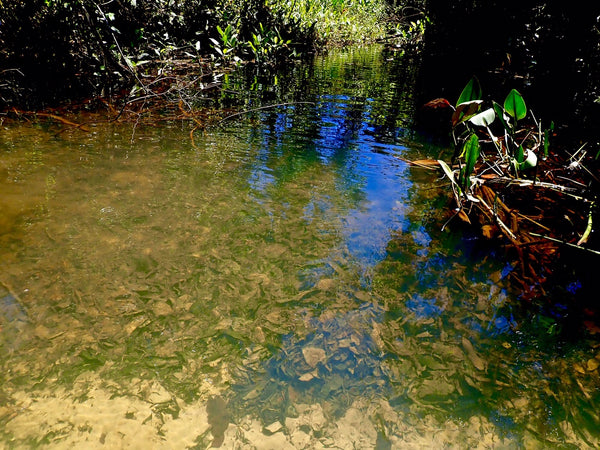
This is a dynamic, fascinating process- part of why we find the idea of a natural, botanical method system so compelling. Many of the organisms- from microbes to small crustaceans to fungi- are almost never seen, except by the most observant and keen-eyed hobbyist…but they’re there– doing what they’ve done for eons. They work slowly and methodically over weeks and months, converting the botanical material into forms that are more readily assimilated by themselves and other aquatic organisms.
The real “cycle of life!”
We add leaves and botanicals to our aquariums, and over time, they start to soften, break up, and ultimately, decompose. I believe that we should leave them “in play” until they completely decompose in our aquariums.
The substances contained within them (lignin, organic acids, and tannins, just to name a few) are liberated into the water- which “fuels” the biome- bacteria, fungi, and other microorganisms and crustaceans, facilitating the formation of a basic “food web” within the botanical-style aquarium– if we allow it to!
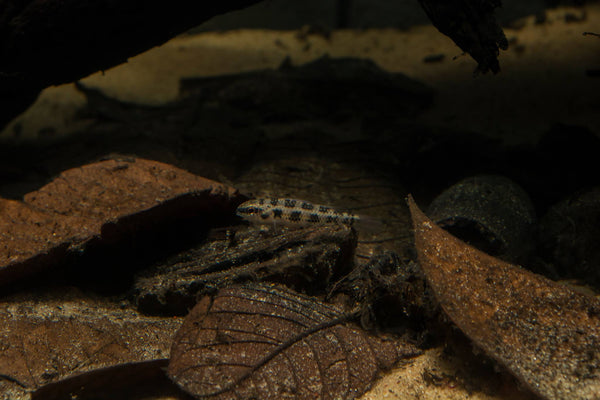
I have personally experienced this time and time again, by setting up botanical method systems for the expressed purpose of providing supplemental food for the resident fishes. I’ve done this with adult fishes, and I’ve actually “reared” (well, Nature did the work!) many fish fry to maturity by setting them up in heavy botanical-stocked systems with little to no supplemental feeding. The fishes feed on the fungal growths and biofilms, as well as the organisms which are associated with them...just like in Nature.
This, to me, is extremely exciting.
This is a fundamental part of what makes our botanical method aquariums work.
Does the liberation of carbons, sugars, etc. in our systems impact the water quality of our aquariums? Of course it does! And yeah- you need to monitor water quality in your aquariums regularly, to establish what’s “baseline” for your system. You need to perform regular water exchanges, too.
It’s just common sense.
It’s important to remember that leaves and botanicals are simply not permanent additions to our ‘scapes, and if we wish to enjoy them in their more “intact” forms, we will need to replace them as they start to break down.
This is not a bad thing.
And it’s really as much of a mental shift as it is anything else- like so much of what we do with botanical method aquarium systems. The willingness for us to really look to Nature as more than just an inspiration for making cool-looking aquariums. Rather, an approach which understands that our botanical-style aquariums require us to step back, observe and accept what happens in wild aquatic habitats, and realize that the same processes occur in our aquariums.
Natural materials, submerged in water, processed by a huge diversity of organisms, working together. A microbiome. All of these things are beautiful, natural, and incredibly important in our closed systems …if we give them a chance.
Stay Wet.
Scott Fellman
 The Tint
Leave a comment