
It would hardly be a stretch to state that I’m about as geeked-out about leaf litter habitats, and creating aquariums that replicate this unique habitat as anyone on the planet. And of course, when you’re creating such a habitat in your aquarium, it makes sense that you’d want to give a lot of thought to how to do this first. I know that we’ve talked about it before, but there’s so much interest in this idea that I just HAD to bring it up once again!
First off, a quick review. As you recall, leaf litter beds are found throughout tropical rivers, streams, flooded forest floors, and other watercourses around the world, from South America, to Asia, and Africa, to name just a few regions. They are remarkably productive habitats, because they offer not only shelter for their inhabitants, but food items, an area to reproduce, and function as a “nursery” of sorts for larval fishes to shelter and feed in. They are among the most productive environments in the wild.
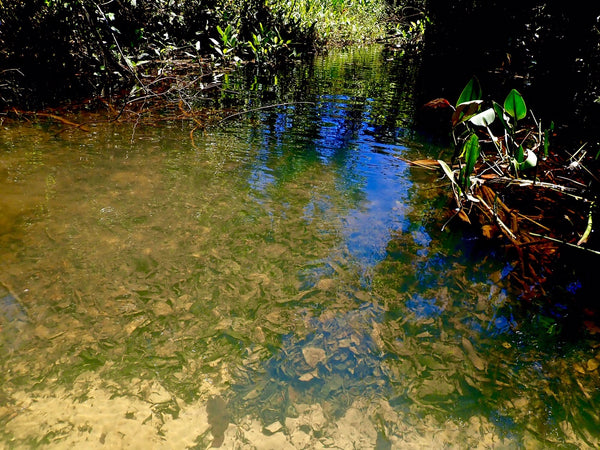
Leaf litter comes from a variety of trees in the rainforests of the tropical world. There is a near constant leaf drop occurring, which continuously “refreshes” the supply. In monsoonal climates, large quantities of leaves will drop during the dry season, and many will find their way into streams which run through the rain forest. In other habitats, such as the igapo forests of Amazonia, the leaves fall onto the forest floor and accumulate, and are seasonally-inundated during the rainy season, creating an extremely diverse and compelling environment that we love so much around here!
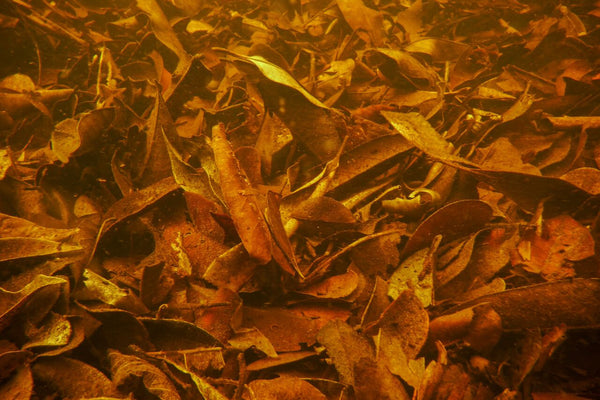
The leaf litter in an igapo when inundated can be as much as 3 feet (1 meter) or more deep, with a huge amount of surface area available to bacteria (which create biofilms) and are often home to surprisingly large populations of fishes like Apistogramma, which use the shelter and “on-board” food offered by these habitats- to their advantage. And they’re vital to some of the small Elacocharax and other “Darter Tetras” which live almost exclusively in these niche habitats. Oh, and shrimp, too!
Suffice it to say, the leaf litter bed is a surprisingly dynamic, and one might even say “rich” little benthic biotope, contained within the otherwise “impoverished” waters. And, as we’ve discussed before on these pages, it should come as no surprise that a large and surprisingly diverse assemblage of fishes make their homes within and closely adjacent to, these litter beds. These are little “food oasis” in areas otherwise relatively devoid of food.
The fishes are not there just to look at the pretty leaves!
I’m obsessed with leaf litter in the wild and in the aquarium. I think it’s because it’s literally an oasis of life. Compelling, diverse, and productive.
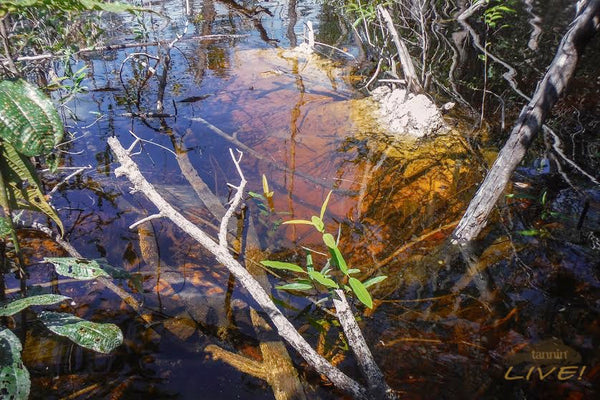
Many tropical rivers and streams are characterized by large quantities of leaf litter and decaying botanicals on the bottom, with typically clear (but tinted) water. As discussed many times in this blog, leaf litter is used as shelter, spawning ground, feeding area, and in some instances, as supplemental food itself. This is a highly productive habitat in Nature that also just happens to look really cool in our aquariums, performing exactly the same function!
In my research on leaf litter beds in Nature, I kept reading about how the process of fermentation plays out within them, and it got me wondering if the same processes occur in the aquarium, and are of benefit to our fishes.
Fermentation in submerged leaf litter beds occurs when microbes break down leaf compounds anaerobically (without oxygen) creating a low-pH, nutrient-rich environment through the release of various organic acids like butyric acid and acetic acid, derived from carbohydrates,. This process is driven by bacteria and fungi that establish biofilms, while they alter the leaf chemistry and promote decomposition.
There are several key processes which occur to make this happen.
The first is Microbial Colonization, in which fungi often arrive with the leaves, while bacteria colonize from the water, forming diverse biofilms on the litter. We see this in our botanical method aquariums all the time, don’t we?
The second is the formation of Anaerobic Conditions, where waterlogged litter creates anoxic zones (lacking oxygen), forcing microbes to use anaerobic pathways like fermentation.
Then comes Carbohydrate Breakdown. This is a process in which microbes ferment readily available sugars and non-lignin carbohydrates (like cellulose), releasing organic acids and alcohol. In turn, this process causes Acid Production. Yep, fermentation generates strong organic acids (e.g., acetic acid, butyric acid), significantly lowering the pH (making it more acidic). Hmm…this is getting interesting!
As a byproduct of these reactions, Lignin & Nutrient Release occurs. While initial breakdown focuses on simple compounds, microbes gradually tackle lignin, releasing nutrients and stabilizing the decomposing litter. And as we’ve discussed here over the years, lignin is a basic component of pretty much all botanical materials!
All of this facilitates the development of a biome of organisms. Leaf litter decomposition is a vital ecosystem function where invertebrate organisms classified as “shredders” physically tear up the leaves, producing large quantities of fine particulate organic matter that serves as a substrate for microbial communities. This leads to Microbial Succession, in which different microbial communities dominate at various stages, with anaerobic fermenters thriving in deeper, low-oxygen parts of the leaf litter beds.
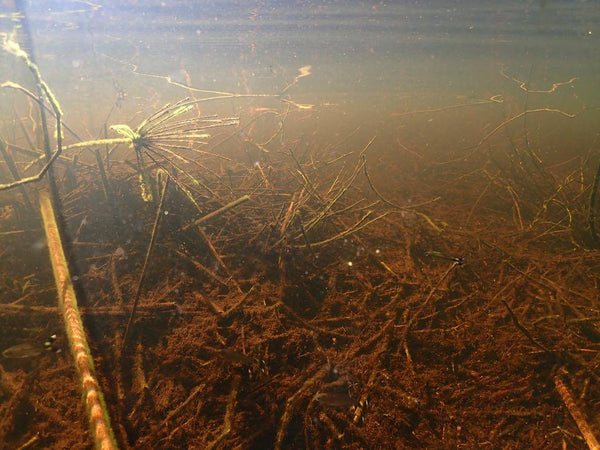
Fermentation releases essential nutrients, making them available to other organisms. Acidic conditions and iron precipitation (due to sulfate-reducing bacteria) can help preserve leaf tissues, creating iron-encrusted “fossils.” These function as substrates for further generations of micro and microorganisms, which become part of the food web base. Yes- fermenting leaf litter provides carbon and energy, supporting microbial food webs in aquatic environments! This is a fundamental part of establishing a botanical method aquarium which functions much like the natural habitats it tries to replicate.
Can we replicate this “food production” concept in our aquariums?
Yeah, we can!
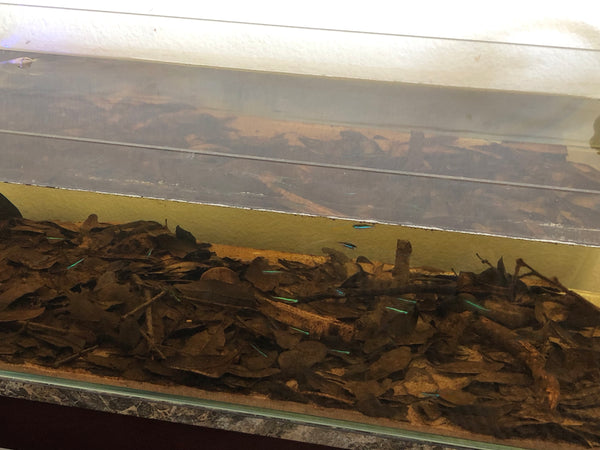
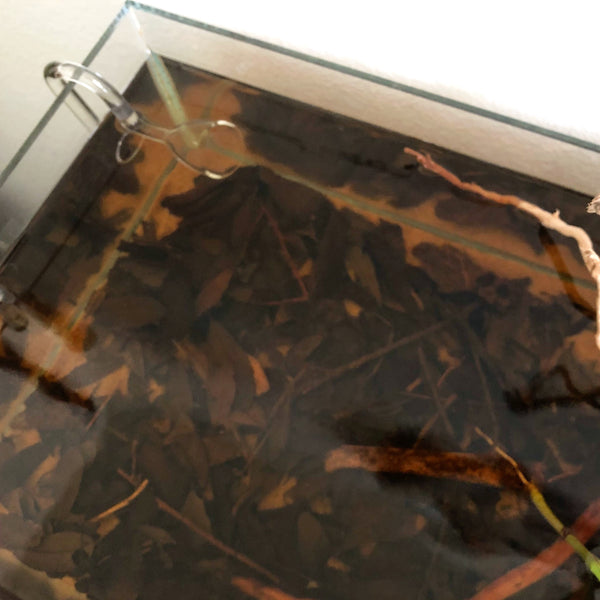
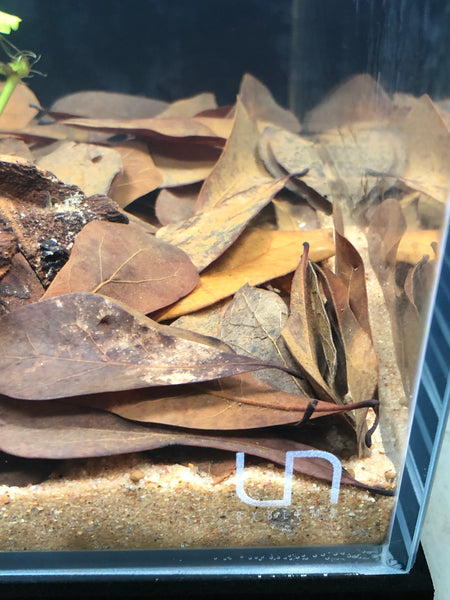
Several years ago, I constructed an aquarium in which the entire “structure” consisted of about a 1.5″ (3.81cm) bed of Live Oak leaf litter, a few Oak twigs…and that was it. A fine sprinkling of sand (like .25″/0.635cm) covered the very bottom of the aquarium.
I selected the live oak leaf litter because it is one of the more “diverse” leaf products we work with- it contains bits of other terrestrial soils, dried mosses, small twigs, and even other types of small leaves. This makes it a very fertile “media” upon which to build an active, dynamic aquatic ecosystem in the aquarium.
You could just as easily use Red Mangrove, Jackfruit, etc.
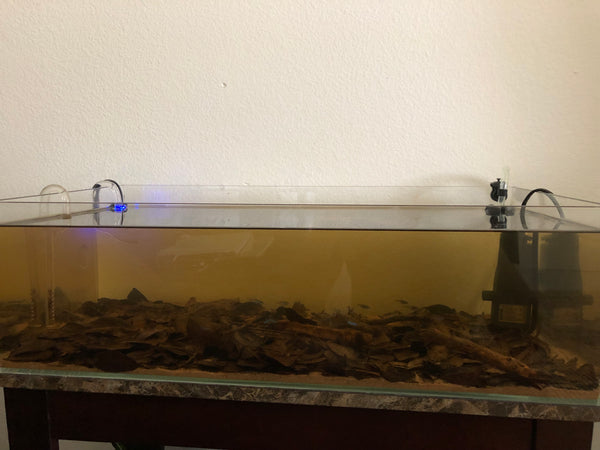
And this aquarium ran incredibly successfully!
Like, super successfully…and easily.
And it was interesting too, from an aquarium function perspective. There was virtually no traditional “cycle time”-curiously. And even more interesting, the tank stayed super “clean” in appearance. It did recruit some visible biofilm on the leaf surfaces, although it never really “bloomed” significantly after the first few weeks, and waned on its own in less than a month.
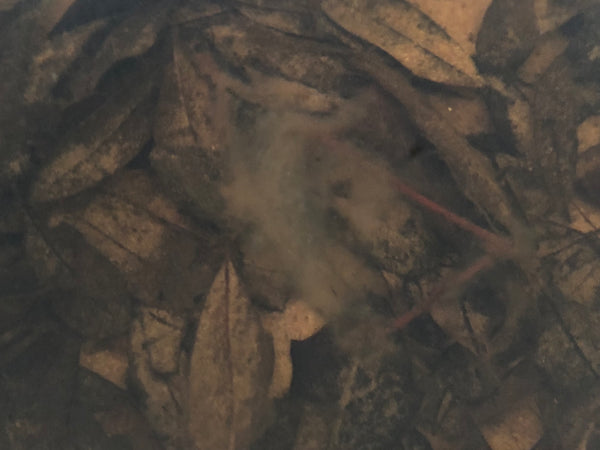
I ran this aquarium as a sort of “proof of concept” tank, so I let the litter to sit for a number of weeks without fishes, seeding it with a cup of decomposed leaf litter/botanicals from a different tank, some pure Parameciumcultures, some Daphnia, and some black worms to sort of “kick start” the micro/macro fauna population. I let it “run in” for about 3 weeks before adding fishes.
My goal for this experiment was quite bold: To run an aquarium without any supplemental feeding of the resident fishes.
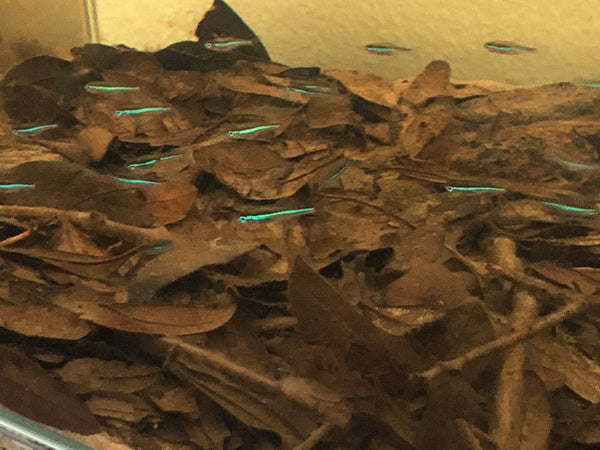
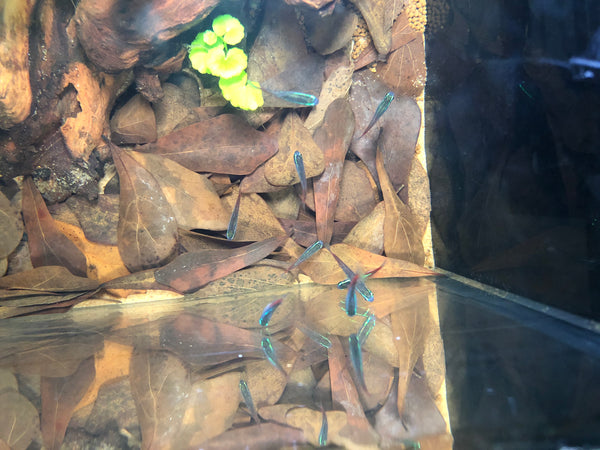
I populated the tank carefully, with 18 “Green Neon Tetras” (Paracheirodon simulans) as the sole occupants. I selected these fish because: a) they are small fishes with little production of waste, and b) they are efficient “micropredators” of small life forms, including the aforementioned Paramecium, biofilms, fungal growths, etc.
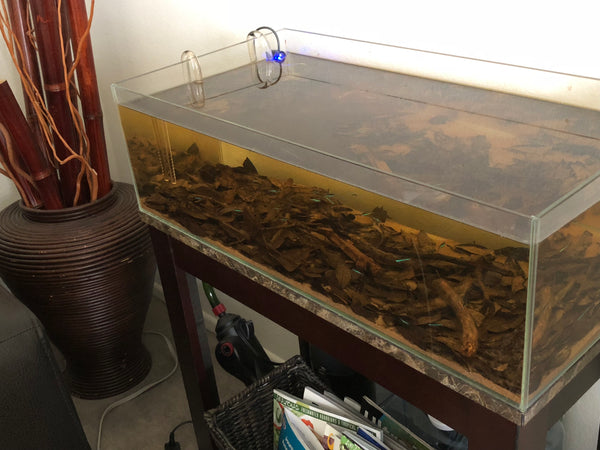
So, from day one, I didn’t feed anything to these fishes. Rather, I let them do what they’ve done for eons in Nature- forage among leaf litter for their sustenance.
And it worked fabulously. (if I say so, myself!)
I started with 18 young, healthy specimens , and when I ended the experiment some 6 months later, I had 18 more mature, healthy specimens- just as fat (if not, MORE so) than when they were added! And, at around three months into the experiment, they spawned! I personally take that as a measure of success!
Of course, despite my successful experiments In this “no-supplemental-feeding” realm, I have no illusions that the idea of just tossing fishes into an aquarium and letting them fend for themselves is some panacea and “ultimate” way to keep fishes. Nope. And, I did perform routine weekly water exchanges and regular filter cleanings (I used an Ehiem 2211).
Nothing crazy there, really. And certainly not anything that would even qualify as “benign neglect”, either. There was definitely not anything close to that. Interestingly, there was no detectible nitrate and phosphate in this aquarium during the entire operational lifespan of the system.
Other than no supplemental feeding, there was little more to distinguish this approach from more “traditionally-run” systems. However, I think it helps prove, to some extent, that there is a “low-maintenance, low food-input” aquarium approach for keeping certain small fishes which is viable.
Of course, that means setting the system up correctly from day one to function in this fashion.
Much like in Nature, if properly conceived and populated with an initial population of live food sources, I believe that an aquarium can be configured to create a productive, biologically-sustainable system, requiring little to no supplemental food input on the part of the aquarist to function successfully for extended periods of time.
Of course, it is significantly different than a natural, fully-open system in many ways. And this is not a “revolutionary” statement or pronunciation, or some “breakthrough” in the art of aquarium keeping.
No.
It is just an idea that- like so many we encourage here- replicates some aspects of natural aquatic systems. With responsible management and continued experimentation, I really see no reason why this concept couldn’t be done on a larger scale with the same great success.
I’ve created several systems like this over the past few years with similar successful results.
My future iterations of this experiment will be to apply this idea to a tank with a significantly deeper leaf litter bed- something like 3″-4″ (7.62cm-10.16cm), to see if there are different possible outcomes with a greater leaf biomass. I am very curious to see if a deeper leaf litter bed functions similarly to the shallow type if regular maintenance is employed.
I suspect there will be not much difference in “performance.”
There’s so much to learn from these sorts of fun experiments…both about the natural leaf litter beds of the world, and the ability to recreate their function in our aquariums…Let’s see some more work in this cool little speciality sector of the botanical method aquarium!
Stay creative. Stay curious. Stay Excited. Stay diligent. Stay observant…
And Stay Wet.
Scott Fellman
 The Tint
Leave a comment