
People often ask me, “What filter do you use use in a botanical method aquarium?” My answer is usually that it just doesn’t matter. You can use any type of filter. The reality is that, if allowed to evolve and grow unfettered, the aquarium itself– all of it– becomes the “filter.”
You can embrace this philosophy regardless of the type of filter that you employ.
I have long favored “all-in-one” (AIO) tanks, and sumps, for a lot of reasons. Yet- my sumps and integrated filter compartments in my A.I.O. tanks are essentially empty.
I may occasionally employ some activated carbon in small amounts, or maybe a filter bag filled with some crushed leaves or alder cones or some other botanicals- but that’s it. The way I see it- these areas, in a botanical method aquarium, simply provide more water volume, more gas exchange; a place for bacterial attachment (surface area), and perhaps an area for botanical debris to settle out. Maybe I’ll remove these debris, if only to prevent them from slowing down the flow rate of my return pumps.
But that’s it.
A lot of people are initially surprised by this.
However, when you look at it in the broader context of botanical method aquariums as miniature ecosystems, it all really makes sense, doesn’t it? The work of these microorganisms and other life forms takes place throughout the aquarium.
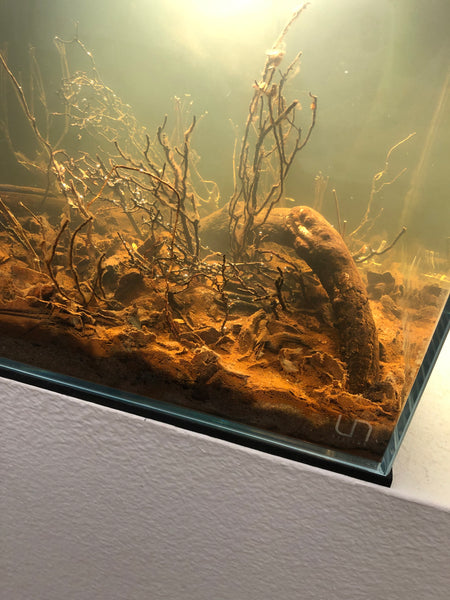
We recently talked about substrates and their impact on the overall botanical method aquarium ecology, and if I digress a bit into aquarium history, there was a significant reliance on substrate-centric “filtration” for many years in the hobby which deserves a bit of discussion here:
The under gravel filter.
Once considered stay-of-the-art, almost “essential” gear for any hobbyist, this one fell by the wayside for many reasons. And I think it ultimately “suffered” from its own “efficiency” at doing what it did best- pulling stuff into the substrate.
Huh?
Okay, let’s do the most cursory intro to the under gravel filter (heretofore referred to as the “UGF”) and how it works, and why I’m sort of nostalgic for some aspects of the UGF.
The physical “filter” is essentially a plastic plate that goes under the “gravel” (hence the name), and is designed to pull water down through the substrate that sits on top of it via use of air stones or (back in the day) a powerhead…Oh, wait- did I say “the gravel?” Yeah…well… Okay. You need materials which is coarse enough to function as a sort of “screen” for particulate, otherwise this stuff could slow down the flow considerably, creating all sorts of issues, ranging from just being plain old dirty” to acting as a “nitrate sink.”
However, it’s part of a cycle of sorts, right?
I mean, it’s pulling “dirt” and organic material into the substrate.
Is that a good thing, or? Well, if you get “dead spots” under the plate (Who the #$%^ knows if that was a “thing” or not. There is likely some physics behind that! Sounds scary, regardless), which could lead to anoxic areas and perhaps buildup of hydrogen sulfide or other nasty stuff which is considered “no bueno” for aquariums, right?
And you have to clean the substrate so that it doesn’t “clog” with detritus, supposedly… And if you overdo it, you essentially wipe out billions of beneficial bacteria that you’re actually trying to foster…so…
Anyways, the principle here is that the substrate acts as a biological filtration “base.” Now, this actually seems problematic from the get-go, right? I mean, you’re using a coarse substrate to trap shit (literally) in it, where bacteria break it down. And of course, this necessitated the use of some form of supplemental filter, like a canister or outside power filter…
And that always made me wonder why you’d even f–k with a UGF in the first place if the whole idea was A) For the substrate to act like a biological filter and B) The fact that you need a supplemental mechanical filter to remove the particulate waste that the UGF would accumulate through its ability to pull stuff into the substrate.
Like, just have a substrate layer and an airstone in your tank and call it a day, right?
I mean, sand beds have their own unique ability to foster denitrification and other biological processes, and do you even need a filter plate to accomplish this? Okay, read up on “plenums” form the early 21st century in reef keeping for more on that, but…I mean, just facilitating a healthy sand bed or substrate layer- meaning, one that isn’t absolutely loaded with fish poop an uneaten food- is half the battle, right?
Notice I didn’t even bring up our friend, “detritus” at all? Because, as you know, I have warm feelings about the stuff. And of course, there is something all very weird about the idea of using a mechanical device to further pull waste material into the substrate.
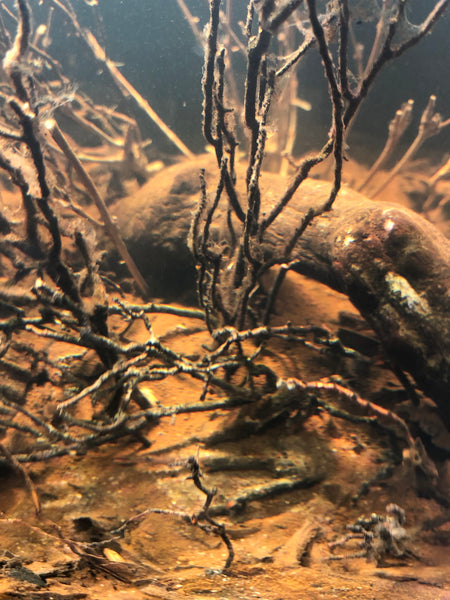
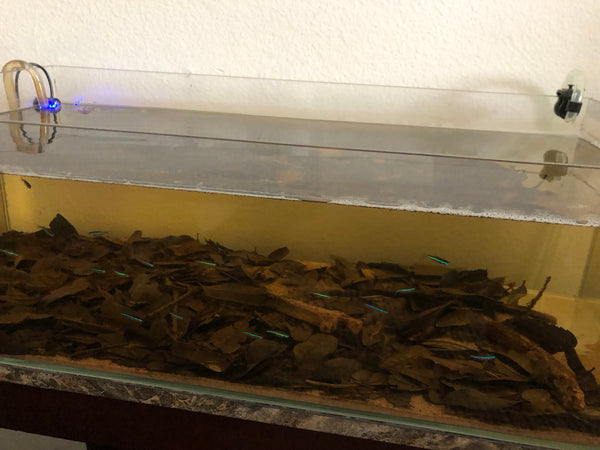
Now, in a botanical-method aquarium, with a layer of leaves and botanicals, many of which are decomposing from the minute you add them to the tank, what advantage would having a mechanical device physically yanking this stuff deeper into the substrate accomplish?
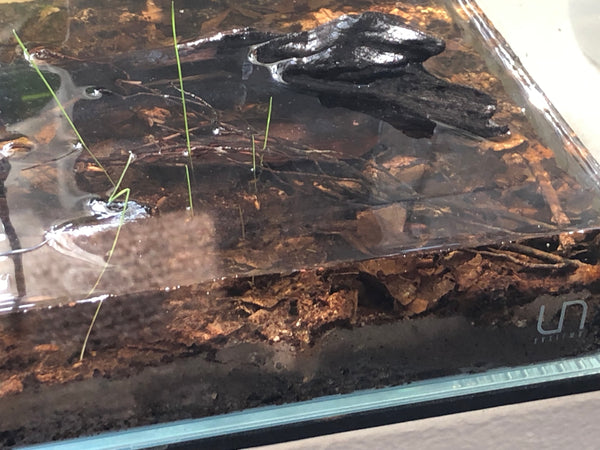
I mean, I’m a huge fan of using substrates to create not only an aesthetic component to our aquariums, but to function as a biological “filter” of its own. I mean, the substrate is alive. It’s actually the largest organism (or more correctly, aggregation of organisms; ie; bacteria) in any given aquarium, when you think about it, right?
Okay, I’m really all over the place with this stuff today…For some reason, I felt compelled to do a bad analysis of the UGF, while simultaneously recalling its nostalgic charms and then beating the living shit out of the idea! All the while, demonstrating my appalling lack of scientific understanding of the whole concept, right?
Okay. Yeah, this blog is really productive! 😆
Yet…I DO have a fascination with the biggest part of the idea of the UGF: It essentially “runs” by facilitating the growth and reproduction of beneficial bacteria within a substrate.
Yup, I have a tougher time reconciling the whole idea that your “gravel” becomes a mechanical filter. It seems sort of unnecessary, because it more or less functions like that anyways, right? I mean, without a plastic air-driven filter plate and lots of maintenance concerns.
Isn’t this like the whole “balanced aquarium” stuff that’s been bandied about the hobby for generations?
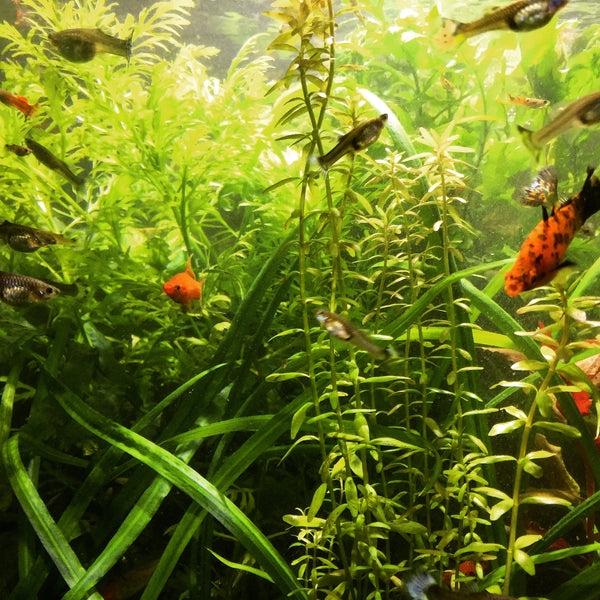
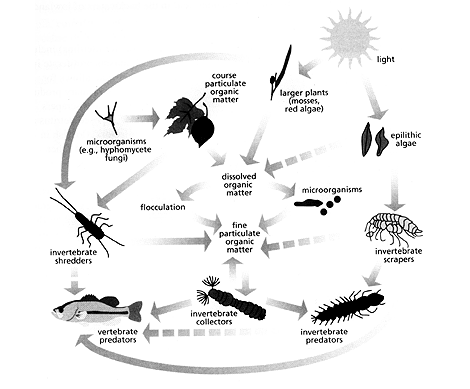
I love things that work with Nature and her natural processes. I love the fact that we play with leaves that break down, fueling bacterial growth, which also serve to facilitate denitrification in our tanks. And the fact that the decomposing botanicals and such are essentially “food” for many of the organisms which reside in our tanks.
Indeed, they facilitate the creation of a sort of “food web”, don’t they?
I think so.
So, there’s this “thing” I have about substrates in general, because they form one of the most interesting and useful components of the closed aquarium ecosystem. And it’s a bit ironic- or perhaps, just coincidental– that the undergravel filter, which holds some strange fascination for me, utilizes the substrate as it’s “media…”
I mean, I suppose there’s more to it than that; it’s worthy of more attention…Not necessarily the idea of bringing back the under gravel filter, mind you- but the idea of embracing substrate as a biological filtration component.
There is so much more to discuss here.. so much more to think about.
So, time for me to stop beating up this old friend, the UGF, and think about the substrate itself some more..It’s time to think about the aquarium itself- and the biological materials within it- as the filter. And of course, there’s more to it than just the “filtration.”
There is the physical movement of the water within the aquairum environment.
Yeah, water movement is an integral part of the equation, too.
Now, with regard to flow or water movement within the aquarium itself, there are multiple schools of thought, of course. I’ll give you my “two cents worth” as a botanical method natural aquarium geek.
So, here’s the deal:
Many of the habitats that we obsess over have minimal to virtually non-existent water movement. You know, slow-flowing tributaries off of main streams, flooded forest floors, vernal pools, etc. And those are certainly something you can and should replicate in the aquarium. However, in my opinion, the flow that we create in the closed system aquarium is not only typically less than the velocities found even in relatively mild natural conditions- it serves the added purpose of keeping oxygenation up and preventing stratification of pH in the tank.
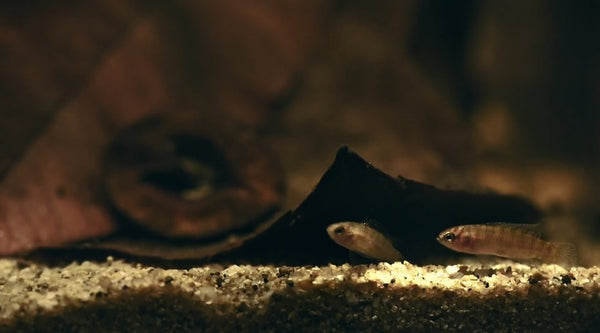
I mean, sure- stagnant is stagnant, right? However, most of us are not trying to create a stinking, stagnant, “malaria swamp” habitat- so some water movement is desired. Of course, Betta and killie keepers have reasons for minimal current/surface agitation’s I get that it’s not a hard and fast rule in every circumstance. However, for most hobbyists- and fishes- some current/water movement in the aquarium is desired.
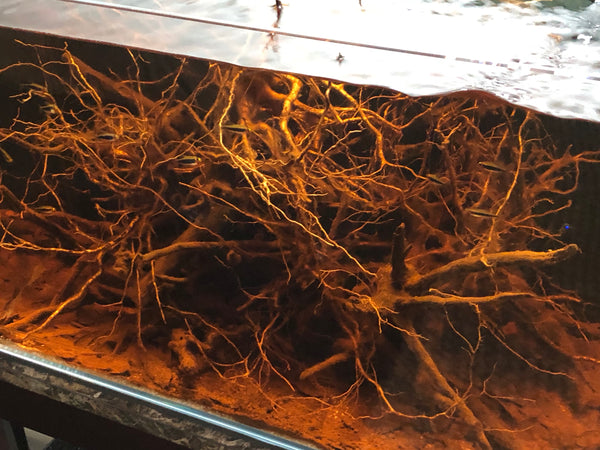
In a tank featuring botanicals, water movement (I’ve been going back and forth using the term “current” as well- which I know is confusing…Let’s just call it “water movement” from now on to avoid confusion) is desired. However, you want to avoid directing filter outputs right into your leaf litter bed, for example. Otherwise, you end up with leaf litter in various states annoyingly flopping around and traveling about the aquarium. That’s really annoying.
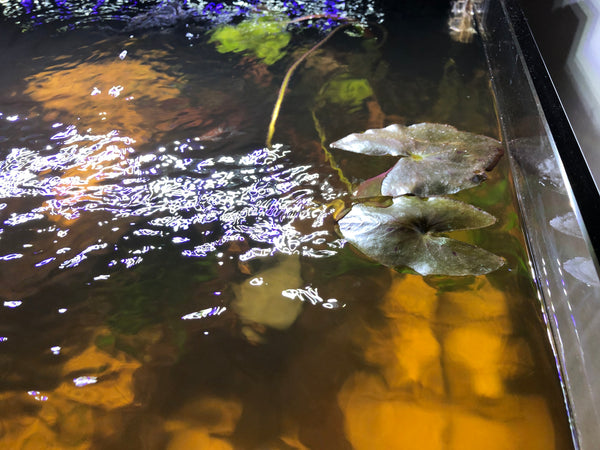
And it’s also disruptive.
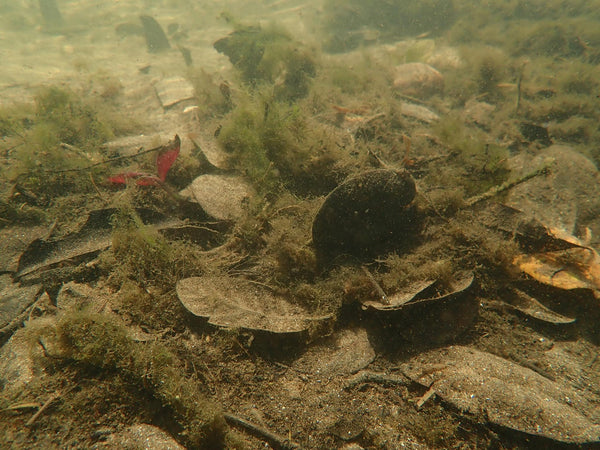
Remember, in many natural habitats in which leaves are present, the water movement into the litter bed is relatively modest. It might be greater over the litter, but it’s relatively modest in the litter itself- perhaps even virtually undetectable. This affects fish population. In fact, a study on floating leaf litter beds I stumbled upon highlighted this little gem:
“Several species show adaptations for living under low oxygen conditions, which possibly allow them to occupy confined spaces inside the banks. On the other hand, several species were observed at the periphery of the floating litter banks and may benefit from the stronger currents and higher oxygen levels that result from the positioning of the floating litter banks at the water’s surface.”
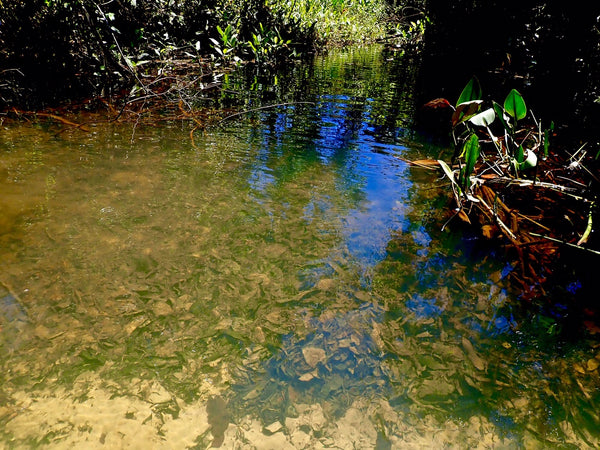
And of course, as fish geeks, we want to encourage healthy environmental conditions in our tanks- and to keep our fishes happy and active for long lives- so water movement and oxygenation in the overall aquarium environment is vital. In practice, I direct modest current into the tank above the litter bed. Inevitably, because of the geometry of our tanks, you’ll see leaves moving about just a bit, and that’s okay.
Some movement in the botanical bed in an aquarium is good- it keeps excesses of fish waste or biofilms from accumulating in one specific location, assuring greater overall system stability.
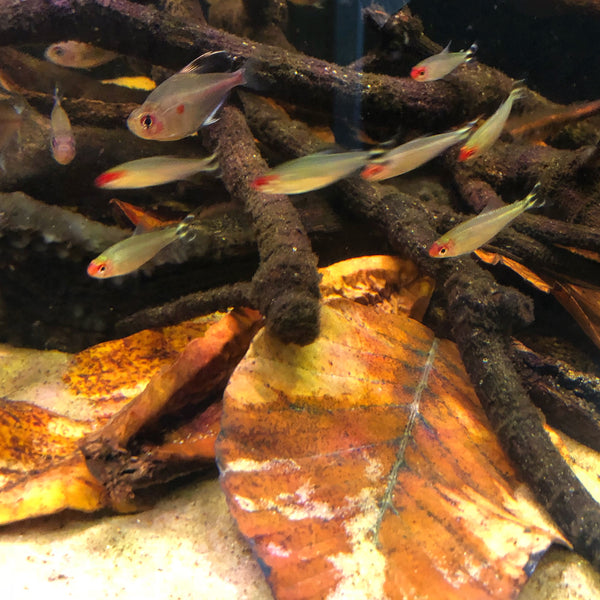
So- the long and the short when it comes to water movement- it’s a good thing I the botanical method aquarium, as long as you’re not blowing everything all over the place!
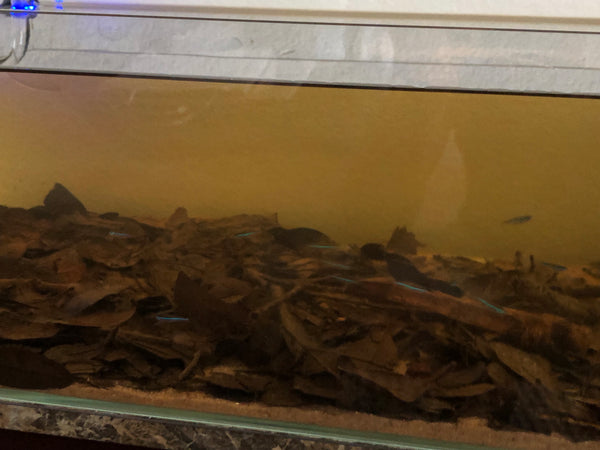
In the aquarium, filtration and water movement tend to go hand in hand. This is intended only as the most brief intro to the topic to “lay down a marker” for us to discuss as a community on social media on an ongoing basis. There are numerous opinions and ideas and thoughts out there on this topic- I hope this serves as a “fire starter” to ignite further discourse!
I the mean time, keep your filter on. Keep your tank water moving. But don’t overthink it. Don’t make your tank too “clean.”
Huh?
I admit, there was a time when I was really fanatical about making sure every single bit of detritus and fish poop and all that stuff was out of my tanks. About undetectable nitrate. I was especially like that in my earlier days of reef keeping, when it was thought that cleanliness was the shit!
It wasn’t until years into my reef keeping work, and especially in my coral propagation work, that I begin to understand the value of food, and the role the it plays in aquatic ecosystems as a whole. And that “food” means different things to different aquatic organisms. In my coral propagation business, the idea of scrubbing and removing every single trace of what we saw as “bad stuff” from our grow-out raceways essentially deprived the corals and supporting organisms of an important natural food source.
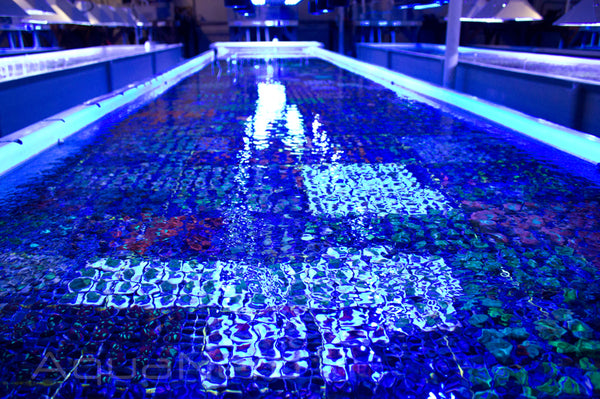
Oops!
Yep, we’d fanatically skim and remove everything, only to find out that…our corals didn’t look all that good. We’d compensate by feeding more heavily, only to continue to remove any traces of dissolved organics from the water…
It was a constant struggle- the metaphorical “hamster wheel”- between keeping things “clinically clean” and feeding our animals. We were super proud of our spotless water. We had a big screen when you came into our facility showing the parameters in each raceway.
Which begged the question: Were we interested in creating sterile water, or growing corals?
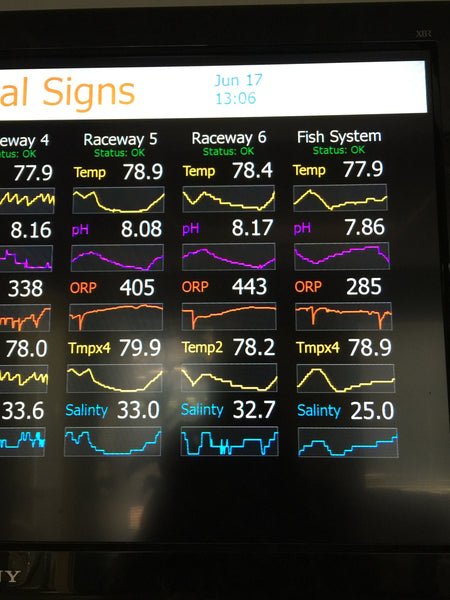
Eventually, it got through my thick skull that aquariums- just like the wild habitats they represent-are not spotless environments, and that they depend on multiple inputs of food, to feed the biome at all levels. This meant that scrubbing the living shit (literally) out of our aquariums was denying the very biotia which comprised our aquariums their most basic needs.
That little “unlock” changed everything for me.
Suddenly, it all made sense.
This has carried over into the botanical method aquarium concept: It’s a system that literally relies on the biological material present in the system to facilitate food production, nutrient assimilation, and reproduction of life forms at various trophic levels.
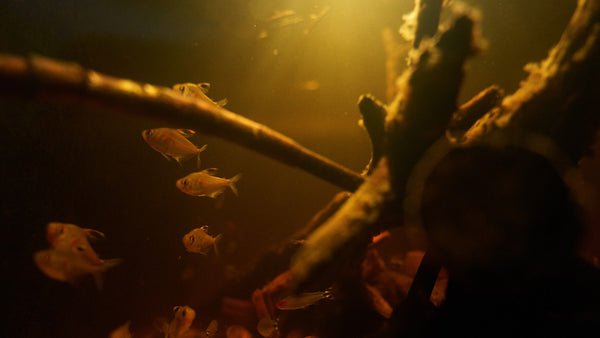
It’s changed everything about how I look at aquarium management and the creation of functional closed aquatic ecosystems.
It’s really put the word “natural” back into the aquarium keeping parlance for me. The idea of creating a multi-tiered ecosystem, which provides a lot of the requirements needed to operate successfully with just a few basic maintenance practices, the passage of time, a lot of patience, and careful observation.
It means adopting a different outlook, accepting a different, yet very beautiful aesthetic. It’s about listening to Nature instead of the asshole on Instagram with the flashy, gadget-driven tank. It’s not always fun at first for some, and it initially seems like you’re somehow doing things wrong.
It’s about faith. Faith in Mother Nature, who’s been doing this stuff for eons.
It’s about nuance.
It’s about looking at things a bit different that we’ve been “programmed” to do in the aquarium hobby for so long. It’s about not being afraid to question the reasons why we do things a certain way in the hobby, and to seek ways to evolve and change practices for the benefits of our fishes.
It takes time to grasp this stuff. However, as with so many things that we talk about here, it’s notrevolutionary…it’s simply an evolution in thinking about how we conceive, set up, and manage our aquariums.
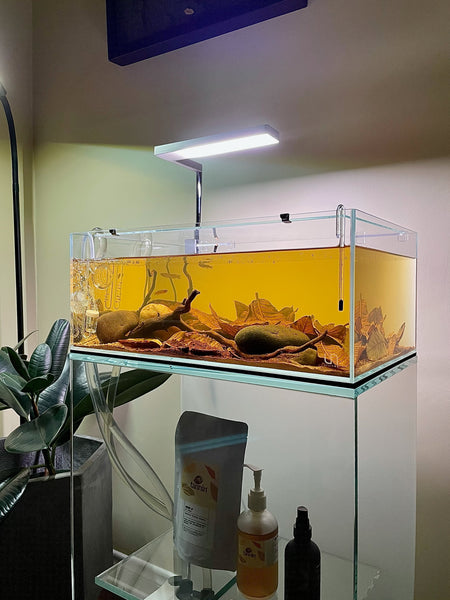
Sure, the aquarium itself is a “filter” of sorts, if you want to label it as such. However, it’s so much more: A small, evolving ecosystem, relying on natural processes to bring it to life.
Wrap you head around that.
It might just change everything in the hobby for you.
Stay open-minded. Stay thoughtful. Stay bold. Stay curious. Stay diligent. Stay observant…
And Stay Wet.
Scott Fellman
 The Tint
Leave a comment