
Of all of the botanical materials that we employ in our aquariums, none are more common, well-studied, or simply ubiquitous in aquatic habitats than leaves.
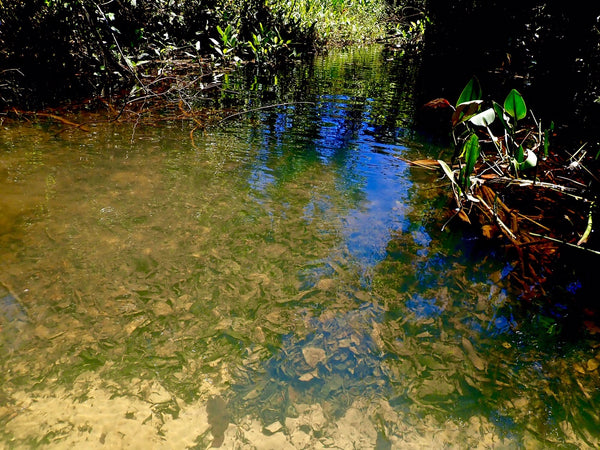
In Nature, leaf litter zones comprise one of the richest and most diverse biotopes in the tropical aquatic ecosystem, yet they are seldom replicated in the aquarium. Now, more so than in years past, but I would not call aquariums configured to replicate these habitats “common.” Even in the more enlightened “postmodern botanical method” years, it’s still rare to see an aquairum “scape” dominated by leaves.
Why?
I think this has been due, in large part- to the lack of a real understanding about what this biotope is all about- not to mention, the understanding of the practicality of creating one in the aquarium.
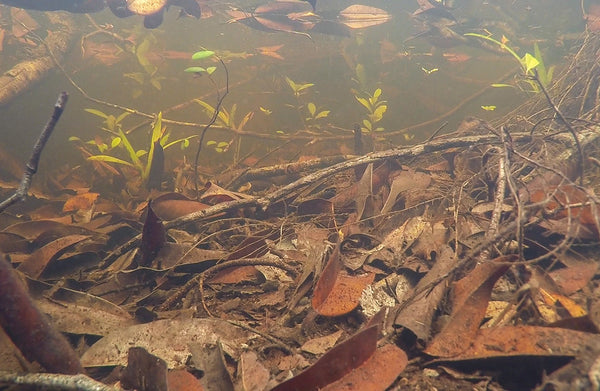
It’s important to understand that a leaf litter bed in Nature- or the aquarium, for that matter- is a rich ecosystem, providing food and shelter to a diverse community of organisms, ranging from fungi to bacterial biofilms. That’s the primary consideration that we should make when we set out to create an aquarium display centered on leaf litter.
And of course, fishes and invertebrates which live amongst and feed directly upon the fungi and decomposing leaves and botanical materials contribute to the breakdown of these materials as well! As I recently touched upon here in “The Tint”, Aquatic fungi can break down the leaf matrix and make the energy available to feeding animals in these habitats.
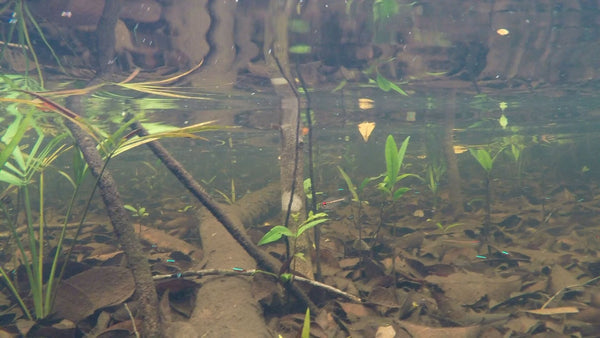
And look at this little gem I found in my research:
“There is evidence that detritivores selectively feed on conditioned leaves, i.e. those previously colonized by fungi (Suberkropp, 1992; Graca, 1993). Fungi can alter the food quality and palatability of leaf detritus, aecting shredder growth rates. Animals that feed on a diet rich in fungi have higher growth rates and fecundity than those fed on poorly colonized leaves. Some shredders prefer to feed on leaves that are colonized by fungi, whereas others consume fungal mycelium selectively…”
“Conditioned” leaves, in this context, are those which have been previously colonized by fungi! They make the energy within the leaves and botanicals more available to higher organisms like fishes and invertebrates!
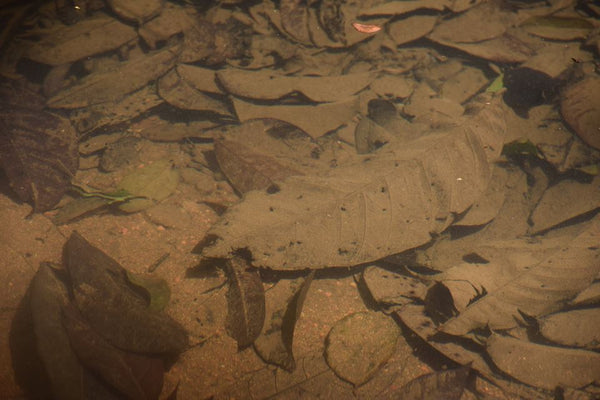
It’s easy to get scared by this stuff…and surprisingly, it’s even easier to exploit it as a food source for your animals! This is a HUGE point that we can’t emphasize enough.
Here is an interesting except from an academic paper on Amazonian Blackwater leaf-litter communities by biologist Peter Alan Henderson, that provides some context for those of us considering replicating these communities in our aquaria:
“..life within the litter is not a crowded, chaotic scramble for space and food. Each species occupies a sub-region defined by physical variables such as flow and oxygen content, water depth, litter depth and particle size…
…this subtle subdivision of space is the key to understanding the maintenance of diversity. While subdivision of time is also evident with, for example, gymnotids hunting by night and cichlids hunting by day, this is only possible when each species has its space within which to hide.”
In other words, leaf litter beds facilitate and accommodate diverse populations of fishes, and we should consider this when creating and stocking our botanical-style aquarium systems.
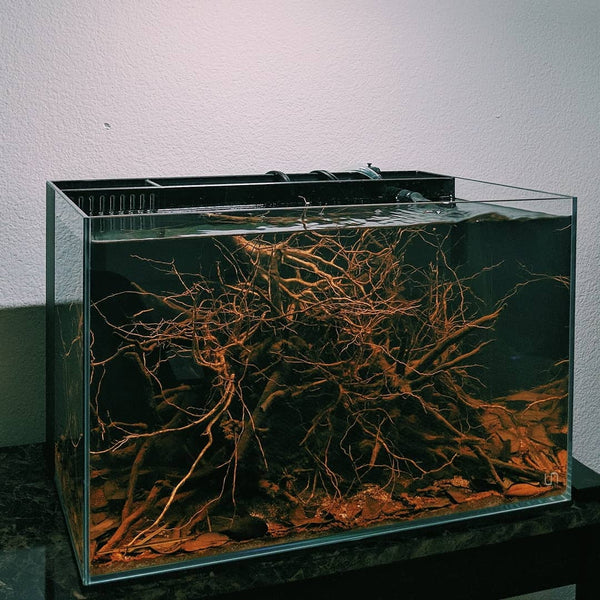
Some litter beds form in what stream ecologists call “meanders”, which are stream structures that form when moving water in a stream erodes the outer banks and widens its “valley”, and the inner part of the river has less energy and deposits silt- or in our instance, leaves.
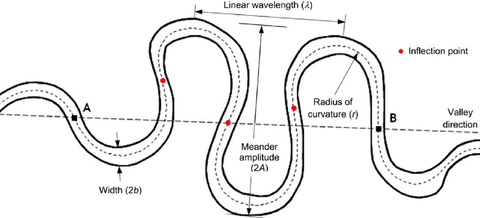
There is a whole, fascinating science to river and stream structure, and with so many implications for understanding how these structures and mechanisms affect fish population, occurrence, behavior, and ecology, it’s well worth studying for aquarium interpretation!
Did you get that part where I mentioned that the lower-energy parts of the water courses tend to accumulate leaves and sediments and stuff?
It’s logical, right? And it’s also interesting, because, as we know, fishes and their food items tend to aggregate in these areas, and embracing the “theme” of a litter/botanical bed or even wood placement, in the context of a stream structure in the aquarium is kind of cool!
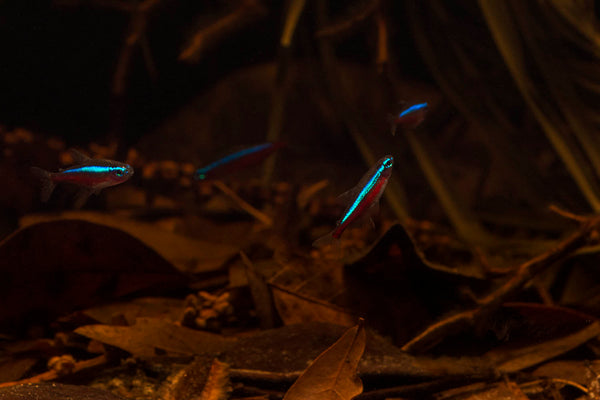
Incorporating leaf litter in our aquariums opens up all sorts of possibilities for interesting experiments ranging from community displays to fry rearing systems. You can go with just a few leaves in your tank- or really go crazy with a deep bed of leaf litter in your tank. It’s wide open for experimentation.
How do you create one?
Well, it’s not particularly complicated, really. Simply add a selection of the prepared leaves of your choice to your aquarium! I mean, simple… In a brand new tank, devoid of fishes, you can add as many as you want all at once. In an established, populated tank, you should build up the depth and quantity gradually over the course of several weeks, monitoring any environmental impacts regularly, to gauge for yourself any issues which may arise along the way.
Common sense, right?
How many leaves, what kind, and how often to add them is a topic open for discussion and debate, really.
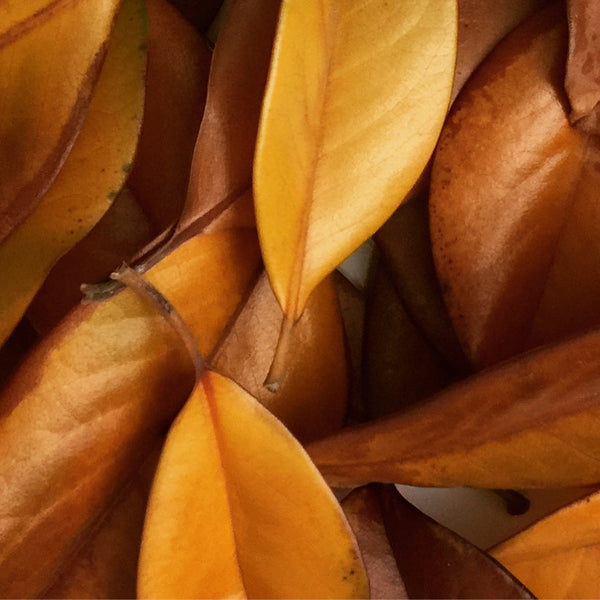
I periodically ponder and discuss the idea of creating a really deep litter bed in an aquarium, to more accurately replicate some of the litter beds found in South America, Asia, Africa, and elsewhere. By “deep”, I’m talking 6″- 12″ (15.24cm-30.48cm). Yes, there are deeper litter beds in these areas (several feet in depth); however, for practical aquarium display purposes, I think the rational “upper limit” is likely more like the 12″ (30.48cm) range.
Or, is it?
Now, there is certainly a difference between the “theoretical” and the “practical”, but I can’t help but think that there is something beneficial about such a deep leaf litter bed…perhaps stuff we haven’t imagined, because we’ve too busy in the hobby talking about all of the possible “downsides” of the idea.
And it’s intriguing for me to contemplate how to make such an idea work. I mean, it isn’t really all that much different than what many of us do now…the main difference being that we’d use MORE of the same materials. I don’t think that there is more than that to it, really.
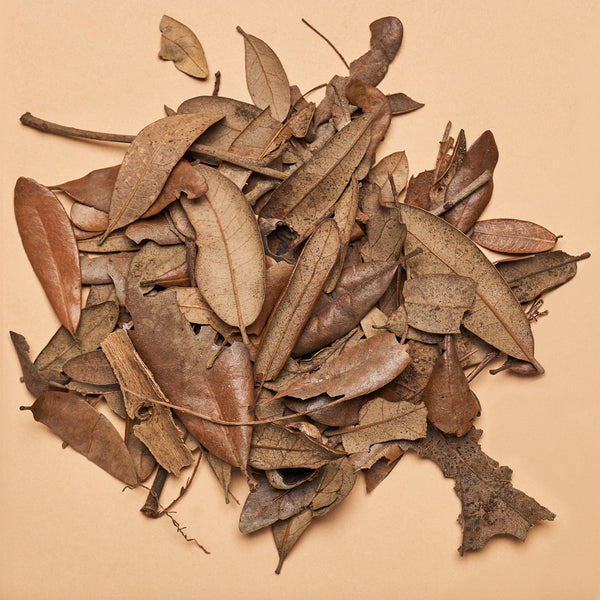
In researching the idea of executing such a deep litter bed, I’ve often thought about what would be the main considerations when attempting to create one in an aquarium.
The ratio of “leaves to water” in a given aquarium could be quite significant. I mean, what size aquarium do you go with? I’m also curious about the impact on the water quality and oxygen levels with that much decomposing materials “in play.”
On the other hand, starting from scratch with a new system and cycling it with bacterial products (like “Culture”) and/or “seeded” substrate materials would no doubt at least “kick start” the biological filtration before fishes ever enter the equation.
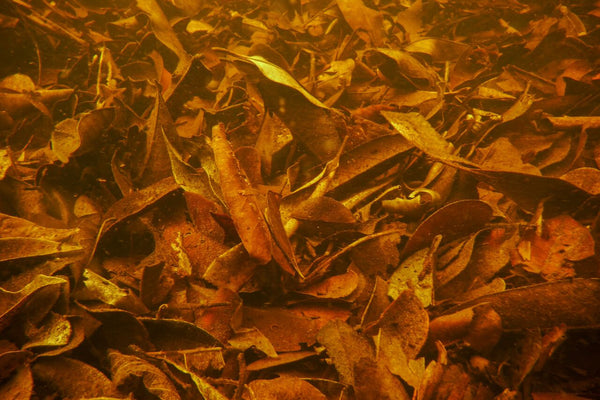
And, although a large mass of leaves can be considered “bioload”, I can’t help but wonder if it would also function as a “nutrient processing” facility, much in the same way live rock does in a reef aquarium? I mean, with that much “media” surface area, could this be the case? Like, denitrification by “deep leaf litter bed!”
Maybe?
Leaves should be continuously replaced. View them as “consumables”, which they are. And, by adding new leaves as existing ones decompose, you are not only keeping some form of environmental stability, you’re replicating the processes which occur in Nature, where leaves drop continuously and find their way into waterways.
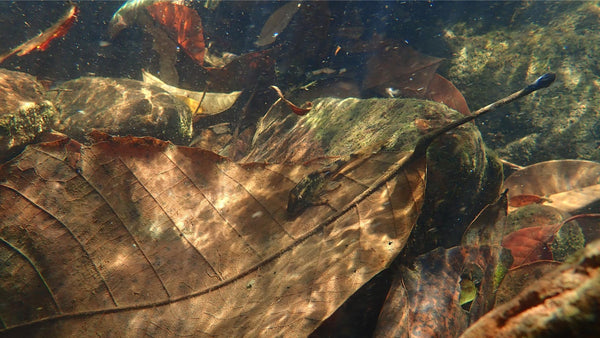
And we keep coming back to the idea that leaf litter beds in aquariums can function in a similar manner as they do in Nature- providing supplemental food for the fishes which reside amongst them. This is a really significant thing…
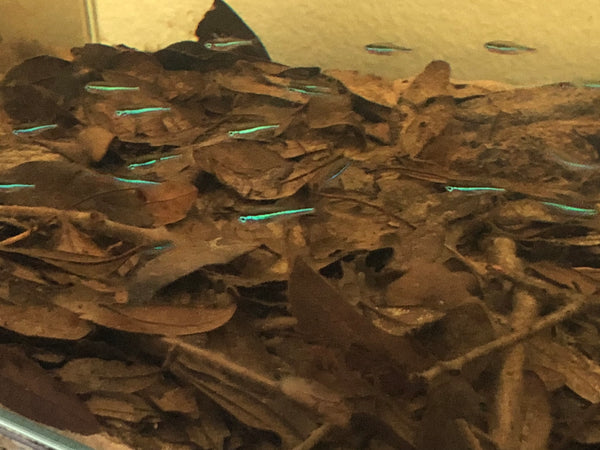
I’ve seen all sorts of fishes spend large amounts of time during the day picking at leaf litter and the surfaces of decomposing botanicals in such beds, and maintaining their girth during periods when I’ve been traveling or what not, which leads me to believe they are deriving at least part of their nutrition from the leaf litter/botanical bed in the aquarium. I
t compelled me to create s series of wildly successful “leaf litter only” tanks, in which no supplemental feeding was employed, to test the validity of my hypothesis.

In the aquarium, much like in the natural habitat, the layer of decomposing leaves and botanical matter, colonized by so many organisms, ranging from bacteria to macro invertebrates and aquatic insects, is a prime spot for fishes!
Here’s an example of one aspect of these habitats I learned about from a scientific study- the relationship between water depth and leaf litter depth– and how it can be applied to our aquarium designs:
In an area where the water depth was a maximum of 6ft/2 meters, the leaf litter depth was only about 8 inches/20cm. In a very shallow side tributary, the litter depth was about 4 inches/10cm, with the water level above it only about 12 inches/30cm!
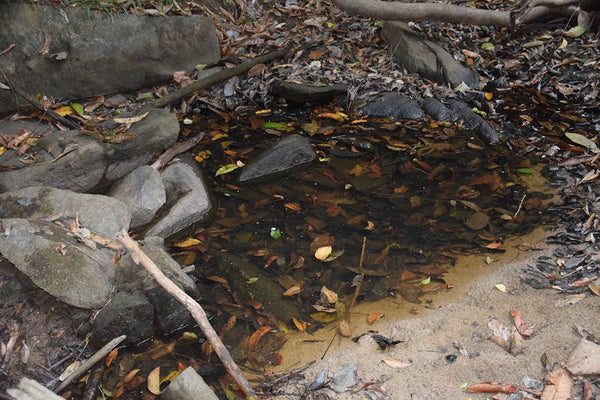
That’s like “aquarium depth”, right? Yeah.
Now, this is an example of just one of many different areas affected by seasonal inundation, and there are numerous areas that are several meters deep during peak months. However, on the average, many of the little Igarape that I found information on were at best a meter or two deep, with correspondingly deep leaf litter beds.
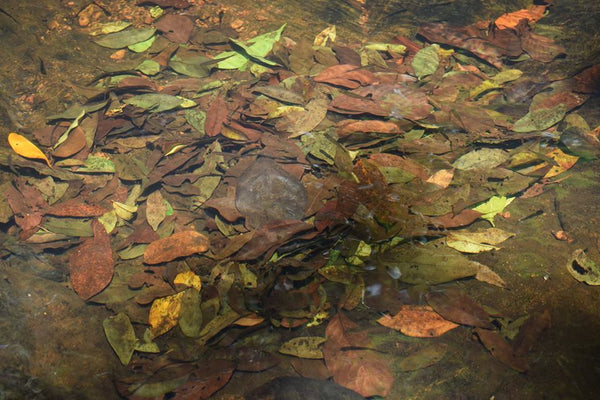
Obviously, most of us aren’t going to use an aquarium that is much more than a meter in depth, but we can always utilize the ratio of water to leaf litter/substrate and play with whatever dimensions excite us!
Nonetheless, I’m a big fan of shallow/wide tanks, because if you do build up a nice botanical/leaf litter layer, you don’t have a huge column of water above, and can really focus on some of the bottom-dwelling fishes which make these areas home.
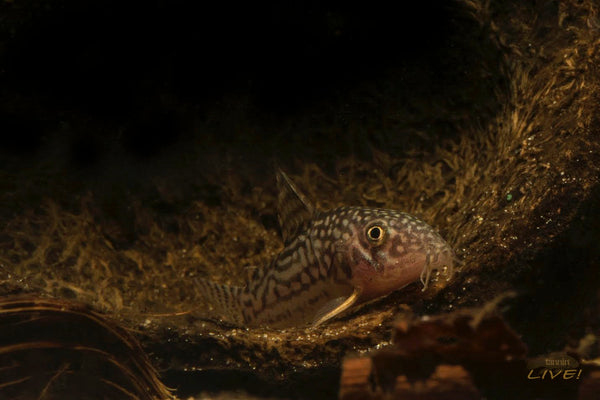
I think an ideal tank dimension for a leaf-litter biotope-style aquarium would be something like 48″x 18″x 16″ /121.92cm x 45.72cm x 40.64cm (about 60 gallons/227.12 L)…shallow and wide, indeed! With these kinds of dimensions, you could create a leaf litter bed over a thin covering of fine, white sand, with a depth of about (4 inches/10cm) and a water column of about 12 inches/30cm above it. This proportion is a very good simulation of this type of habitat.
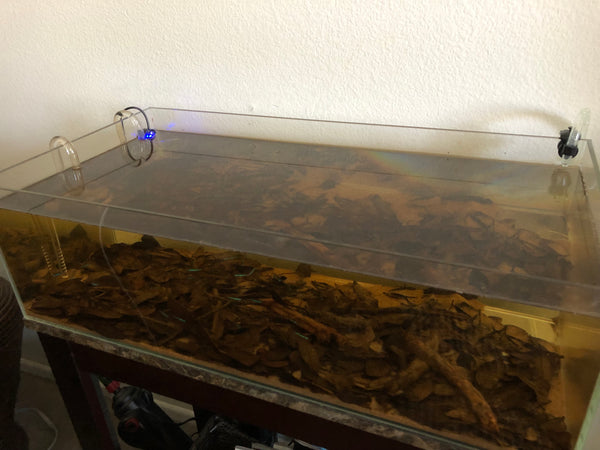
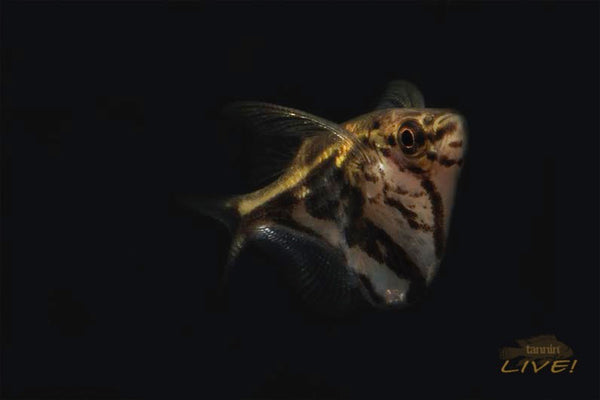
With a relatively low profile tank, you’re not likely to feature “vertically-oriented” fishes, such as Angelfishes, in this tank! Rather, you’d focus on fishes like characins, including the leaf-litter dwelling “Darter Characins” like Aphyocharax, Elachocarax, Crenuchus, and Poecilocharax. For interest, you could introduce some biotipically appropriate Hoplias and Otocinculus catfishes, too. For the “upper” water columns, you could play with specimens of various Hatchetfishes and Pyrrhulina, killies like Rivulus, and cichlids, such as specimens of Apistogramma, Aequidens, and Crencichla.
Obviously, this is just a guide based on some studies of these areas, and you can create your own species mixes and even specialize in one or two featured species found in these habitats (that would be VERY cool!). The important thing, in my opinion, would be that you are attempting to create a few different aspects of these unique habitats. Filtration could be provided by either a canister filter or an outside power filter, with flow directed towards the surface. IN fact, even an air-powered sponge filter could do the trick.
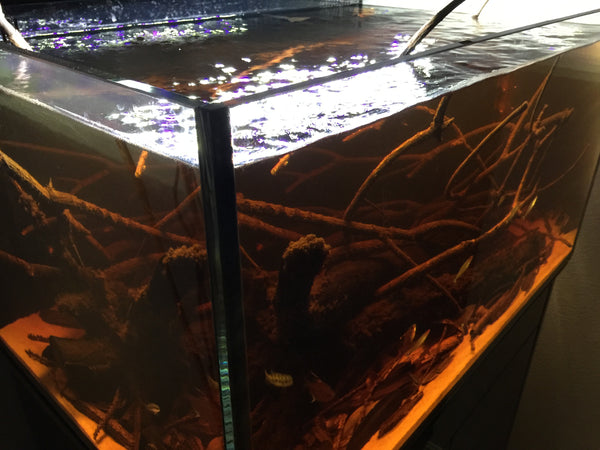
Water temperature, based on studies, would be perfect if you could keep it at about 26 degrees C/78 degrees F. Now, the pH of many of these habitats that were surveyed averaged around 3.5-4.2- extremely acidic water with no real ionic content, that, as we’ve discussed previously, is something that is challenging to achieve, and equally as interesting to maintain (notice I said “interesting”, because it’s not at all impossible…just challenging). My little shallow leaf litter bed tank was able to maintain a pH of about 6.2-6.3. A far cry from the aforementioned 4.2, but not bad, from an aquarium standpoint!
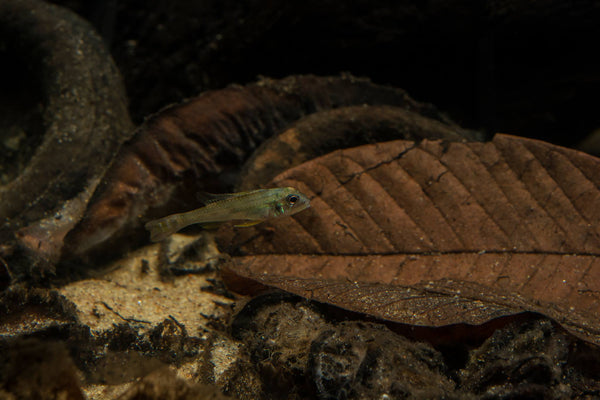
Thusly, a modest-sized aquarium operated at low pH would be a great “testbed” for various types of research into the maintenance of these types of biotopes. Likely, you could “scale up” once you’ve mastered achieving your desired pH in a small tank.
The most common fishes associated with leaf litter in the wild are species of characins, catfishes and electric knife fishes, followed by our buddies, the cichlids (particularly Apistogramma, Crenicichla, Dicrossus, and Mesonauta species)! Some species of RIvulus killies are also commonly associated with leaf litter zones, even though they are primarily top-dwelling fishes.
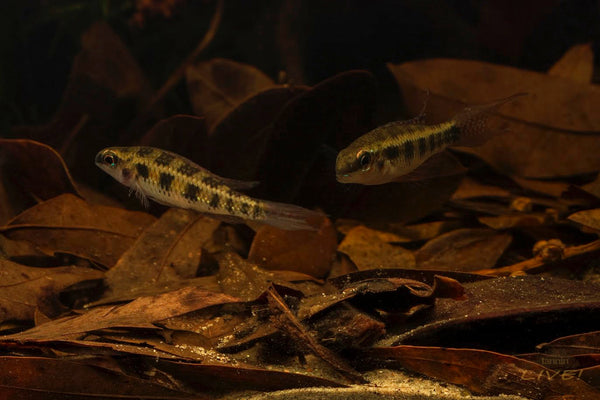
And of course, fishes, and the other organisms present- and their processes- create not only the basis of a “food web”, but the development of an entire community of co-dependant organisms, which work together to process nutrients and support life forms all along the chain.
When we encourage, rather than remove these organisms when they appear, we’re helping perpetuate these processes. I can’t stress how important it is to let these various organisms multiply.
And we need to re-think our relationship with leaf litter, detritus, decomposing botanical materials, and sediments in our tanks.
Yes, I’m asking you to not only “leave them be” -but to encourage their accumulation, to foster the development and prosperity of the organisms which “work” them.
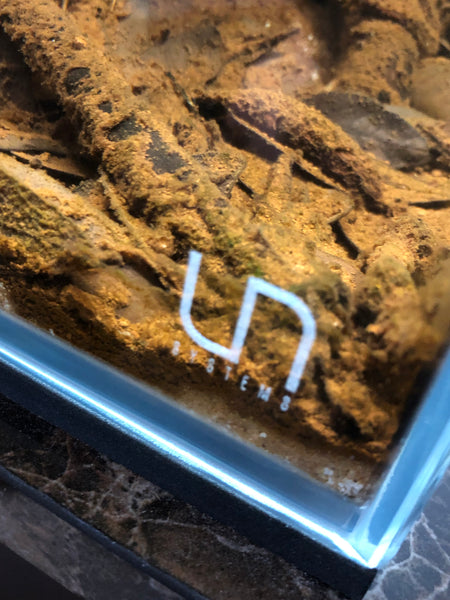
Once again, I have to at least ask the rather long question, “Are these things (detritus; decomposing leaves) really problematic for a well-managed aquarium, optimized to take advantage of their presence? Or, do they constitute an essential component of a closed aquatic ecosystem…One which can actually provide some benefits (ie; supplemental nutrition) for the resident fishes and the community of life forms which support them?”
Many of us have already made a mental shift which accepts the transient, subtle beauty of decomposing botanical materials, tinted water, biofilms, and the like, so it goes without saying that taking it a little further and allowing these materials to completely break down to serve as the primary “substrate” for our aquatic eco-diversity is simply the next iteration in the management of blackwater/brackish botanical method aquariums.
Don’t be afraid.
Open your mind.
Study what is happening.
Draw parallels to the natural aquatic ecosystems of the world. Look at this “evolution” process with wonder, awe, and courage.
Stay inquisitive. Stay thoughtful. Stay open-minded. Stay brave…
And Stay Wet.
Scott Fellman
 The Tint
Leave a comment