
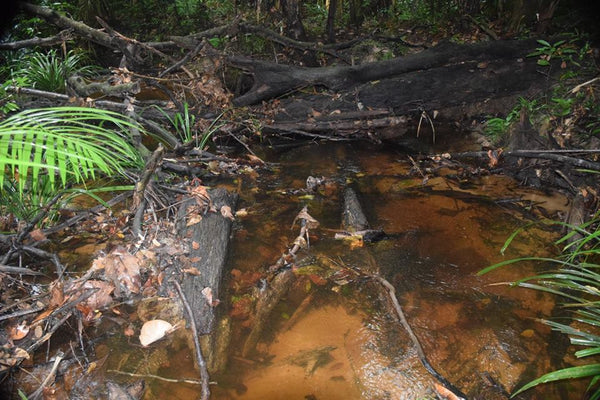
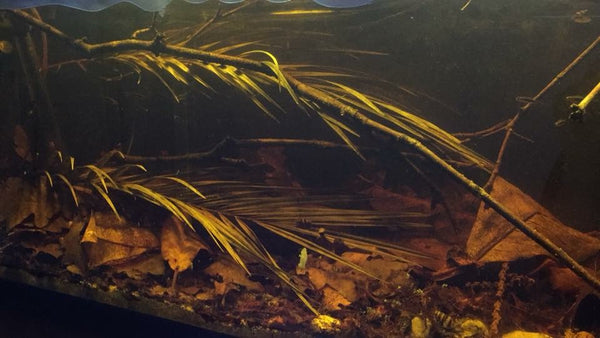
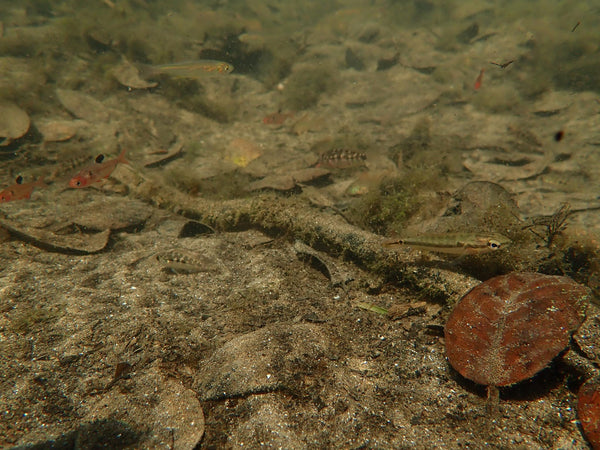
I am not at all joking when I tell you that I’d take an aquarium that can faithfully replicate the scenes above or below the waterline in form and function- decomposing leaf litter, algae, sediment and all- over any IAPLC “Grand champion’s” meticulously-planned, beautifully executed aquarium.
Like, any day of the week.
With zero hesitation at all.
None.
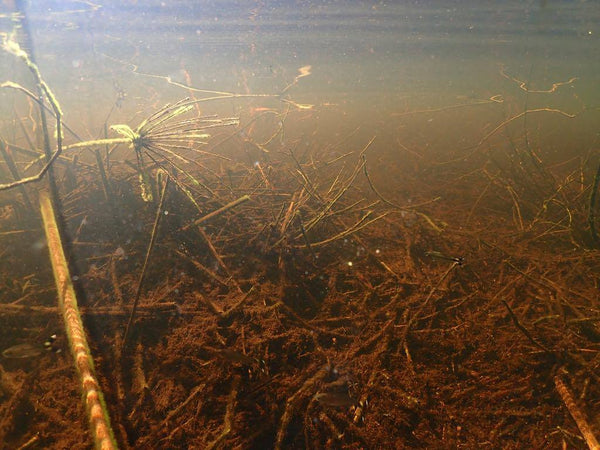
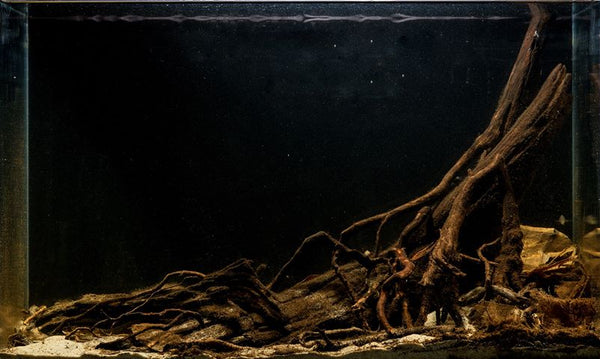
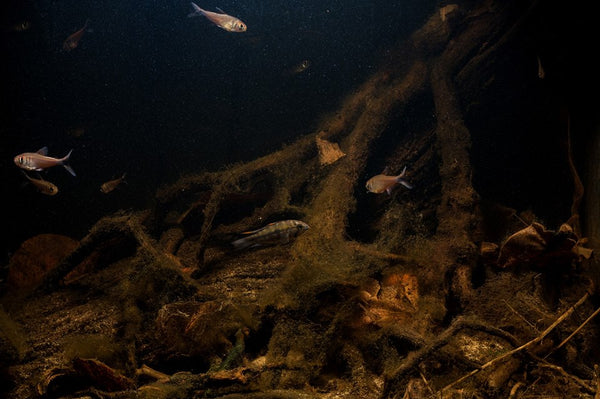
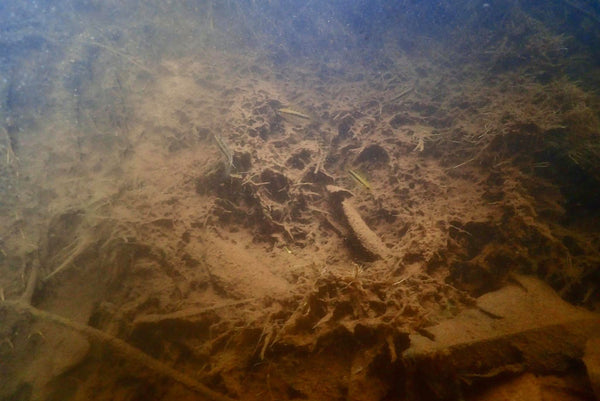
Tinted, turbid water. Sediment, biofilm. Decomposing botanical materials. Soil. A random scattering of branches covered in fungal growth.
To me, that’s freaking gorgeous. Beyond anything I’ve ever seen in any contest anywhere on planet Earth.
Unfiltered Nature.
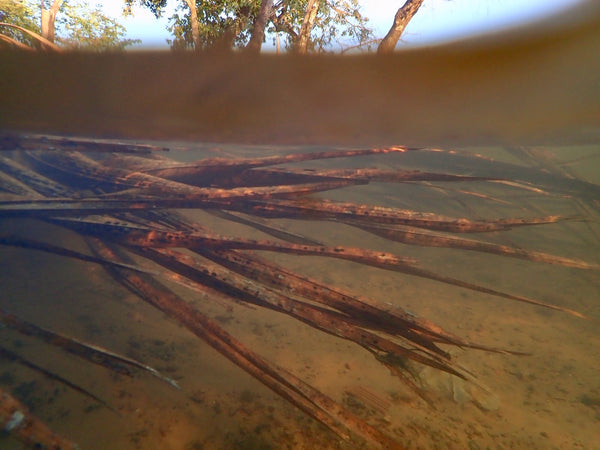
Okay, I’m not mentioning this to brag about how our avant-garde love of dirty, often chaotic-looking aquariums makes us cooler than the glass pipe and stupidly-named aquascaping rock crowd, or something like that. 😆 (well, possibly, but..)
However, I want you to understand the degree to which I love the concept of Nature in it’s most compelling form, and how strongly I feel that we as a global community of hobbyists need to look beyond what’s regularly presented to us as a “natural aquarium” and really give this stuff some thought. We CAN and SHOULD interpret natural aquatic features more literally in our aquairums.
Now, not all of Nature requires us to make extreme aesthetic preference shifts in order to love it.
Well, maybe not all. A lot of it, though.
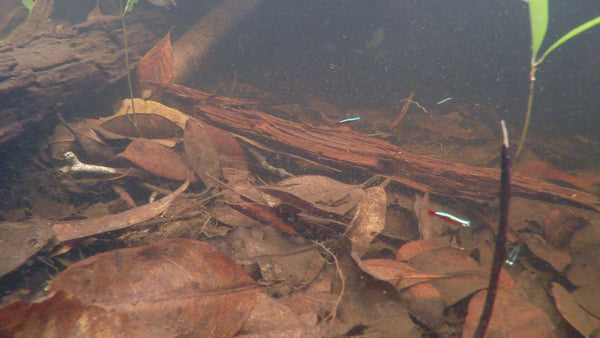
Let’s look at some interesting aquatic features from Nature which push us out of our collective hobby comfort zone. Let’s try to think why we hesitate to replicate them, and what to expect when we do.
We could all appreciate this, I think.
One concept that critics seem to delight in leveling against those of us who play with botanical-method aquariums is our love of letting Nature take an “active role” in our aquariums…
Embracing a certain degree of “randomness” in our aquariums. They call it “sloppy” or “undisciplined.”
Okay.
In general, it helps to ask questions about why things look the way they do in Nature. What creates the aggregations of wood, soils, leaves, etc. that we as a hobby spend so much effort and energy trying to wrap our heads around? Could it be that factors like current, weather events, and wind distribute materials the way they do for a reason? Could our fishes benefit from replicating this dynamic in our aquariums?
And, is there not incredible beauty in that apparent “randomness?”
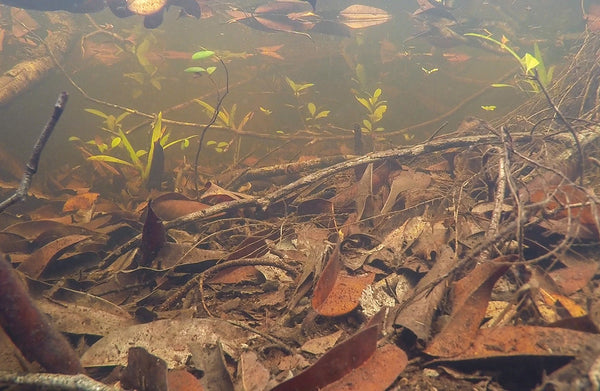
Now, there are some ideas that are significant departures from what you’ll normally see, yet are not radical enough to discourage you from accepting some different aesthetics and functions in the aquarium…
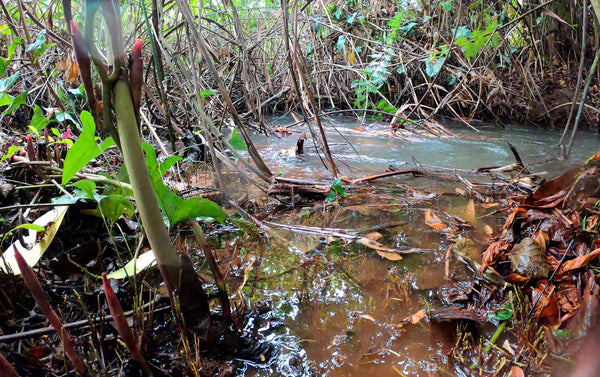
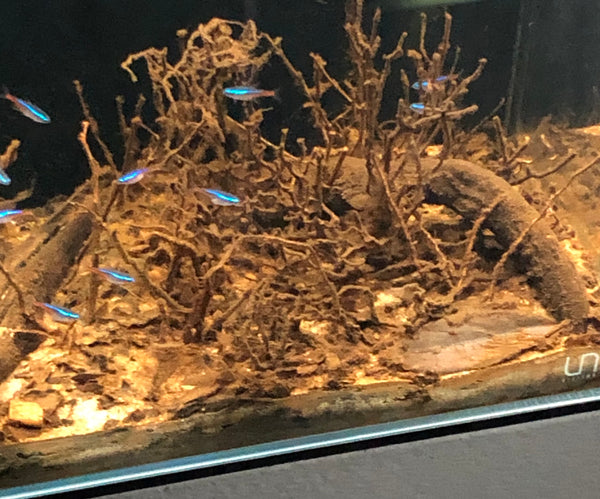
Example: There are a lot of aquatic habitats in Nature which are filled with tangles of terrestrial plant roots, emergent vegetation, fallen branches, etc., which virtually fill small bodies of water completely.
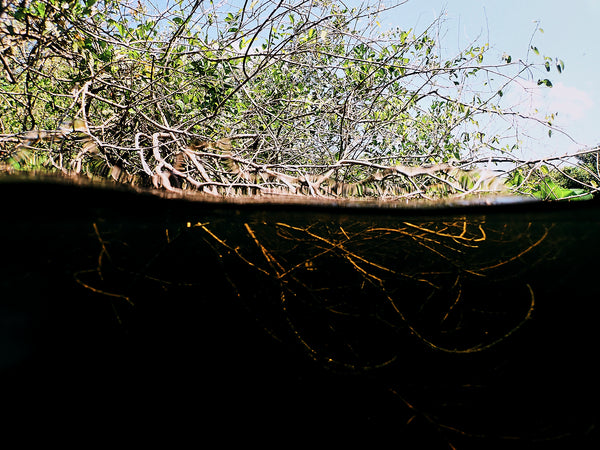
These types of habitats are unique; they attract a large quantities of smaller fishes to the protection of their vast matrix of structures. Submerged fallen tree branches or roots of marginal terrestrial plants provide a large surface area upon which algae, biofilm, and fungal growth occurs. This, in turn, attracts higher life forms, like crustaceans and aquatic insects.
And yeah- that brings our friends, the fishes– to the party.
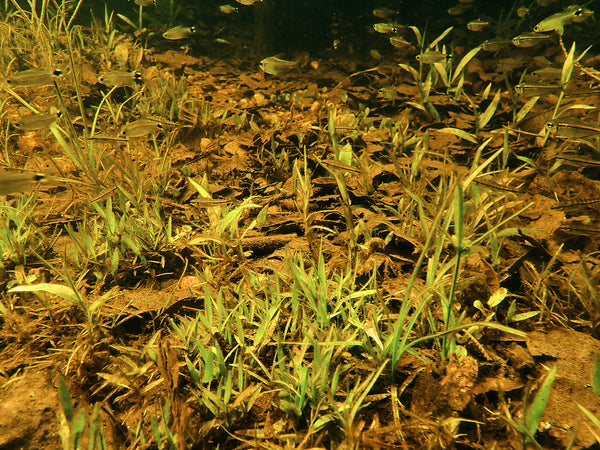
These are incredible habitats for fishes.
Can’t we replicate such aquatic features in the aquarium?
Of course we can!
This idea is a fantastic expression of “functional aesthetics.” It’s a package that is a bit different than the way we would normally present an aquarium. We hesitate to densely pack an aquarium like this, don’t we?
Why do you think this is?
I think that we hesitate, because- quite frankly- having a large mass of tangled branches or roots and their associated leaves and detritus in the cozy confines of an aquarium tends to limit the number, size, and swimming area of fishes, right?
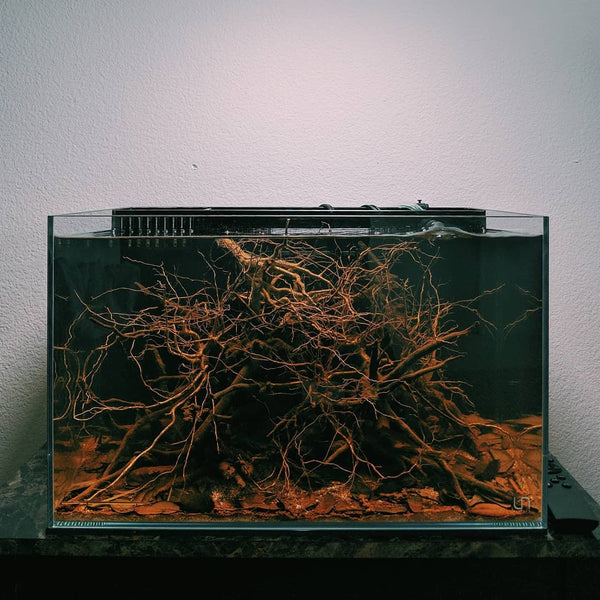
Sure, it does...
On the other hand, I think that there is something oddly compelling, intricate, and just beautiful about complex, spatially “full” hardscapes. And when you take into account that these are actually very realistic, entirely functional representations of certain natural habitats, it becomes all the more interesting!
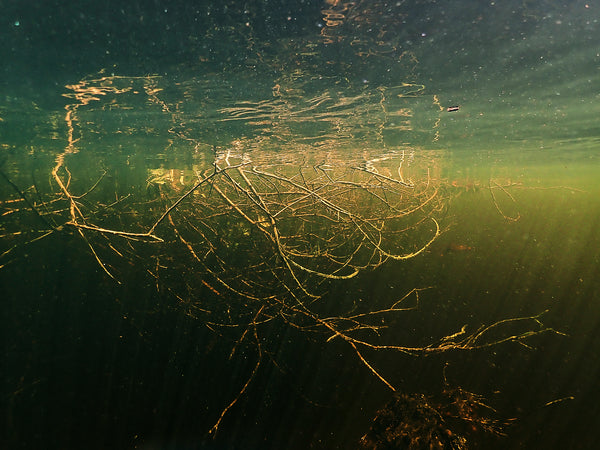
What can you expect when you execute something like this in the aquarium?
Well, for on thing, it WILL take up a fair amount of space within the tank. Depending upon the type of materials that you use (driftwood, roots. twigs, or branches), you will, of course, displace varying amounts of water. So, for example, if you tend to use a lighter, more “diffuse” wood, you’ll displace less water from the aquarium than you would if you use materials like Manzanita or other “denser” types of wood.
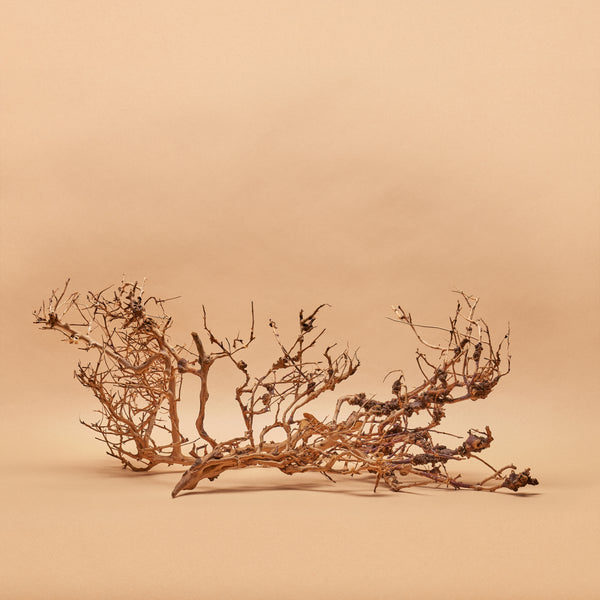
It’s really up to you in terms of twhat kind of effect you’re looking for, of course.
However, a dense matrix of material like roots will recruit biofilms after a relatively short period of time. This stuff will likely “ebb and flow”, largely dissipating after a relatively short period of time. However, there are no guarantees- and you WILL, 100% see this stuff on the surfaces at some point. What you choose to do is up to you. You can wait it out, manually remove it with siphon snd oft brash, etc.
Keep in mind that this biofilm growth is precisely what happens in Nature in densely-packed aquatic systems with fair amount of nutrients, sediment, and not a significant volume of flow. Stuff settles on the branches, and further fuels biofilm growth. It’s a rich, highly productive “micro habitat” that hosts an astonishing amount of life.
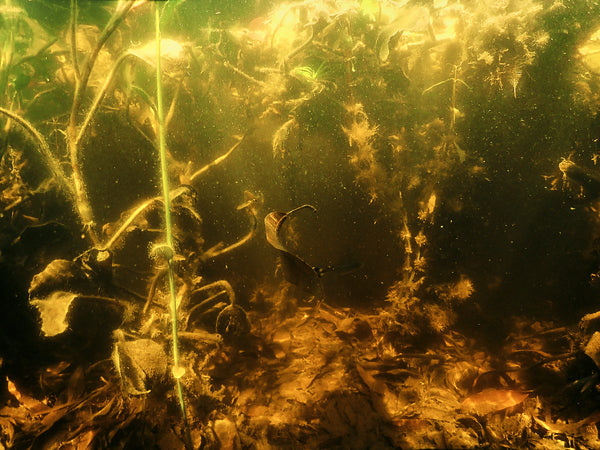
Another potential problem with this kind of configuration in the aquarium is that you’ll have to decide for yourself just how hard to push the lighting over the tank. Too much, and you’ll grow a big ol’ batch of stringy, gooey algae.
You have to play with it- especially if your purpose for lighting the tank is aesthetic, as opposed to facilitating plant growth.
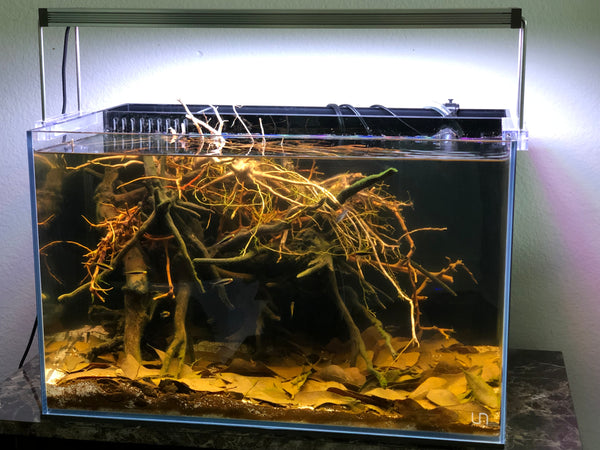
I know, because I purposely pushed it to the limit in one of the several iterations of my “Tucano Tangle” aquarium, blasting the shit out of the tank to see exactly what would happen..And, well, it was a fairly predictable result!
Light+nutrient+limited water movement= algae.
Duh.
On the other hand, with the right balance of light, fishes, and water movement, you can achieve beautiful results with a dense matrix of wood or roots.
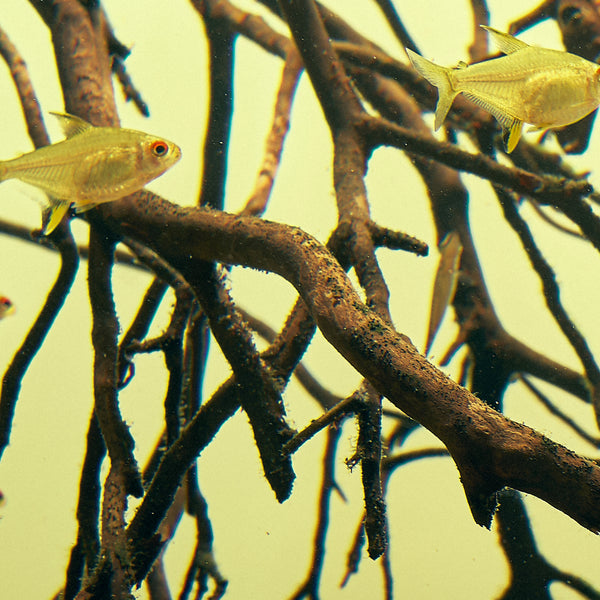
Ideas like this require multiple mental shifts and an acceptance that you may not be completely in control of the whole game.
Uncomfortable with this idea?
I understand.
It’s hardly “revolutionary” or crazy…Yet, to attempt to replicate one of these complex natural habitats in the aquarium requires us to look ourselves in the mirror and see if we’re up to the challenges (aesthetic and otherwise).
Had enough of this. Or thirsty for more?
I submit to you the idea of turbid, sediment-filled tanks, where dead branchy materials, decomposing leaves, twigs, biofilms, clays, soil and silt play…
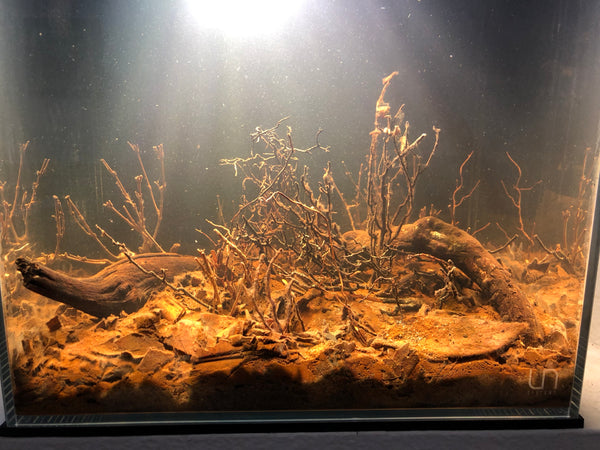
This type of feature really pushes us out of our comfort zone.
You have silty, sedimented material which, when disturbed, will cloud the water a bit for days at a time. Sort of like what happens in Nature- but it’s in your living room.
Could you handle this?
What’s the upside to a tank like this?
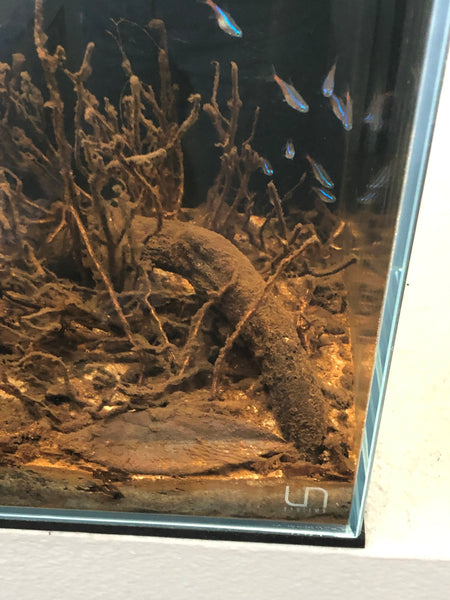
Well, for one thing, you have the benefit of a substrate which actively leaches minerals, organic materials, and other compounds into the aquarium. It also fosters the growth and proliferation of fungi, bacteria, and microorganisms which not only facilitate processing of dissolved organics, but serve as a supplemental food sources for our fishes.
This is extremely similar to the benefits such areas of flooded forest floors and such provide in Nature.
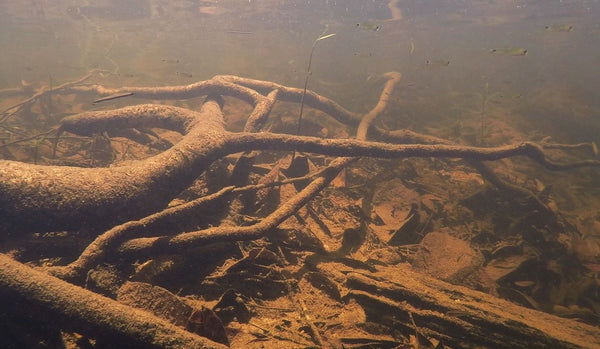
It’s a very different type of “aesthetic beauty” than we are used to.
It’s an elegant, remarkably complex microhabitat which is host to an enormous variety of life forms. And it’s a radical departure from our normal interpretation of how a tank should look. It challenges us, not only aesthetically- it challenges us to appreciate the function it can provide if we let it.
“Functional aesthetics.”
Again.
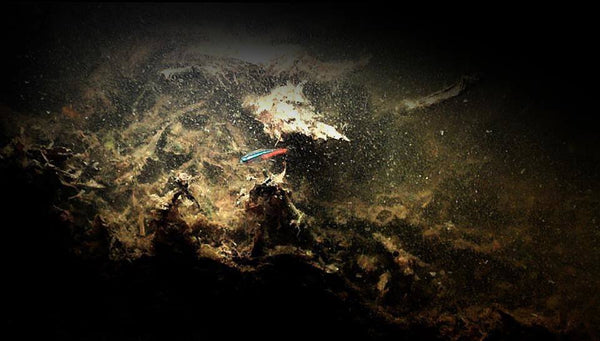
Suffice it to say, there are NO rules in rediscovering the unfiltered art beneath the surface of the water. Over the decades, I’ve come to believe in representing Nature as it exists in both form and function, without “editing” the very attributes of randomness and resulting function that make it so amazing.
I’m utterly inspired by this.
I favor the preservation of biofilms, decomposition, and that “patina” of biocover that exists when terrestrial materials contact water. Understanding that these materials break down and influence the environment…and that this process doesn’t always conform to the hobby interpretation of what is “beautiful.”
It’s an appreciation of the ephemeral, the transitional.
It makes sense to me.
I believe that there is a huge hunger in the aquarium hobby to find out more about the natural habitats from which our fishes hail, and to create more realistic functional representations of them in our aquariums. Not just the biotope crowd, which seeks to recreate the “look.”
In my own rebellious way, I also can’t help but think that part of this enthusiasm which a growing number of aquarists seem to have for this stuff is that aquarium hobbyists in general have a bit of a “rebellious streak”, too! Our taste in “style” is changing. And that maybe, just maybe– we’re collectively a bit- well, “over” the idea of the “rule-centric”, mono-stylistic, overly dogmatic thinking that has dominated the aquascaping world for the better part of a decade.
Maybe it’s time to look at Nature as an inspiration again- but to look at Nature as it exists– not trying to sanitize it; clean it up to meet our expectations of what an aquarium is “supposed to look like.”
And by the same token, also understanding that not every hobbyist wants to-or can-go to the other extreme-trying to validate every twig, rock, and plant in a given habitat, as if we’re being “scored” by some higher power- a universal “quality assurance team”- which must certify that each and every rock and branch is, indeed from the Rio Manacapuru, for example, or your work is just some sort of travesty.
At the end of the day, we all should do what we love.
That’s a given.
However, we should also stop convincing ourselves that what we do is the only way to achieve a successful, beautiful aquarium. There is much we can learn from each other. And much we can learn from Nature- which can help us create more successful aquariums.
Blurring the lines between Nature and the aquarium, from an aesthetic sense, at the very least- and in many respects, from a “functional” sense as well, proves just how far hobbyists have come…how good you are at what you do.
What an incredible dynamic!
Those who profess loudly that their highly stylized interpretation of Nature is somehow a “better” way to manage an aquarium than a system which fosters the processes (and as a collateral “benefit”- the look) of Nature in a more realistic way should take a deep breath and study wild aquatic habitats “holistically.”
It will only make their works better and even more meaningful.
Learning how natural habitats work, and what outside pressures they face from human intervention helps us to appreciate, understand, and protect them for future generations to enjoy.
It should go beyond merely creating the “look” of these systems to win a contest, IMHO. Rather, we should also focus on the structural/functional aspects of these environments to create long-term benefits for the fishes we keep in them. That’s a real “biotope aquarium” in my book.
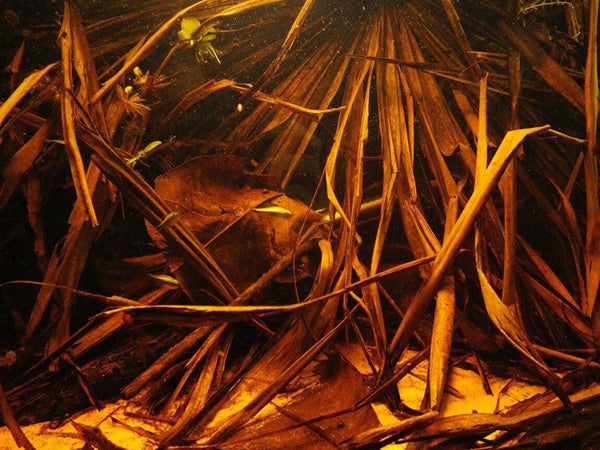
Leaves, detritus, submerged terrestrial plants- all have their place in an aquarium designed to mimic these unique aquatic habitats. You can and should be able to manage nutrients and the bioload input released into our closed systems by these materials, as we’ve discussed (and executed/demostrated) here for years. The fear about “detritus” and such “crashing tanks” is largely overstated, IMHO- especially with competent aquarium husbandry and proper outfitting of a tank with good filtration and nutrient control/export systems in place.
If you’re up to the challenge of attempting to replicate the look of some natural habitat- you should be a competent enough aquarist to be able to responsibly manage the system over the long term, as well.
Ouch, right? Hey, that’s reality. Sorry to be so frank. Enough of the “shallow mimicry” B.S. that has dominated the aquascaping/contest world for too long, IMHO. You want to influence/educate people and inspire them? Want to really advance the hobby and art/science of aquarium keeping? Then execute a tank which can be managed over the long haul. Crack the code. Figure out the technique. Look to Nature and “back engineer” it.
These things can be done.
There are many aspects of wild habitats that we choose to replicate, which we can turn into “functionally aesthetic” aquarium systems. Let’s not forget the trees themselves- in their submerged and even fallen state! These are more than just “hardscape” to those of us who are into the functional aesthetic aspects of our aquariums.
I hope that you have your own aquarium which serves as an “unlock” for the future of your botanical method work. I hope that you find your unique way in the hobby, and enjoy every second of it!
At the end of the day, I admit that our approach is less easily “digested” than many other approaches. Yet, I believe that there is an elegance, an educational component, and a beauty that botanical-method aquariums can deliver like no other.
Continue to take pride in what you do.
Don’t let dogma and the prevailing mindset of “what’s cool” distract you from doing what you love and believe in. Embrace, enjoy, and accept the thoughts, attitudes, and works of others, while constantly questioning and striving to do what moves you.
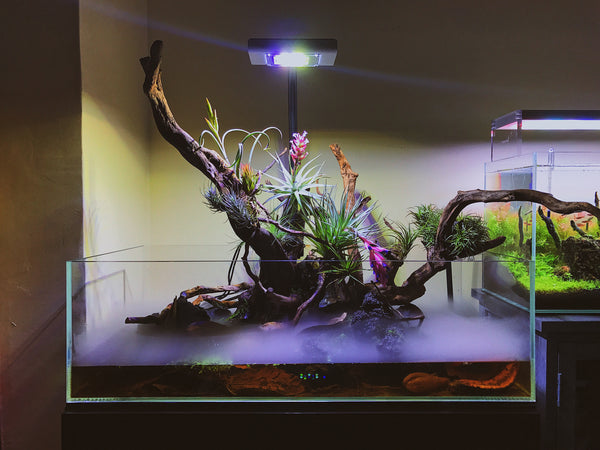
Okay, that title sounds a lot like some “rah- rah” shit, but the reality is that we should all commit ourselves to do at least one major aquarium project, one that really puts down a “marker”- or tests some idea that you’ve had in your head. Something that pushes the boundaries of what we do in botanical-method aquarium practice.
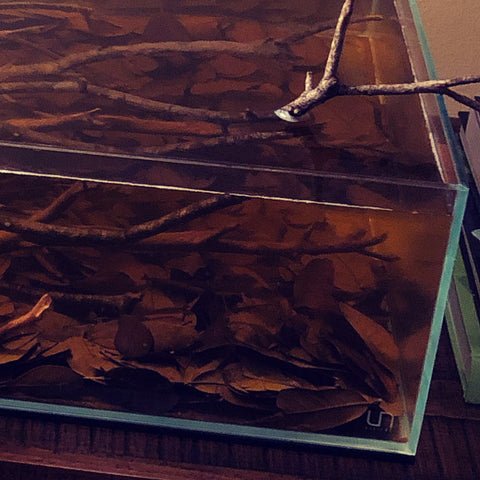
Despite the “major” descriptor- the tank doesn’t have to be a big one. I’ve had some of my most epic tanks and greatest influential developments arise out of nano tanks. Some of my best tanks/ideas-The “Urban Igapo” concept, The “Tucano Tangle”, the botanical method brackish water system, and a “Java Fern Jungle”-all came from tanks of 25 US gallons or less. Each one had outsized impact on my philosophies moving forward.
Each one represented a “turning point” in my personal botanical method aquarium journey.
Of all of the tanks I’ve played with in the past 10 years, none has had greater impact on me and my future work than the 50-gallon botanical method tank which I built in 2017. This tank helped move the mark…pushed me into a new era of more thorough, more natural ecosystem creation.
It was the first larger tank in which I really let Nature take control. Let her dictate the pace, the diversity, and the aesthetic.
It started quite simply, really.
An almost stupid-looking stack of wood.
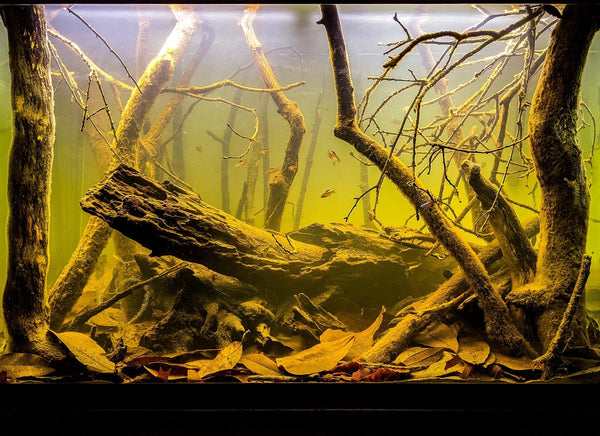
Not just any wood, though- Red Mangrove branches. A wood variety that imparts large amounts of tannins into the water. A very “dirty” kind of wood, with lots of textured surface area- perfect for biofilm and fungal colonization.
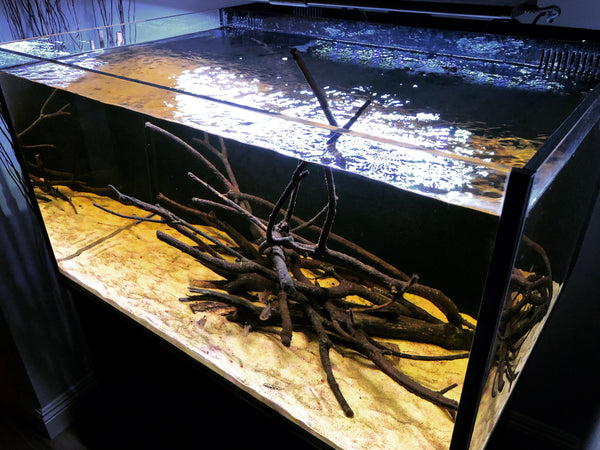
The idea behind the tank was to accept completely what Nature does to the materials we use- without any intervention on my part, nor a bent towards placing aesthetics first.
Why?
Well, for one thing, it was to put down my personal “marker” for “Natural” in the aquairum hobby. This word is used too often, and in weird ways, IMHO. Some hobbyists emphasize how “natural” their aquairum is without really looking at the absurdity of how hard they’re trying to fight off Nature- by forcing decidedly unnatural combinations of plants and other materials to exist in a highly staged, very precisely manicured world of aesthetic-first philosophy.
The result IS a beautiful aquarium- one which has natural components, sure- but which could hardly be considered anything but an artistic view of Nature when placed into this context. Like what an English garden is to a wild meadow.
I sometimes fear that this burgeoning interest in aquariums intended to replicate some aspects of Nature at a “contest level” will result in a renewed interest in the same sort of “diorama effect” we’ve seen in planted aquarium contests.
In other words, just focusing on the “look” -or “a look” (which is cool, don’t get me wrong) yet summarily overlooking the function– the reason why the damn habitat looks the way it does and how fishes have adapted to it in the first place.
Considering how we can utilize this for their husbandry, spawning, etc.- is only a marginal improvement over where we’ve been “stuck” with for a while now as the “gold standard” in freshwater aquariums..
Some people are simply too close minded to apply their skills to doing things in a TRULY more natural way.
Some of these people need to just stare at a few underwater scenes for a while and just open their minds up to the possibilities…
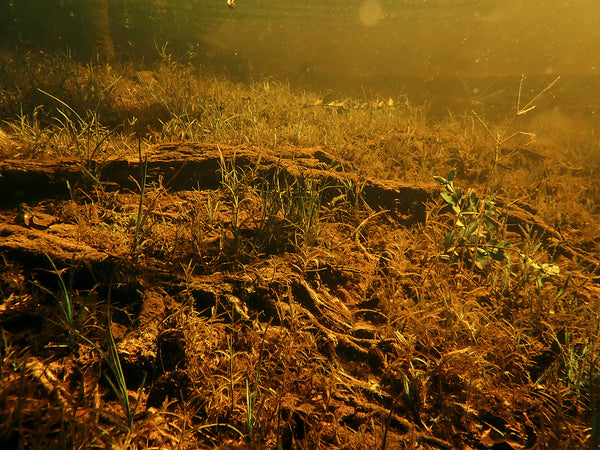
We all need to go further. Out of our comfort zones.
I’m sure I’m being just a bit over-the-top (oaky, maybe QUITE a bit!), but the so-called “Nature Aquarium” movement seems to have, IMHO, largely overlooked the real function of Nature, so there is some precedent, unfortunately. A sanitized, highly stylized interpretation of a natural habitat is a start…I’ll give ’em that-but it’s just that- a start.
The real exciting part- the truly “progressive” part- comes when you let Nature “do her thing” and allow her to transform the aquarium -as she’s done in the wild for eons.
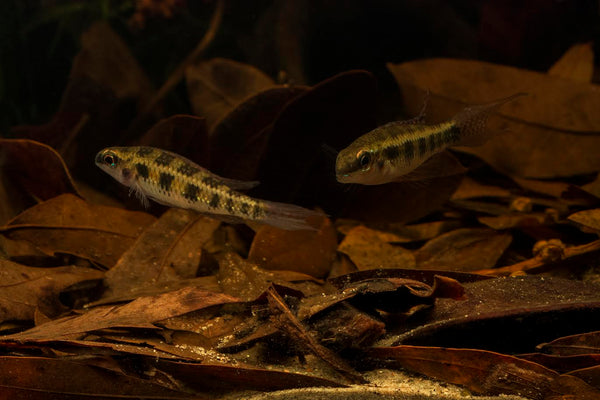
So, yes- It should go beyond merely creating the “look” of these systems to win a contest, IMHO. Rather, we should also focus on the structural/functional aspects of these environments to create long-term benefits for the fishes we keep in them. We should aim to incorporate things like biofilms, detritus, decomposition into our systems, just as Nature does.
That’s a real “biotope aquarium” or ‘Nature” aquarium in my book.
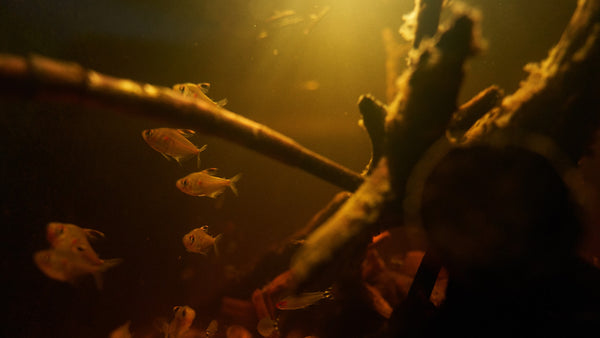
What part of the “function” can we really work on in this regard?
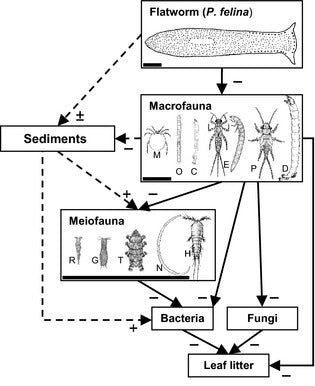
Well, perhaps the most important things that botanical method aquariums can do is to facilitate the assembly of a “food web” within the system.
To me, these are fascinating, fundamental constructs which can truly have important influence on our aquariums.
So, what exactly is a food web?
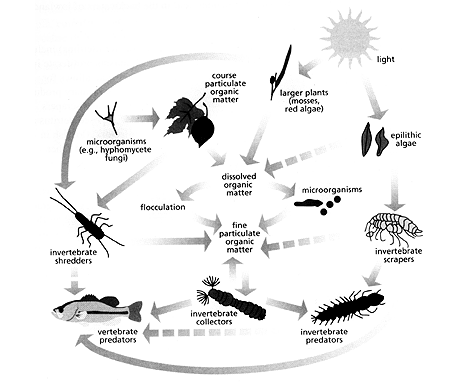
A food web is defined by aquatic ecologists as a series of “trophic connections” (ie; feeding and nutritional resources in a given habitat) among various species in an aquatic community.
All food chains and webs have at least two or three of these “trophic levels.” Generally, there are a maximum of four trophic levels. Many consumers feed at more than one trophic level.
So, a trophic level in our case would go something like this: Leaf litter, bacteria/fungal growth, crustaceans…
In the wild aquatic habitats we love so much, food webs are vital to the organisms which live in them. They are an absolute model for ecological interdependencies and processes which encompass the relationship between the terrestrial and aquatic environments.
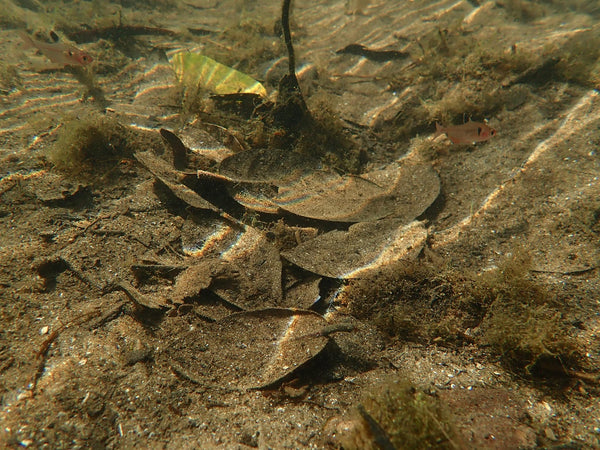
In many of the blackwater aquatic habitats that I’m so obsessed with, like the Rio Negro, for example, studies by ecologists have determined that the main autotrophic sources are provided by the flooded forest floors of the igapo, along with aquatic vegetation and various types of algae. (For reference, “autotrophs” are defined as organisms that produce complex organic compounds using carbon from simple substances, such as CO2, and using energy from light (photosynthesis) or inorganic chemical reactions.)
Hmm. examples would be phytoplankton!
Now, I was under the impression that phytoplankton was rather scarce in blackwater habitats. However, many ecologists feel that phytoplankton in blackwater trophic food webs might be more important than originally thought!
Now, lets get back to algae and macrophytes for a minute. Most of these life forms enter into food webs in the region in the form of…wait for it…detritus! Yup, both fine and course particular organic matter are a main source of these materials. I suppose this explains why heavy accumulations of detritus and algal growth in aquaria go hand in hand, right?
Detritus is “fuel” for life forms of many kinds.
In Amazonian blackwater rivers, studies have determined that the aquatic insect abundance is rather low, with most species concentrated in leaf litter and wood debris, which are important habitats. Yet, here’s how a food web looks in some blackwater habitats : Studies of blackwater fish assemblages indicated that many fishes feed primarily on burrowing midge larvae (chironomids, aka “Bloodworms” ) which feed mainly with organic matter derived from terrestrial plants!
And of course, allochtonous inputs (food items from outside of the ecosystem), like fruits, seeds, insects, and plant parts, are important food sources to many fishes. Many midwater characins consume fruits and seeds of terrestrial plants, as well as terrestrial insects.
Insects in general are really important to fishes in blackwater ecosystems. In fact, it’s been concluded that the the first link in the food web during the flooding of forests is terrestrial arthropods, which provide a highly important primary food for many fishes.
These systems are intimately tied to the surrounding terrestrial environment. Even the permanent rivers have a strong, very predictable “seasonality”, which provides fruits, seeds, and other terrestrial-originated food resources for the fishes which reside in them. That’s a huge hobby “unlock”. Think about that for a few seconds…
It’s long been known by ecologists that rivers with predictable annual floods have a higher richness of fish species tied to this elevated rate of food produced by the surrounding forests.
And of course, fungal growths and bacterial biofilms are also extremely valuable as food sources for life forms at many levels, including fishes. The growth of these organisms is powered by…decomposing leaf litter!
Sounds familiar, huh? Yeah, I talk about this a lot!
So, how does a leaf break down?
It’s a multi-stage process which helps liberate its constituent compounds for use in the overall ecosystem. And one that is vital to the construction of a food web. I’ve talked about the process before- let’s do it one more time!
The first step in the process is known as leaching, in which nutrients and organic compounds, such as sugars, potassium, and amino acids dissolve into the water and move into the soil. The next phase is a form of fragmentation, in which various organisms, from termites (in the terrestrial forests) to aquatic insects and shrimps (in the flooded forests) physically break down the leaves into smaller pieces.
As the leaves become more fragmented, they provide more and more surfaces for bacteria and fungi to attach and grow upon, and more feeding opportunities for fishes!
Okay, okay, this is all very cool and hopefully, a bit interesting- but what are the implications for our aquariums? How can we apply lessons from wild aquatic habitats vis a vis food production to our tanks?
This is one of the most interesting aspects of a botanical-method aquarium:
We have the opportunity to create an aquatic microcosm which provides not only unique aesthetics- it provides nutrient processing, and to some degree, a self-generating population of creatures with nutritional value for our fishes, on a more-or-less continuous basis.
Incorporating botanical materials in our aquariums for the purpose of creating the foundation for biological activity is the starting point.
Leaves, seed pods, twigs and the like are not only “attachment points” for bacterial biofilms and fungal growths to colonize, they are physical location for the sequestration of the resulting detritus, which serves as a food source for many organisms, including our fishes.
Think about it this way: Every botanical, every leaf, every piece of wood, every substrate material that we utilize in our aquariums is a potential component of food production!
The initial setup of your botanical-method aquarium will rather easily accomplish the task of facilitating the growth of said biofilms and fungal growths. There isn’t all that much we have to do as aquarists to facilitate this but to simply add these materials to our tanks, and allow the appearance of these organisms to happen.
You could add pure cultures of organisms such as Paramecium, Daphnia, species of copepods (like Cyclops), etc. to help “jump start” the process, and to add that “next trophic level” to your burgeoning food web.
In a perfect world, you’d allow the tank to “run in” for a few weeks, or even months if you could handle it, before adding your fishes- to really let these organisms establish themselves. And regardless of how you allow the “biome” of your tank to establish itself, don’t go crazy “editing” the process by fanatically removing every trace of detritus or fragmented botanicals.
That 50 gallon tank I just mentioned was a tank which really pushed this idea to the forefront of my daily practice. Everything from the selection of materials to the way the tank was set up, to the “aquascape” was imagined as a sort of “whole.”
Yeah, I said the “A” word…Let’s think about the “aquascape” part bit more deeply for just a second…
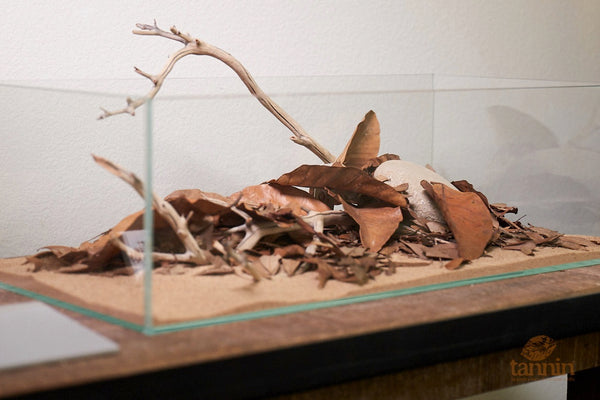
What IS the purpose of an aquascape in the aquarium…besides aesthetics? Well, it’s to provide fishes with a comfortable environment that makes them feel “at home”, right?
Exactly...
So when was the last time you really looked into where your fishes live- or should I say, “how they live” – in the habitats from which they come? The information that you can garner from such observations and research is amazing!
One of the key takeaways that you can make is that many freshwater fishes like “structure” in their habitats. Unless you’re talking about large, ocean going fishes, or fishes that live in enormous schools, like herring or smelt- fishes like certain types of structure- be it rocks, wood, roots, etc.
Structure provides a lot of things- namely protection, shade, food, and spawning/nesting areas.
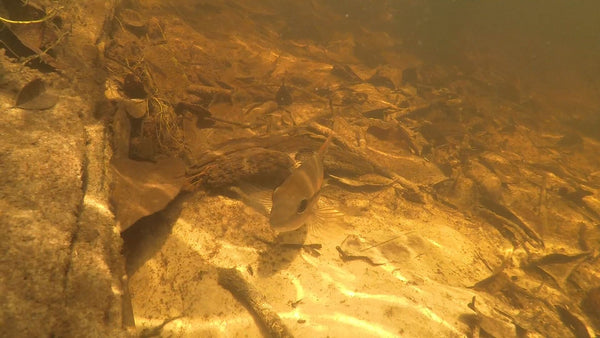
And of course, the structure that we are talking about in our aquairums is not just rocks and wood…it’s all sorts of botanical materials and leaves that create “microhabitats” in all sorts of places within the aquarium.
We can utilize all of these things to facilitate more natural behaviors from our fishes.
So, yeah-think about how fishes act in Nature.
They tend to be attracted to areas where food supplies are relatively abundant, requiring little expenditure of energy in order to satisfy their nutritional needs. Insects, crustaceans, and yeah- tiny fishes- tend to congregate and live around floating plants, masses of algae, and fallen botanical items (seed pods, leaves, etc.), so it’s only natural that our subject fishes would be attracted to these areas…
I mean, who wouldn’t want to have easy access to the “buffet line”, right?
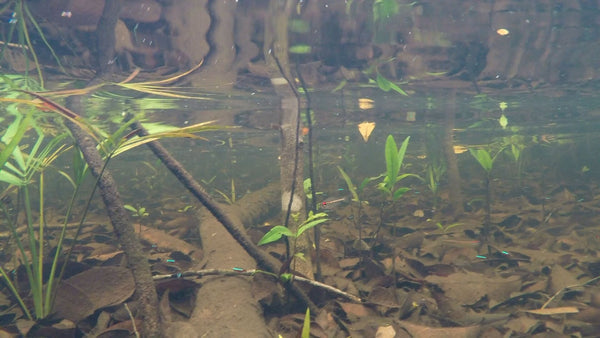
And with the ability to provide live foods such as small insects (I’m thinking wingless fruit flies and ants)- and to potentially “cultivate” some worms (Bloodworms, for sure) “in situ”- there are lots of compelling possibilities for creating really comfortable, natural-appearing (and functioning) biotope/biotype aquariums for fishes.
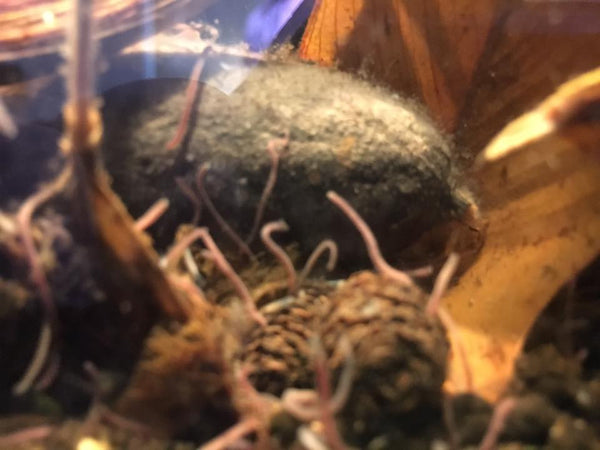
Ever the philosopher/ muser of the art of aquaristics, I sometimes fear that the burgeoning interest in biotope aquariums at a contest level will result in the same sort of “diorama effect” we’ve seen in planted aquarium contests. In other words, just focusing on the “look” (which is cool, don’t get me wrong) yet summarily overlooking the reason why the habitat looks the way it does and how fishes have adapted to it…and considering how we can utilize this for their husbandry, spawning, etc.
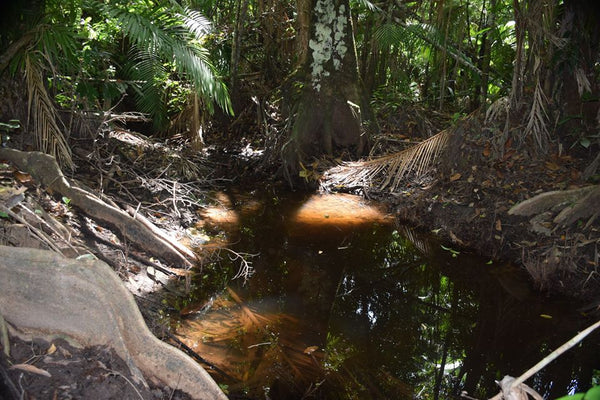
I’m sure it’s unfounded, but the so-called “Nature Aquarium” movement seems to have, IMHO, completely overlooked the real function of nature, so there is some precedent, unfortunately. I hope that “biotopers”, who have a lot of awareness about the habitats they are inspired by, will at least consider this “functional/aesthetic” dynamic that we obsess over when they conceive and execute their work.
Question, observe, and query those who do things differently than you do. However, don’t just levy criticism on something you don’t understand because it differs radically than what you love so much.
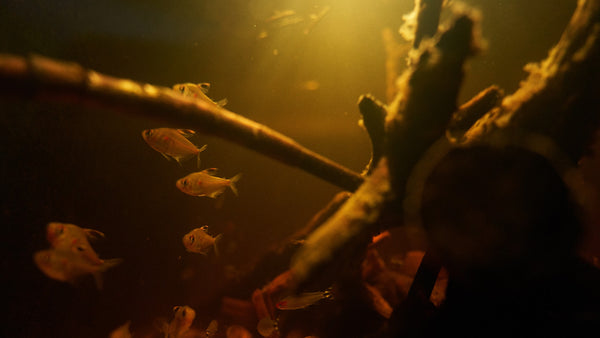
Find what makes your heart sing, and do it. Share it with the world. Educate. Listen. Enjoy.
You’ll never be “wrong.”
 The Tint
Leave a comment