
When you consider the types of aquariums that we work with, I would imagine that it is probably funny to outsiders, or those new to our obsession, to hear us going on and on about utilizing dried leaves, twigs, and seed pods in our aquariums with words such as “methodology” and “technique” and the like.
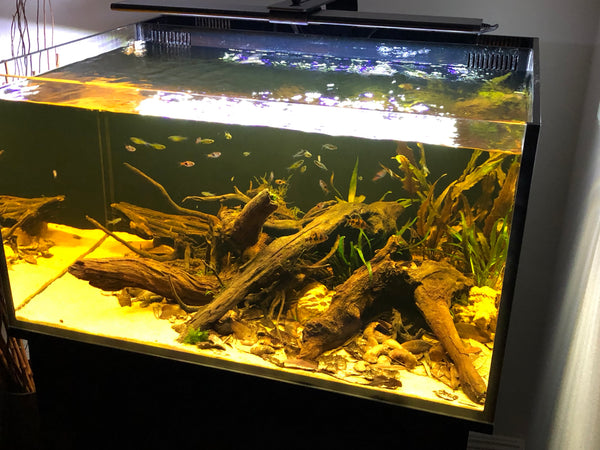
I also can’t help but think that the great Takashi Amano, who spent years studying many aspects of Nature and her influence on the aquatic environments, would really love this stuff. I think that he’d love the unique aesthetics, sure- but I think he’d especially love how these ephemeral materials we play with can influence the way our aquariums function.
It’s the essence of his embrace of the Japanese philosophy of wabi-sabi.
I can’t help but wonder if he’d gently scold the hobby, and perhaps lament how it has embraced mostly the more superficial aspects of Nature, beautiful as they are- as opposed to “the whole picture.”

I suppose that there are occasional smirks and giggles from some corners of the hobby when they initially see our tanks, with some thinking, “Really? They toss in a few leaves and they think that the resulting sloppiness is “natural”, or some evolved aquascaping technique or something?”
Funny thing is that, in reality, it IS a sort of evolution, isn’t it?
I mean, sure, on the surface, this doesn’t seem like much: “Toss botanical materials in aquariums. See what happens.” It’s not like no one ever did this before. And to make it seem more complicated than it is- to develop or quantify “technique” for it (a true act of human nature, I suppose) is probably a bit humorous.

On the other hand, it’s not just to create a cool-looking tank. We don’t embrace the aesthetic of dark water, a bottom covered in decomposing leaves, and the appearance of biofilms and algae on driftwood because it allows us to be more “relaxed” in the care of our tanks, or because we think we’re so much smarter than the underwater-diorama-loving, hype-mongering competition aquascaping crowd.
Well, maybe we are? 😆
I mean, we are doing this for a reason: To create more authentic-looking, natural-functioning aquatic displays for our fishes. To understand and acknowledge that our fishes and their very existence is influenced by the habitats in which they have evolved.
Yes, wild tropical aquatic habitats are influenced greatly by the surrounding geography and flora of their region, which in turn, have considerable influence upon the population of fishes which inhabit them, and their life cycle. The simple fact of the matter is, when we add botanical materials to an aquarium and accept what occurs as a result-regardless of wether our intent is just to create a different aesthetic, or perhaps something more- we are to a very real extent replicating the processes and influences that occur in wild aquatic habitats in Nature.
The presence of botanical materials such as leaves in these aquatic habitats is fundamental. Again, it’s an indication of that intimate relationship between the terrestrial and aquatic environments. And it often starts with a bunch of leaves falling off of trees and becoming submerged in water.

What makes leaves fall off the trees in the first place?
Well, it’s simple- er, rather complex…but I suppose it’s simple, too. Essentially, the tree “commands” leaves to fall off the tree, by creating specialized cells which appear where the leaf stem of the leaves meet the branches. Known as “abscission” cells. for word junkies, they actually have the same Latin root as the word “scissors”, which, of course, implies that these cells are designed to make a cut!
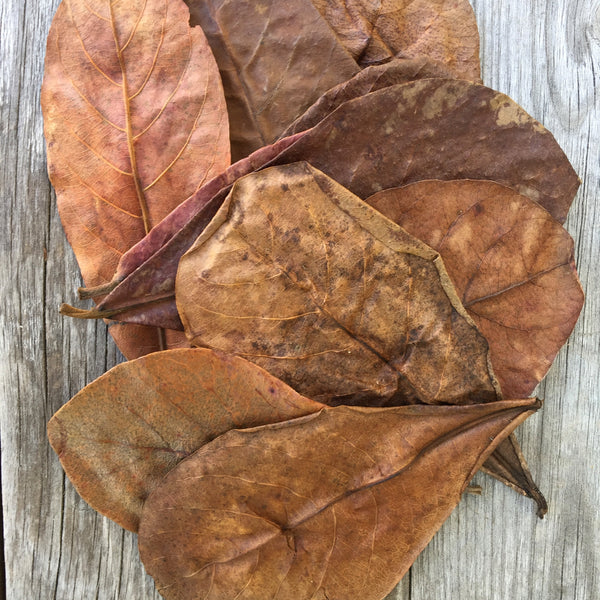
And, in the tropical environments, the leaf drop is extremely important to the surrounding environment. The nutrients are typically bound up in the leaves, so a regular release of leaves by the trees helps replenish the minerals and nutrients which are typically depleted from the soils by eons of leaching into the surrounding forests.
And the rapid nutrient depletion, by the way, is why it’s not healthy to burn tropical forests- the release of nutrients as a result of fire is so rapid, that the habitat cannot process it, and in essence, the nutrients are lost forever.

Now, interestingly enough, most tropical forest trees are classified as “evergreens”, and don’t have a specific seasonal leaf drop like the “deciduous” trees than many of us are more familiar with do…Rather, they replace their leaves gradually throughout the year as the leaves age and subsequently fall off the trees.
The implication here?
There is a more-or-less continuous “supply” of leaves falling off into the jungles and waterways in these habitats, which is why you’ll see leaves at varying stages of decomposition in tropical streams. It’s also why leaf litter banks may be almost “permanent” structures within some of these bodies of water!

And, for the fishes and other organisms which live in, around, and above the litter beds, there is a lot of potential food, which does vary somewhat between the “wet” and “dry” seasons and their accompanying water levels. The fishes tend to utilize the abundant mud, detritus, and epiphytic materials which accumulate in the leaf litter as food. During the dry seasons, when water levels are lower, this organic layer compensates for the shortage in other food resources.

During the higher water periods, there is a much greater amount of allochthonous input (remember that?) from the surrounding terrestrial environment in the form of insects, fruits, and other plant material, which fall into the water from the overhanging forest canopy.
I suppose that, in most of our aquariums, it’s pretty much always the “wet season”, right? We tend to top off and replace decomposing leaves and botanical more-or-less continuously.
Now, of course, where is where I get into what I will call “Operational Ecology!”
One can perform many thought experiments in this area…
What if we stopped replacing leaves and even lowered water levels or decreased water exchanges in our tanks to correspond to, for example, the Amazonian “dry season” (June to December)…And if you consider that many fishes tend to spawn in the “dry” season, concentrating in the shallow waters, could this have implications for breeding?
Could this be a re-thinking or re-imagining of how we keep, spawn and rear our fishes?

I cannot help but believe so.
I further proffer that we need to look a lot deeper into the idea of environmental manipulation for the purpose of getting our fishes to be healthier, more colorful, and especially, to spawn.
Now I know, the idea is nothing new on a “macro” level- we’ve been increasing and lowering water temps in our aquariums, adjusting lighting levels, and tweaking environmental parameters to get fishes to spawn for a long time.

(Awesome pic by Mike PA Calnun)
Killie keepers have played with this concept in the drying and incubation periods in annual killifish eggs for many years. That’s some serious “next-level stuff!” Specific environmental manipulations for definitive results (ie; controlled egg hatching, etc.) is something that has been proven by generations of hobbyists.
And there are unique ecological relationships between killifishes and their habitats- none perhaps as profound as the annual killifishes, specifically those from Africa, such as the much-loved Nothobranchius species.

(Image by Andrew Bogott, used under CC BY-S.A. 4.0)
Now, the typical environments which these fishes live in are small temporary savannah pools in sandy soils, with a layer of black mud on top. And that’s where it gets kind of interesting. Nothos don’t just live and reproduce in any old mud hole.
Nope.

Rather, they’re intimately tied to specific types of soils, muds, and sands. And there is good reason, too.
According to one study I read, “Nothobranchius never inhabit pools consisting only of orange-colored laterite soils (Reichard et al., 2009; Watters, 2009). Although these pools are very common in the African savannah, especially after heavy precipitation, they are characterized by kaoline-type clay minerals and are slightly acidic, and their substrate is not suitable for Nothobranchius embryo survival during the dry period.”
And here is another huge takeaway:
“The critical prerequisite of Nothobranchius occurrence in a particular pool is the specific composition of the substrate (Watters, 2009). Soil conditions are the primary drivers of habitat suitability for Nothobranchius, as the eggs can only survive the embryonic period and develop successfully on Quaternary vertisol and calcimorph soils.”
In other words, the relationship between these fishes and their environment is supercritical.

These pools accumulate in a soil type called Vertisol.
This is a clay soil with little organic matter which occurs in regions having distinct wet and dry seasons. Alkaline clay minerals ( called smectites) are considered to be prerequisites to create suitable conditions during embryonic development in desiccated pool substrates.
An absolute relationship between the fish and their habitat.
And here’s the other cool takeaway-one which actually can have some impact on the way we keep and breed these unique fishes:
The mud-rich layer in such pools has low permeability, a characteristic which enables water to remain in the pools after the surrounding water table has receded. Without the presence of this impermeable layer, the pools will rapidly desiccate. Visually, this substrate is dark brown to black, often forming a thick layer of soft mud on the bottom of the pool.
This, of course, makes these unique aquatic ecosystems all the more fascinating to us as tropical fish hobbyists!

(Image by HAL333- used under CC BY-SA 4.0)
In the dry part of the range of the genus Nothobranchius in southwestern Mozambique, many pools inhabited by the well-known killies, N. furzeri and N. orthonotus are usually isolated from more permanent bodies of water, and are filled exclusively by rainwater during periods of high precipitation. Some of these pools, however, may be occasionally connected, as they are essentially depressions in the dry savannah, in which water drained from these larger bodies of water, accumulates.
These pools and their cycles directly impact the life cycle and reproductive strategies of the annual fishes which reside in them.
The fascinating concept of embryonic diapause ( a form of prolonged, yet reversible developmental arrest) is well-known to scientists and lovers of annual killies. The occurrence and length of time of diapause varies from species to species, yet is considered by scientists to be an evolutionary adaptation and ecological trait in various populations of Nothobranchius, tied directly into the characteristics of the ephemeral habitats in which these fish reside!

(Image by Kils- used under CC BY-S.A. 3.0)
Diapause assures species survival by enabling the annual life cycle of these fish to be completed, and can even be affected by the presence of adult fishes in the habitat (not a good idea to hatch if potential predators are around, right?)- a fascinating adaptation! Since the embryonic phase of most Nothobranchius is a relatively long period of their lives- and in some species- the longest phase of their life, factors which impact embryonic development are extremely important.
Oh, and the really interesting part:
“Organic material aggregates in the pool in the form of dead aquatic and terrestrial vegetation but does not cover the large part of the bottom, as is typical of water bodies in forested areas with leaf litter. Despite the presence of rapidly decaying material, the water stays alkaline due to the high buffering capacity of the alkaline clay in the sediment.” (Reichard, 2009)
Something that we as botanical-method aquarium enthusiasts experience often- the buffering effect of substrate, despite a huge presence of decomposing leaves and botanical materials. It’s part of the reason why some have trouble getting their pH down to very low levels in aquariums, I think!
That’s where the idea of alternative substrates comes in!

So, yeah– the substrate is of critical importance to the aquatic life forms which reside in them. One study I read indicated that the soils are “the primary drivers of habitat suitability” for these fish, and that the eggs can only survive the embryonic period and develop in specific soil types containing alkaline clay minerals, known as “smectites”, which create the proper soil conditions for this in desiccated pool substrates.
A takeaway for us as hobbyists.

I could go on and on and on talking about all sorts of relationships between fishes and their habitats, because there are so many!
And there are also killifish habitats covered in leaf litter-a component of the habitat which creates very specific conditions for the fishes’ reproduction! Yeah- if you look hard enough, you can find examples for just about everything your looking for by observing Nature closely.

The relationship between land and water is something that we as hobbyists are just starting to consider in aquariums. A relationship which has vast implications for the aquarium hobby. This idea of “operational ecology” is “baked-in” to what we do in our little hobby speciality!

And there is so much to learn about this stuff.
Just confining our research to hobby literature is to overlook the vast amount of information available to us via academic research. We as hobbyists should all “deep dive” now and then into the many resources available to us!
Again, the most important takeaway from today’s little review is that our fishes found in specific habitats for a reason. They’re often intimately tied to the environments in which they are found- not only benefitting from, but sometimes contributing to– the overall habitat.
We have worked with temperature, photoperiods, and water chemistry for some time…However, I don’t think we’ve been doing a lot of other types of environmental manipulations…like adjusting water levels, increasing nutrient loads (ie; “pulsing” adding leaves and other botanicals), fostering biofilm growth, manipulating current, dissolved oxygen, food types, etc. for the expressed purpose of general husbandry and yeah- the spawning many other types of fishes.

“Operating” our systems, if you will.
Yeah, “operational ecology.”
I think that there are so many different things that we can play with- and so many nuances that we can investigate and manipulate in our aquariums to influence fish health and spawning behavior.
I think that this could even add a new nuance to a typical biotope contest aquarium, such as creating an aquarium which simulates the “Preto da Eva River in Brazil in October”, or whatever…with appropriate environmental conditions, such as water level, amounts of allochthonous material, etc. for that time of year..
Not just an aesthetic representation designed to mimic the look of the habitat- anyone can do that- but a “functionally aesthetic” representation of a natural habitat, intended to operate like one..Full time.
A biotope aquarium. focused on “operational ecology.”
Nuances. Micro-influences. Subtle steps.

The possibilities are endless here! How do we start?
Well, we make those “mental shifts” and accept the dark water, the accumulation of leaves and botanicals, decomposition, biofilms, fungi, and the apparent “randomness” of their presence. We study the natural habitats from which they come, not just for the way they look- but for WHY they look that way, and for how the impacts of the surrounding environments influence them in multiple ways.
There is a tremendous amount of academic material out there for those willing to “deep dive” into this. And a tremendous amount to unravel and apply to our aquarium practices! We’re literally just scratching the surface. We’re making the shifts to accept the true randomness of Nature as it is. We are establishing and nurturing the art of “functional aesthetics.” Then we move into “operational ecology.”
(Damn, I love coming up with names for stuff that we embrace, huh? LOL)
My real hope for the future?
That one day, when some kid somewhere adds some Latifolia pods, Catappa bark, or banana stem pieces to her wild Betta tank, for example, and someone asks why, they’ll respond with something like, “Because these materials mimic the allochthonous inputs which occur in their wild habitats, and provide foraging and humic substances which will manipulate the aquarium environment and encourage the development of biofilms and other microorganisms for their long-term health”
That’s a mouthful!
Okay, I seriously doubt that some 11-year-old will respond exactly in those words- but I think that she’d suggest that the idea of using botanicals to do more than just create a pretty look in the aquarium is important. To understand that creating an aquatic ecological system is what it’s all about.
My hope is that this mindset will percolate into the consciousness of the general hobby, for the good of all who play with tropical fishes. Not just for us obsessed weirdos!
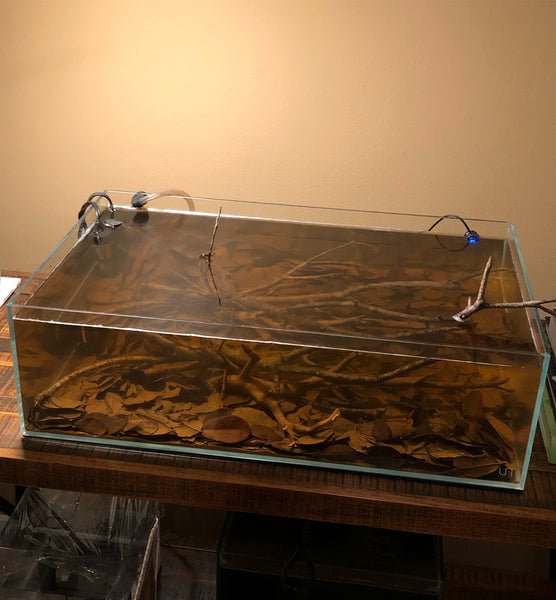
Perhaps one day, among the things we indoctrinate neophyte aquarists to play with as fundamental skills, besides water exchanges, quarantine, and careful stocking, will be things like “adding appropriate botanical materials to the aquarium to facilitate more natural conditions for the aquatic organisms we keep.”
We are all contributing towards the evolution of aquarium practice, regardless of if we’re conscious of it!
This is the mission before us all.
Study the natural. Embrace the ephemeral. Think of the possibilities.
It starts with observing and studying Nature. And your aquarium.
Then, just add leaves, some soil…
And open your mind…
Amano himself, I think, would appreciate this.
Stay dedicated. Stay curious. Stay resourceful. Stay observant. Stay creative…
And Stay Wet.
Scott Fellman
 The Tint
Leave a comment