
If there is one aspect of our botanical method aquariums which fascinates me, it’s the way they facilitate the natural processes of life- specifically, decomposition.
I use this term a lot around here…What, precisely does it mean?
de·com·po·si·tion- dēˌkämpəˈziSH(ə)n –the process by which organic substances are broken down into simpler organic matter.
A very apt descriptor, if you ask me!
We add leaves and botanicals to our aquariums, and over time, they start to soften, break up, and ultimately, decompose. This is a fundamental part of what makes our botanical method aquariums work. Decomposition of leaves and botanicals not only imparts the substances contained within them (lignin, organic acids, and tannins, just to name a few) to the water- it serves to nourish bacteria, fungi, and other microorganisms and crustaceans, facilitating basic “food web” within the botanical method aquarium– if we allow it to!
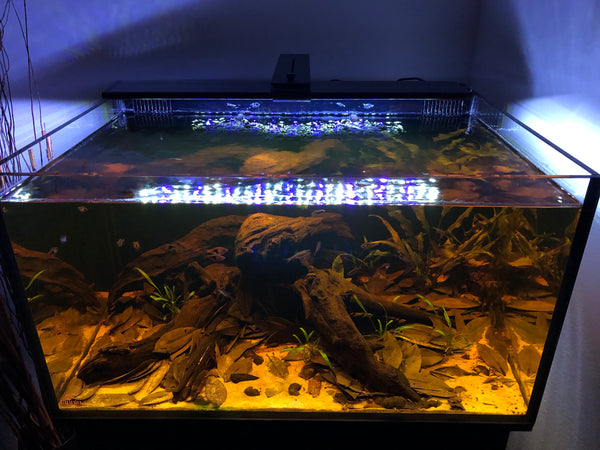
Decomposition of plant matter-leaves and botanicals- occurs in several stages.
It starts with leaching -soluble carbon compounds are liberated during this process. Another early process is physical breakup or fragmentation of the plant material into smaller pieces, which have greater surface area for colonization by microbes.
And of course, the ultimate “state” to which leaves and other botanical materials “evolve” to is our old friend…detritus.
And of course, that very word- as we’ve mentioned many times here- has frightened and motivated many hobbyists over the years into removing as much of the stuff as possible from their aquariums whenever and wherever it appears.
Siphoning detritus is a sort of “thing” that I am asked about near constantly. This makes perfect sense, of course, because our aquariums- by virtue of the materials they utilize- produce substantial amounts of this stuff.
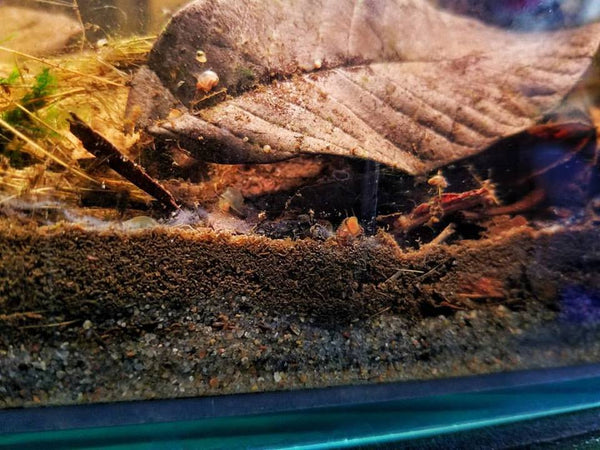
Now, the idea of “detritus” takes on different meanings in our botanical-method aquariums…Our “aquarium definition” of “detritus” is typically agreed to be dead particulate matter, including fecal material, dead organisms, mucous, etc.
And bacteria and other microorganisms will colonize this stuff and decompose/remineralize it, essentially “completing” the cycle.
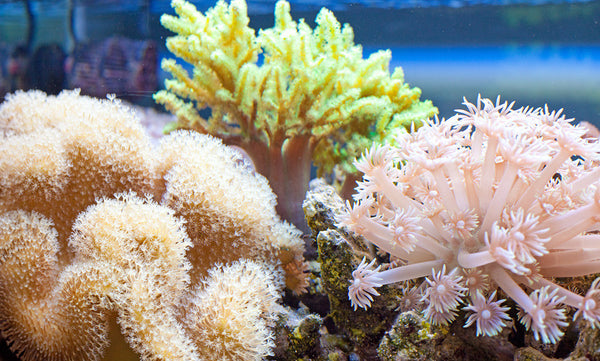
In the reef aquarium world, where I have operated for decades, you’ll see a lot of hobbyists freak out about “detritus” and such accumulating in the aquarium, and they blame filter socks, rock, and other filter media for all sorts of problems in their aquariums. I understand this concern for water quality, but I think it sort of places emphasis on the wrong part of the equation; that is, what exactly is accumulating, and why? Uneaten food? Bad! Need to be more careful here. Fish waste? Unavoidable to some extent (unless you lower population density/food inputs).
You get the idea…
I think it’s all relative, though.
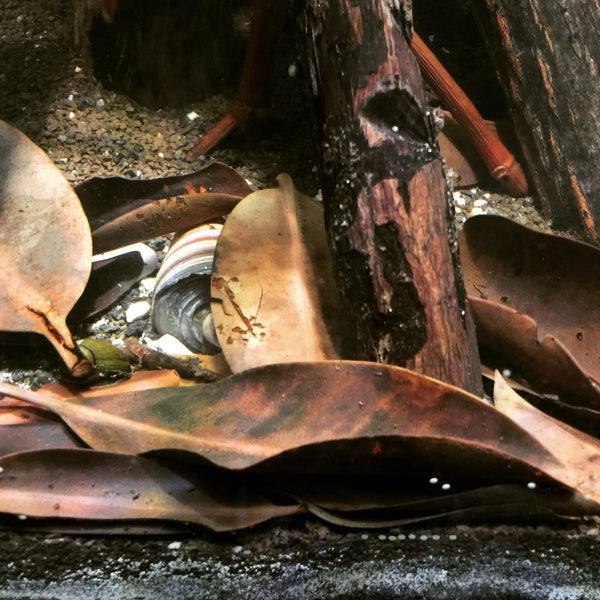
In a botanical method aquarium, we tend to see a fair amount of fine “bits and pieces” of decomposing leaves and botanicals accumulate in our tanks- on the substrate, in the leaf litter bed, and in mechanical filter media. This stuff, although somewhat unsightly to many if allowed to accumulate in the aquarium, is essentially harmless...Inert.
And, it’s just sort of “there”, if you know what I mean. And, other than potentially being visually distracting, this material is not really detrimental- I mean, you want it in your system (at least in its “original” form). It’s what imparts the tannins, humic substances, and other desirable compounds into our water.
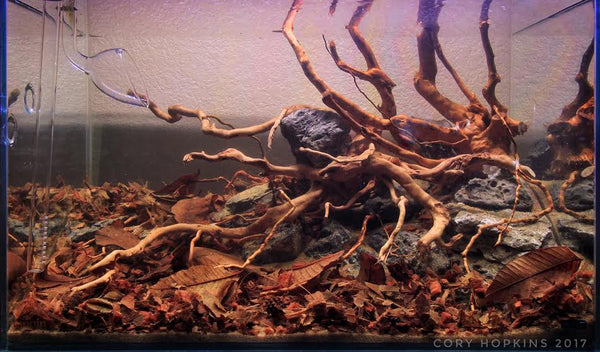
And is it really that “unsightly?”
I’m not completely convinced that it is. The look of the broken-down botanical material isn’t beloved by everyone, but it IS a natural thing, right?
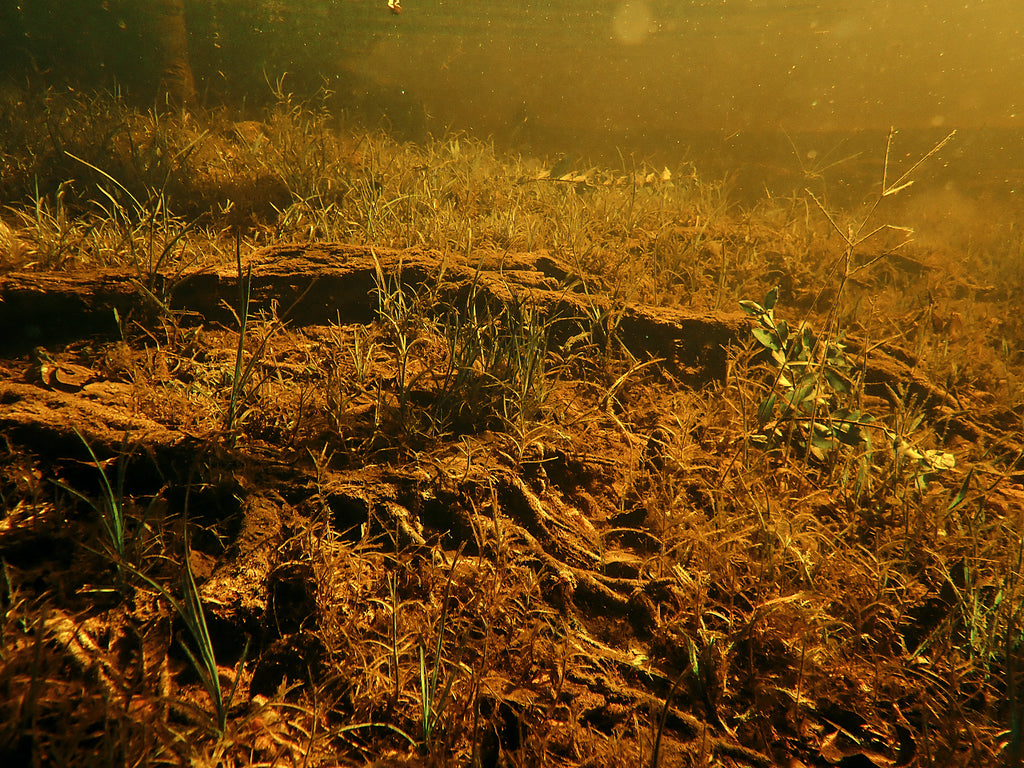
Again, if it’s uneaten food, you need to figure out a more accurate feeding approach. “Detritus” in general, in my opinion, gets a kind of a “bad rap”, as the bulk of it is really broken down already by the time it accumulates. Sure, in systems with large, predatory cichlids and messy eaters, you’re likely to see a lot more than you would in a lightly-stocked tank with say, Endler’s Livebearers, small Rasbora, or Gouramis, but still…do most of us really overfeed or under-filter THAT much?
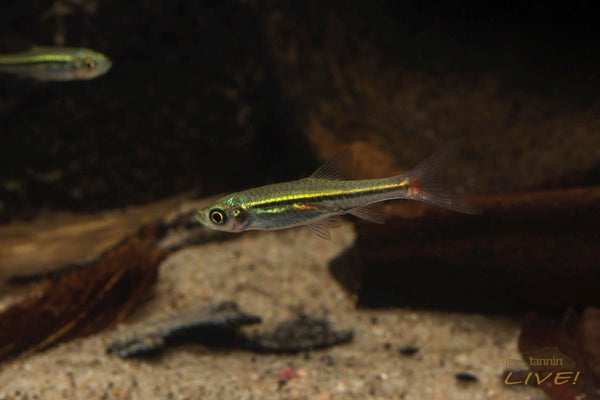
I don’t think so.
Of course, if you see uneaten food and such accumulating in your tank, it looks crappy. I think it’s important to look beyond just the aesthetics. However, do you have phosphate or nitrate issues as a result of accumulating organics from this stuff, or is some of it- enough of it- being utilized by bacteria and other “unseen residents” of your tank that it’s not really a “problem” from an environmental standpoint?
As we all know, regular water exchanges are a great way to keep this balance, as you’ve no doubt have had beaten into your head since your aquarium-keeping “infancy.” And sure, you need to test your water to get a “snapshot” of what’s happening in your tank.
The basics.
So…we’re back to the beginning, yet again.
Is “detritus”- a menace or benefit?
Or perhaps, something in between? Like biofilms, fungal growth, aufwuchs, and decomposition- is it something that is inevitable, natural- perhaps even beneficial in our aquariums? Or, is it something that we should learn to embrace and appreciate? All part of a natural process and yes- aesthetic– that we have to understand to appreciate?
It is.
My personal thoughts? Keep it clean, but don’t get overly concerned about the material breaking down in your tank. Take it out…leave it in…it’s your call.
Just get it into your head that it’s the “end product” of a natural process- one which occurs everywhere on the planet. One which fuels the proliferation of life.
Embrace the natural processes which occur in your system. We mention this over and over and over, because it’s so very important.
Understand that the process of decomposition is a fundamental, necessary function that occurs in our aquariums on a constant basis. Realize that in the botanical method aquarium, we are, on some levels, attempting to replicate the natural habitats- and botanical materials are just part of the equation.
And of course, these botanical materials not only offer enhanced aesthetics- they offer enrichment of the aquatic habitat through their release of tannins, humic acids, vitamins, etc. as they decompose- just as they do in nature.
Leaves and such are simply not permanent additions to our ‘scapes, and if we wish to enjoy them in their more “intact” forms, we will need to replace them as they start to break down.
This is not a bad thing. It just requires us to “do some stuff” if we are expecting a specific aesthetic. Notice the emphasis on aesthetic. You’re impacting the ecological function of your system when you remove leaves as they break down. Full stop.
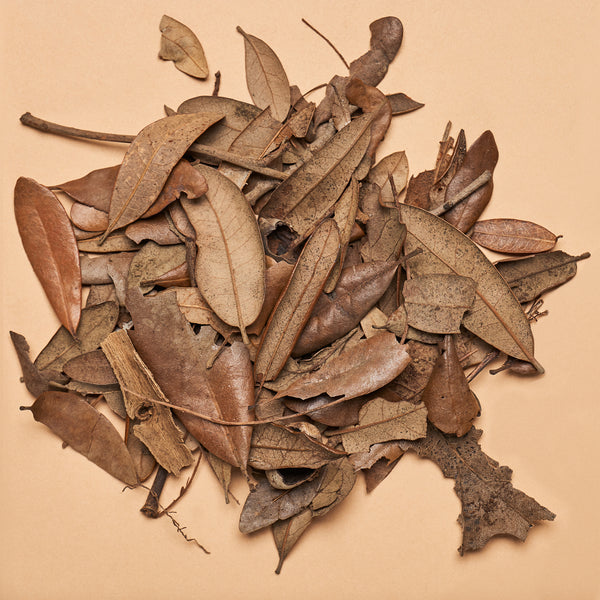
Much like flowers in a garden, leaves will have a period of time where they are in all their glory, followed by the gradual, inevitable encroachment of biological decay.
At this phase, you really should (IMHO) opt to leave them in the aquarium to enrich the environment further and offer a new aesthetic, or you can remove and replace them with fresh leaves and botanicals. Or, you can leave the decomposing ones in and add new ones. This is the best of both worlds, and is very much replicates the process which occur in nature, doesn’t it? Stuff either remains “in situ” as part of the local habitat, or is pushed downstream by wind, current, etc.
Pretty much everything we do in a botanical method aquarium has a “natural analog” to it!
Some hobbyists have commented that, as their leaves and botanicals break down the scape as initially presented changes significantly over time. Yeah, it does. Wether they know it or not, they are grasping “Wabi-Sabi”...sort of.
(Again, Fellman?” Yes. This concept is really important!)
One must appreciate the beauty at various phases to really grasp the concept and appreciate it. To find little vignettes- little moments- of fleeting beauty that need not be permanent to enjoy.
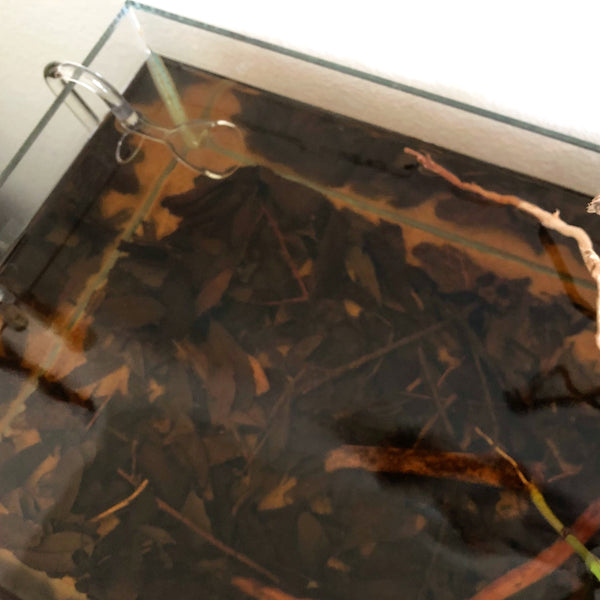
And, despite their impermanence, these materials function as diverse harbors of life, ranging from fungal and biofilm mats, to algae, to micro crustaceans and even epiphytic plants. Decomposing leaves, seed pods, and tree branches make up the substrate for a complex web of life which helps the fishes that we’re so fascinated by flourish.
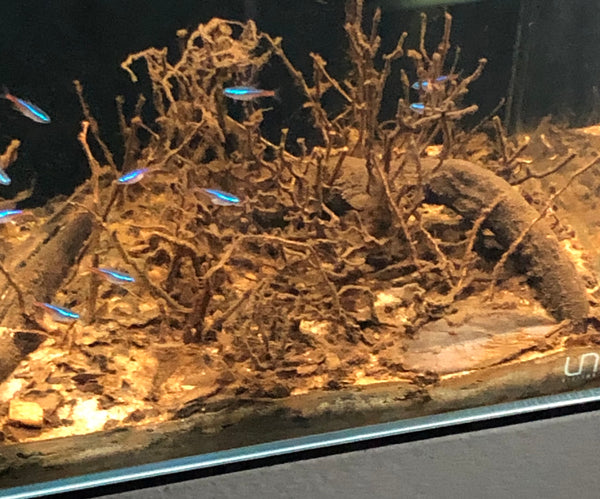
As I’ve discussed previously, I’ve maintained several botanical-based aquariums for extended periods of time without supplementary feeding. The fishes were as fat and happy as their brethren in “well fed” aquariums.
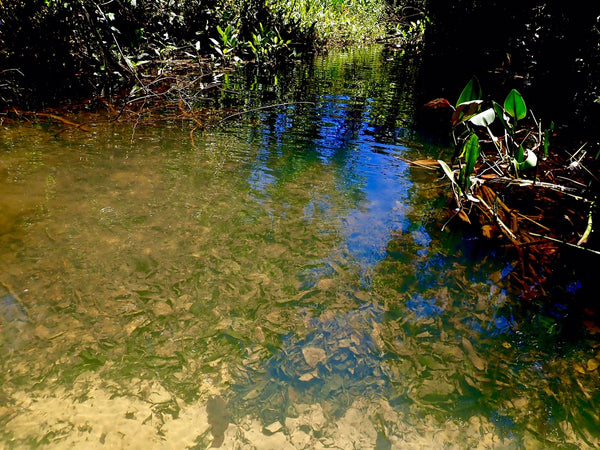
In the wild habitats of the world, it’s interesting to note that, where materials fall from the trees and surrounding dry areas, the greater the abundance of fishes and other aquatic animals which utilize them is found.
That makes sense.
And materials will continue to fall into the water and accumulate throughout the year, maintaining the richness of the habitat as others decompose or are acted on by the organisms residing in the water- from fungi to fishes!
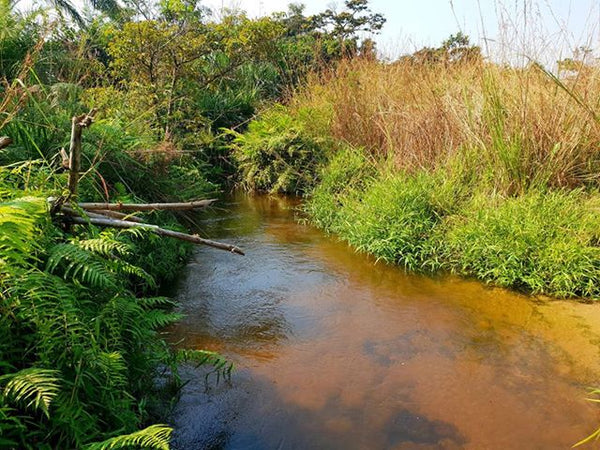
Not unlike the environment of an aquarium, where we are replacing the botanicals as they break down, right?
Yes! 😆
Again, it’s that idea about the “functional aesthetics” of the blackwater, botanical method aquariums. The idea which acknowledges the fact that the botanicals we use not only look cool, but they provide an important function (supplemental food production) as well- both for our fishes and for the organisms which support our captive ecosystems.
This is a profoundly important idea.
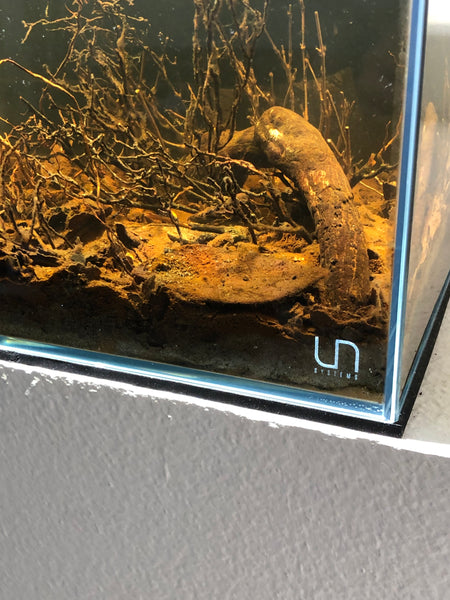
Perhaps arcane to some- but certainly not insignificant.
And of course, we’ve talked before about the “botanical nursery” concept- creating an aquarium for fish fry that has a large quantity of decomposing botanicals and leaves to foster the production of these materials, which serve as supplemental food for your fish fry. I have done this before myself and can attest to its viability. You fishes will have a constant supply of “natural” foods to supplement what you are feeding them in the early phases of their life.
Learn to make peace with your detritus! As always, look to the wild aquatic habitats of the world for an example of how this food source functions within the greater biome.
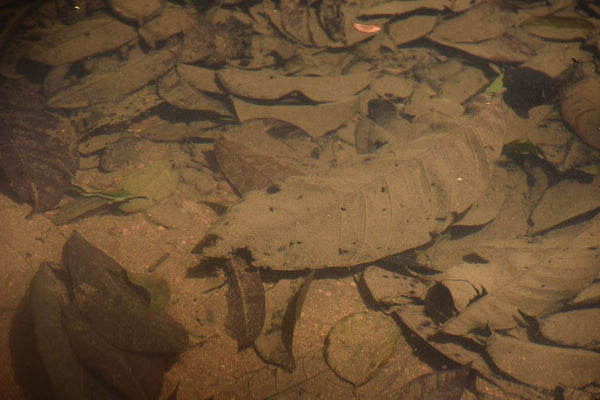
Understand that, when we create a botanical method aquarium, not only do we have the opportunity to create aquariums which differ significantly from those in years past- we have a unique window into the natural world and the role of these materials in the wild.
We’re not as freaked out by stuff like detritus and biofilms as we were previously. We’re letting go of some of our preconceived notions of what a “healthy” aquarium looks and functions like- and I think that’s a HUGE evolution in the hobby.
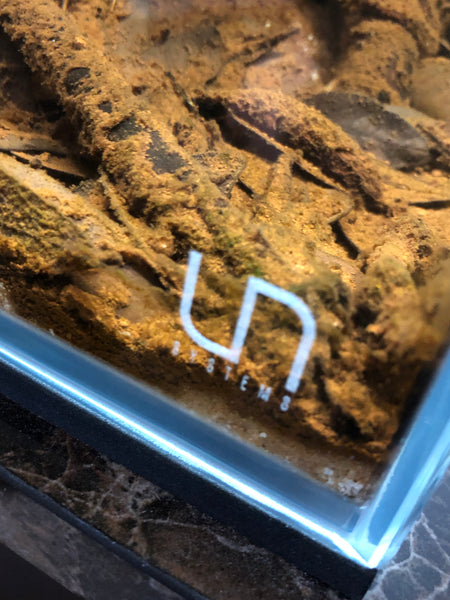
Consider that the next time you toss some more botanicals into your aquarium! You’re not just adding to the “look”- you’re contributing to the abundance within the system! A proliferation of various assemblages of life forms…And it all is driven by one of Nature’s most essential ecological processes- decomposition.
And, if you look at them objectively and carefully, these assemblages-and the processes which form them- are beautiful.
Stay fascinated. Stay curious. Stay open-minded. Stay diligent. Stay observant…
And Stay Wet.
Scott Fellman
 The Tint
Leave a comment