
With so many people coming into the botanical method aquarium world from all different sectors in the hobby, it’s a given that we receive more questions from folks about things which many of us who have been “in the game” for a while might take for granted.
Yet, it’s important NOT to take anything for granted, and to consider all the possibilities, reasons, and ideas for managing our systems.
Apart from, “What botanicals should I use for a _____________ style setup?” the most common question I personally receive is “”Do I leave them in or let them break down in my tank?”
And of course, my simple answer is…“Leave ’em in…”
Now, this is an important question. How we answer it- work with it- has fundamental implications for how we operate our botanical method aquariums.
It’s about how much of a “mental shift” we’ve made into excepting the transient nature of botanical method aquariums and the way that they function.

I tend to favor Nature. But that’s just me. She’s pretty good at stuff, I think.
I like the idea of leaving botanical materials in my aquariums until they break down completely. Long, long ago, I made that mental shift to a philosophy which says, “Hey, it’s okay to have some decomposing stuff and biofilms and…detritus…in your tank. It’s natural!”

Now, the caveat here is that I didn’t just “give myself permission” to neglect tanks or avoid basic husbandry…no, that wasn’t the point. The point is to accept that materials breaking down in our aquariums can provide “fuel” for the biological processes which create long-term stability in a closed system.
Like any other type of aquarium, a botanical method system relies on time-honored practices of maintenance, nutrient export, and attention from the aquarist. However, one thing that we have that a lot of types of systems don’t is an abundance of potential food sources for a myriad of organisms which reside in our tanks. We are very much creating a little microcosm, and it needs to respect the “checks and balances” which Nature imposes.
And of course, we can’t ever lose sight of the fact that we are creating and adding to a closed aquatic ecosystem, and that our actions in how we manage our tanks must map to our ambitions, tastes, and the “regulations” that Nature imposes upon us.
She’ll kick your ass if you don’t pay attention. Nature owes us nothing. Seriously. She’ll do what She does, regardless of our mindset.

Let’s get back to aesthetics for just a second.
Personally, I don’t mind the “look” of a tank with decomposing leaves and botanicals. Where some might see “dirty”, I see “natural.” I see the ultimate expression of ephemeral and the living embodiment of “wabi-sabi”– an acceptance of the beauty of transience. And I don’t think my tanks look that “dirty”.
As we’ve mentioned numerous times here, Nature is not exactly a neat and tidy, perfectly-ratioed place. Rather it’s often a world of chaos, randomness, detritus, biofilms, and fungal growth.

I think we have to sort of “desensitize” ourselves from the stigma of “biocover” on our wood and botanical surfaces. Now, I know, this idea undermines a century of aquarium-keeping/aquascaping dogma, which suggests that wood in the aquarium must be pristine, and without anything going on it (outside of the aquatic mosses that everyone’s been obsessed with in the last decade or so).
As hobbyists, we often fanatically remove this stuff as fast as it appears- not only denying Nature a chance to appear in Her most raw and elegant state- we’re also simultaneously removing a critical microhabitat which provides environmental stability. Oh, and food sources, as well.
And of course, that’s really sort of antithetical to what happens in Nature! Nature utilizes everything.
When terrestrial materials fall into the water, opportunistic life forms, ranging from algae to fungi to bacteria- even sponges-will colonize the available space, eking out a living as they compete for resources. In addition to helping to break down some of these terrestrial materials, the life forms that inhabit submerged tree branches, leaves, and such reproduce rapidly, providing forage for insects and aquatic crustaceans, which, in turn are preyed upon by fishes.
And of course, in the confines of the aquarium, Nature imposes a few limitations that we need to be aware of.
Everything that you add into your aquarium which begins to break down once submerged is essentially bioload. It requires us to understand that it places a “burden” on our biological filtration. That’s a fundamental consideration that we have to put in our heads. It’s not “good” or “bad”- it’s simply a consideration.

Everything that imparts proteins, organics, tannins, etc. into the water is something that you need to consider. However, it’s always been my personal experience and opinion that, in an otherwise well-maintained, ecologically mature aquarium, with regular attention paid to husbandry, stocking, and maintenance, the “burden” of botanicals in your water is surprisingly insignificant.
And these systems are remarkably stable once established.

Even in test systems where I intentionally “neglected” them by conducting very sporadic water exchanges, once I hit my preferred “population” of botanicals (by building them up gradually), I have never noticed significant phosphate or nitrate increases that created algae issues, health issues for my fishes, which could be attributed to their presence. The fact that those biological “yardsticks” for water quality are solid is pretty significant, IMHO.
As most of you who work with botanical method aquariums know, the key to long-term success with them is to go slowly, deploying massive amounts of patience, common-sense husbandry, monitoring of environmental parameters, and careful stocking management. Not really much different from what you’d need to do to successfully maintain ANY type of aquarium for the long haul.
It’s also important to consider that most of the compounds which are released as a result of the breakdown of botanical materials, if left in your system, are utilized by animals and plants.

Allowing plants, fishes, shrimp, and bacteria the chance to utilize the decomposing botanicals in their life cycle is an important part of the game, IMHO. Being overly fastidious about siphoning out every speck of dirt or botanical material as it breaks down is “overkill”, in my opinion, and can be just as detrimental as over-doing things.
I can envision systems created to optimize the breakdown and accumulation of botanicals, with targeted water-column flow, use of more coarse (or fine) mechanical filtration media, moderated lighting to discourage excessive algal growth, and even careful selection of hardscape materials, such as Mangrove root tangles, Manzanita wood, etc. to encourage these materials to settle in and among them, as occurs in Nature.

Letting our minds wander a bit, and accepting and encouraging this stuff, rather than freaking the fuck out every time we see a gram of detritus in our tanks will go a long way towards fostering new discoveries, “best practices”, and maybe even breakthroughs!
And when you really think about it and brush off the initial “shock value” of their appearance, the fact is that accumulations of broken-down botanical materials and detritus are a hugely important part of the aquatic ecosystem, providing “fuel” for microorganisms and fungi at the base of the food chain in aquatic environments.
In fact, in natural blackwater systems, the food inputs into the water are channeled by decomposers, like fungi, which act upon leaves and other organic materials in the water to break them down.
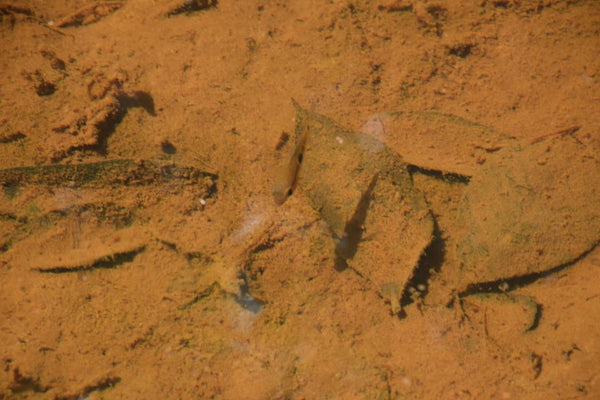
And the leaf litter “community” of fishes, insects, fungi, and microorganisms is really important to these systems, as it assimilates terrestrial material into the blackwater aquatic system, and acts to reduce the loss of nutrients to the forest which would inevitably occur if all the material which fell into the streams was simply washed away downstream!

That sounds all well and good and well, grandiose, but what are the implications of these processes- and the resultant detritus– for the closed aquarium system?
Well, in years past, aquarists who favored “sterile-looking” aquaria would have been horrified to see this stuff accumulating on the bottom, or among the hardscape. Upon discovering it in our tanks, it would have taken nanoseconds to lunge for the siphon hose to get this stuff out ASAP!
In our world, the reality is that we embrace this stuff for what it is: A rich, diverse, and beneficial part of our microcosm. It provides foraging, “Aquatic plant “mulch”, supplemental food production, a place for fry to shelter, and is a vital, fascinating part of the natural environment.
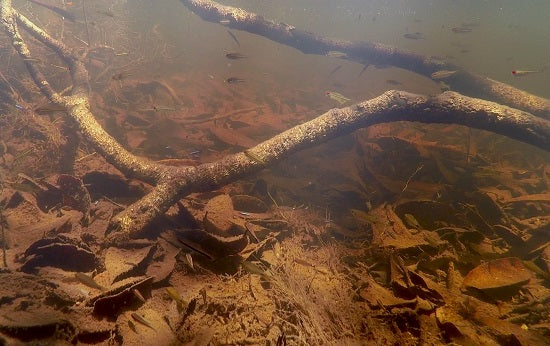
It is certainly a new way of thinking when we espouse not only accepting the presence of this stuff in our aquaria, but actually encouraging it and rejoicing in its presence!
Why?
Well, not because we are thinking, “Hey, this is an excuse for maintaining a dirty-looking aquarium!”
No.
We rejoice because our little closed microcosms are mimicking exactly what happens in the natural environments that we strive so hard to replicate. Granted, in a closed system, you must pay greater attention to water quality, but accepting decomposing leaves and botanicals as a dynamic part of a living closed system is embracing the very processes that we have tried to nurture for many years.

And it all starts with the ‘fuel” for this process- leaves and botanicals. As they break down, they help enrich the aquatic habitat in which they reside. I say it over and over and over agin, because this is a process that has played out in Nature for eons.
Nature strikes a balance. Nature thrives on efficiency. When you’re adding botanicals to a tank, you’re not just doing “aquascaping”- you’re laying down the groundwork for the “biological operating system” – the ecology– of your aquarium. As such, you need to think “big picture” here. (That “functional aesthetics” thing again!)
And while we’re talking about adding botanicals, from time to time, I need to revisit the “doomsday scenarios” that could possibly occur. Now, it’s important to note that the very few “disasters” I’ve been told about with botanical method aquariums over the years typically happened under a few situations or combinations of them:
1) The aquarist did not prepare anything as instructed by the vendor, potentially introducing chemical or other environmental contaminants
2) A significant amount of botanicals relative to water volume was added all at once to a long-established, ecologically stable aquarium
3) A significant amount of botanicals was added to an established tank in a very short period of time (like within a few days)
Now, again, there are always anomalies, but these 3 situations are almost “set ups” for some types of issues. Typically, what happens is you’d see fishes gasping at the surface for oxygen, which becomes rapidly depleted by the enormous bacterial population which emerges as a result of the addition of a large influx of materials. This can quickly overwhelm the biological filtration capacity of a tank.
Usually, the “rescue” consists of increased vigorous aeration and a succession of water changes, removing the botanicals, use of activated carbon, etc…the typical “emergency fixes” for problems of this nature. Or simply accepting what happened and letting it play out naturally. An “uglier” approach, but one that always works.
The best preventative is to go slowly. To consider impacts of everything that we do.
The reality is, adding botanicals to your tank and using them, replacing them regularly, etc, is no more “dangerous” than anything else we do as aquarists. You simply need to go slowly, apply common sense, and observe your tank carefully.

Is that a guarantee of success?
Of course not.
Could you have some weird combination of events, local water composition, overly sensitive fishes, etc. which could give you a disastrous outcome?
Of course.
Look, “stuff “can still occasionally go wrong, even when you follow instructions and employ common sense. Aquariums are closed natural ecosystems, and changing the delicate balance within them always risks disrupting established biological processes. Just like using additives, CO2, or other regimens in our tanks, when we “invade” the actual processes, stuff that we don’t anticipate can happen.
It’s the reality of Nature, and a reminder that, although we can control some things, Mother Nature calls the shots…We are treading on Her turf, and we have to understand that there are no guarantees for success “just because.”
Nature owes us nothing.
It’s not a bad thing. It’s just…reality.
Now, all that doom and gloom and “reality checking” being said, Nature PROVIDES us with something. For free.
Huh?
Consider…detritus.
Yeah, detritus.
Yeah, I know, I just talked about this stuff the other day…
But it’s so important.
Produced by the “processed” and decomposing plant matter, detritus, is considered by many aquatic ecologists to be an extremely significant food source for many fishes, especially in areas such as Amazonia and Southeast Asia, where the detritus is considered an essential factor in the food webs of these habitats.

And of course, if you observe the behavior of many of your fishes in the aquarium, such as characins, cyprinids, Loricarids, and others, you’ll see that in between feedings, they’ll spend an awful lot of time picking at “stuff” on the bottom of the tank. In a botanical method aquarium, this is a pretty common occurrence, and I believe an important benefit of this type of system.
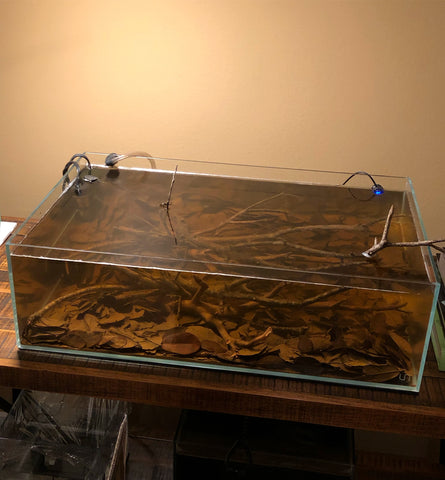
Botanical method aquariums, complete with their compliment of decomposing leaves and seed pods, can serve as a sort of “buffet” for many fishes- even those who’s primary food sources are known to be things like insects and worms and such. Detritus and the organisms within it can provide an excellent supplemental food source for our fishes!
The dynamic of input and utilization of materials from the surrounding forest habitats is fascinating and profound for those of us who wish to mimic these habitats in our aquariums… And we can, to a certain extent, by utilizing botanicals as part of our aquarium’s “operating system.”
Nature offers us abundance, challenges, guidelines, and hard and fast “rules.” How we choose to work with them is our choice, our decision, and our privilege. We, at the very least, owe Her the opportunity to demonstrate this in our tanks…
Yet it’s always important to remember that Nature owes us nothing.
Stay curious. Stay inspired. Stay bold. Stay diligent. Stay undaunted…
And Stay Wet.
Scott Fellman
 The Tint
Leave a comment