
I’m a big fan of the group of fishes collectively called “knife fishes”- those ones with the muted colors, strange body shapes, and equally odd behaviors.
These are epic fishes, with all sorts of fascinating ones. Now, the “rap” on most of the Knives is that they get really large, are nocturnal, cryptic, predatory, etc…
And I admit that.
Some simply get too large and hide like mad during pretty much any time of day you’re likely to be in front of your aquarium. I don’t know about you, but paying good money for a fish whom you might see the tail of, maybe three times a year- all the while, pandering to its specialized dietary requirements- can get old after a while, right?
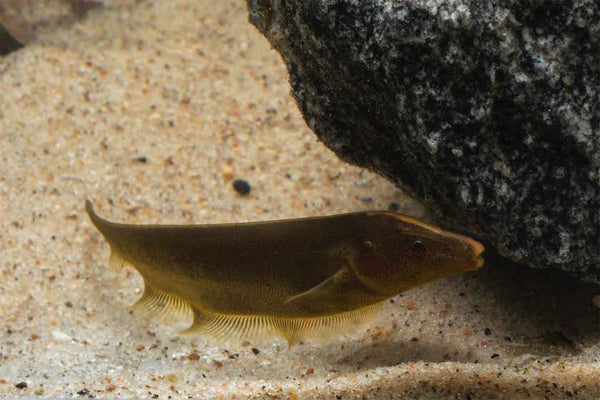
However, they’re my weakness…if there were ever a bunch of fishes I’d break my “no large fish” rule for (yeah, I f-cking HATE keeping large fishes), it’d be these guys. However, there are smaller ones…Yeah, you heard me. Ones that reach reasonable sizes; some of which don’t even spend every second of their existence hiding…
Sure, I know my fave, the Black Ghost (Apteronotus albifrons) will often become rather tame, and come out all hours. But they do get kind of large…I give them a pass for their cool factor.
A lot more on that guy in a second…
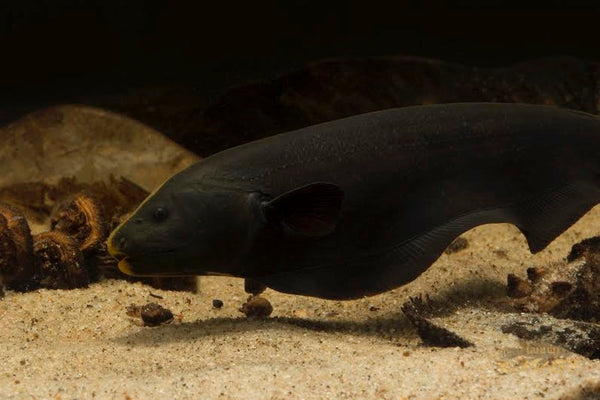
Knifefishes all have long, slender bodies, often with a downwards-pointed or tube-like snout used for foraging on riverbeds.Most are found in the Amazon and Orinoco River basins. They are generally dark brown, gray, or sometimes pale in color, with some species displaying sexual dimorphism where males develop elongated jaws or teeth.
Most are aggressive predators of small aquatic insect larvae and fishes. Apteronotid populations are most diverse in the Amazonian floodplain, where many species have become “specialized” to inhabit deep portions of the river channels.
Some main channel apteronotids are aggressive piscivores, whereas others are planktivores. Still other species have tubular snouts and forage on the beds of aquatic insect larvae on the rivers bottoms. Curiously, at least one species (Sternarchogiton nattereri) is known to eat freshwater sponges which grow on submerged trees, stumps, and other woody debris. (How could I not love THAT?)
And there actually ARE others out there that fit my bizarre size “requirements…”
Like the Hypomidae, aka “Grass Knifefishes”- with 30 some-odd species in the Amazon region, only a few of which have found their way into the aquarium trade/hobby…The neatest thing about these fishes is that they are generally considerably smaller than the big guys- the Clown Knife Fish, Banded Knife Fish, etc…
Many come from small rainforest streams, rivulets, even flooded forest areas and other habitats that we’re kind of into around here…so, yeah! They tend to spend most of their daylight hours hiding in leaf litter (we can offer ’em that, huh?) and come out at night to go after the lights go out…And they like to eat insect larvae and small crustaceans, so providing the right kinds of foods isn’t that hard.
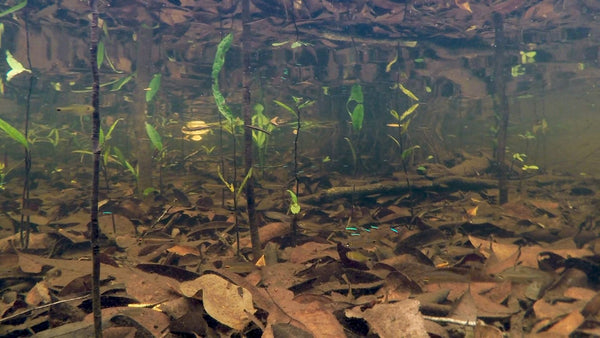
The tricky part is obtaining the fishes to begin with…acclimating them, getting them to overcome their natural shyness- and feeding them at the right time of day (or night, typically)! I’d imagine that creating an aquarium for these fishes would be challenge free…it’s the ability to enjoy them (ie; see them) when we want that could be problematic!
Nonetheless, the possibilities are tantalizing, huh?
My “dream species?” A fish called Microsternarchus bilineatus. It reacts a length no larger than 4.75 inches/12cm…Can you imagine? A dwarf fricking knife fish!
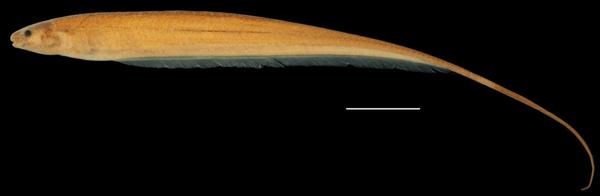
(Image by John P. Sullivan)
Yeh, I admit, I’ve NEVER seen this species in the hobby…likely never will. Neither will you. However, it’s that chance of stumbling upon one that was collected as “by-catch” or whatever, which keeps busy fish geeks like me excited and “on the hunt” for years.
Those unusual aquatic habitats in Amazonia are filled with places for these unique fishes to live…and they’re just waiting to be rediscovered and caught…
Now, if your like me, even amongst your fave group of fishes, you’ve got that “one fish” that never leaves your mind. The one that captured your heart at some point in your hobby career, and simply never got out of your system.
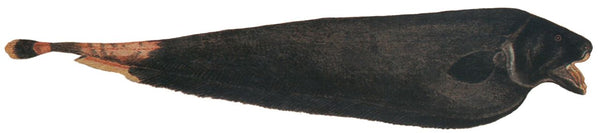
As I hinted on above, mine is the “Black Ghost Knifefish”, Apteronotus albifrons. I’m not sure what it was that first attracted to me to this fish. The odd name, the amazing “look”, or, after I had seen them in real life- their interesting behavior and yes- personalities!
The scientific name tells a lot:
Apteronotus albifrons (Linnaeus 1766) albi-, from albus (L.), white; frons (L.), face or brow, referring to whitish band extending from tip of snout to occiput…
While the formal scientific discovery dates back to the 18th century, the rise in popularity within the aquarium hobby was significantly documented in magazines like TFH and FAMA. These magazines -and some books -helped popularize the species by detailing its unique biology, lore, and care requirements.
I remember seeing a pic in the classic bio, “Exotic Tropical Fishes” that had a “head shot” of the fish, and it had this oddly comical, yet altogether weird look- you know, all black…even the eyes…and it’s mouth gave it a sort of friendly look. And of course, the references to the endemic people of the region believing that the souls of their departed ancestors resided in the fish and I couldn’t let this one go.
And since I have’t kept one in a while, and am contemplating on doing it again soon, I thought that I’d take a quick look on what the fish REALLY needs and how best to keep it based on my accumulated experience and research. There must be a FEW things we had wrong about the fish, huh?
The only “down side” I ever though about with this fish is that it has the potential to hit up to 18″ (45cm) or more in length, necessitating a large aquarium if you’re wanting to accommodate the fish for anything approaching a natural life span (decades!). Like a 4-6 foot long tank minimum is appropriate.
Now, this little piece is not going to be the usual “Keeping the _______ in the Aquarium” stuff. I simply can’t write a good, solid article like that without all of the weird inferences and such that I like to make. Rather, let’s quickly examine my beloved fish on the basis of what we know about it from science that can help us keep it happy in our aquariums!
As we all probably know by now, Black Ghosts are known to be weekly electric fishes, using their capabilities for navigation, location and identification of potential prey. It has a specialized organ in its tail containing a small group of cells that can discharge electricity at frequencies approaching 2000 times per second, the fastest in the animal kingdom! And interestingly, the tail of the Black Ghost- including the spinal cord, regenerates following amputation.
Weird.
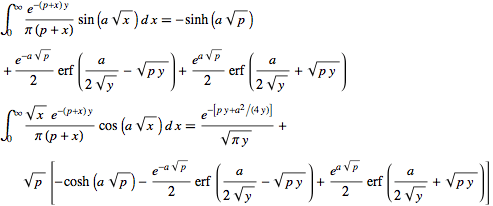
The electric production of this fish has been extensively studied by scientists. Like, really extensively…As a fish geek searching for information on the ecology of the fish, I was met with dozens of “way-over-my-head” style scientific papers on the fish’s electrolocation capabilities.
You know, the kinds of articles filled with exotic graphs and formulas, and nothing that tells you what kinds of water conditions the fish comes from? Yeah. That kind. Had to really dig for that stuff. Don’t academic ichthyologists ever study the environments where the fishes come from? Well, at least the fish is quite highly regarded by science…And, interestingly, these fishes are commonly used in studies about neuromuscular diseases and other human-related neurological anomalies.
Although they are nocturnal predators, they’re hardly what we’d call “aggressive” fish; instead, being rather shy and retiring! In fact, descriptors such as “peaceful” and “friendly” have been used over the years to (accurately, IMHO) describe the fish’s temperament! This is, I think, a bit contrary to what most of us would immediately assume about such a fish, right? The popular perception for a fish like this is usually: “It’s big, it’s menacing- it’s a Tetra killer and hell-raiser for sure!”
Even the swimming behavior of this fish is a bit cool. And well-studied, of course…The Black Ghost lacks dorsal and pelvic fins, instead using a long, undulating anal fin to glide forwards and backwards with ease.
From a paper by M.J. and S.J. Lannoo, 1993 entitled, “Why do electric fishes swim backwards? An hypothesis based on gymnotiform foraging behavior interpreted through sensory constraints.” you find this gem: “The fish swims backwards (reverse swimming) which is characteristic of two foraging behaviors: searching for prey and assessing it. In assessing a potential prey item, it typically scan the prey from tail to head by swimming backwards, then ingest it after a short forward lunge. A scan in the opposite direction – from head to tail by forward swimming – would have the prey located near the tail and out of position for the final lunge.”
Yeah, that about covers it.
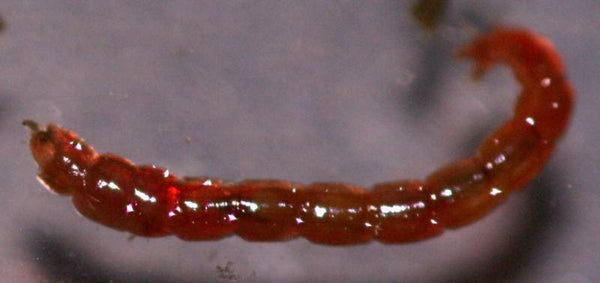
Gut content analysis of a number of wild collected specimens from Paraguay and Peru indicated that the bulk of it’s diet consisted of worms (annelids) and insect larvae, so yeah, that explains why they seem to love “black worms” and “blood worms” in the aquarium. Can they prey on small fishes? Sure- they have a pretty good sized mouth and a sophisticated electromagnetic navigation system, so yeah, they can locate potential prey items easily at night when they hunt…
However, in no instance in any of the papers which I reviewed on wild-collected specimens of this fish did gut-content analysis of both juvenile and adult specimens reveal anything other than worms and insect larvae! Would I trust them with my “Green Neon Tetra” shoal in my aquarium? Umm, not likely, but I think they’d have a more difficult time with the more laterally compressed, vertically oriented characins, like Hyphessobrycon species and such! And, in general, if you keep them stuffed with worms, the likelihood of “Phee-Phee”, your beloved Pencilfish, disappearing one night goes down dramatically, in my experience!
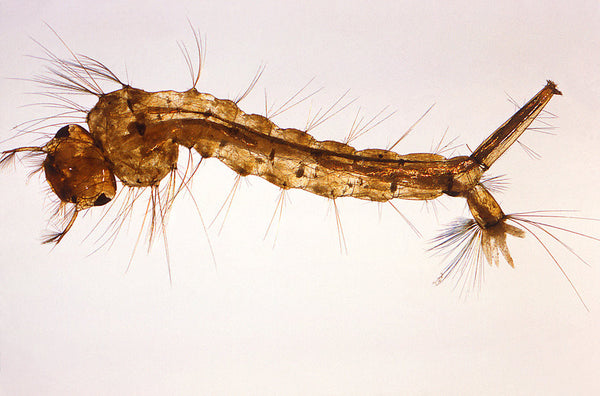
Can you keep a group of them together?
I honestly don’t know. The common hobby “wisdom” say that you can’t, because they will fight constantly and beat the crap out of each other. I suppose it’s true; these fishes use electrolocation to hunt and examine their environment, so it wouldn’t surprise me if they simply annoyed the shit out of each other with the constant “radio chatter.” On the other hand, are they actually “territorial?”
I mean, you do see multiple specimens together in the fish store, or in wholesale facilities right? (as if THAT is the gold standard for living arrangements, lol)…However, I guess that, in a large enough tank, it’s possible...but I just don’t know. I’ve always kept a single specimen of this fish.
Who’s up for this experiment?
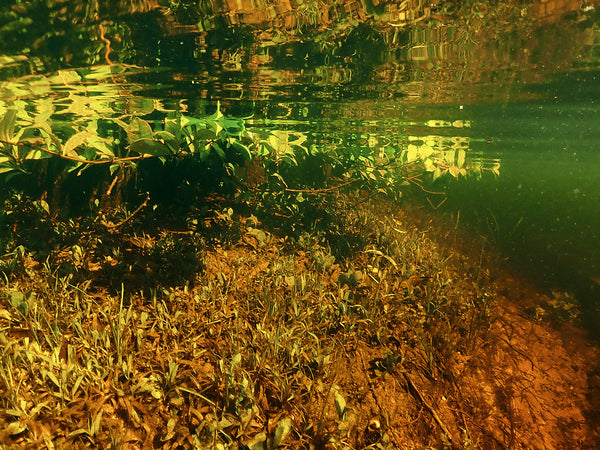
Now, because they come from Amazonia, the first thing that comes into mind is sluggish, acidic blackwater streams (’cause, like, that’s everything in The Amazon region, right? NO SCOTT!) The reality is that most specimens are found in the wild in rapidly flowing waters of streams with a sandy bottom. And as we know from many of our past pieces on the substrates in this region, a lot of those sands are chemically neutral. However, much to my happiness, usually, lots of botanical debris and wood are found in these habitats!
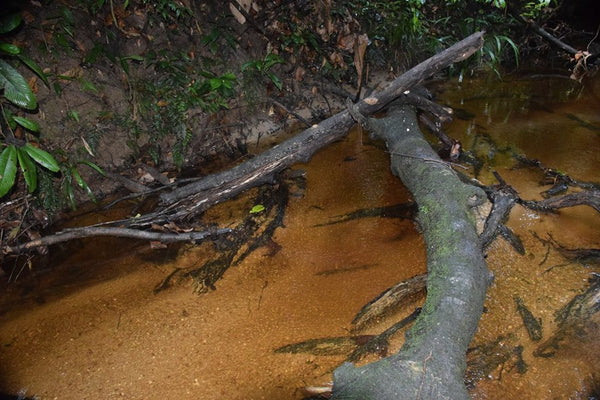
So, if one were to recreate the habitats where these fishes are commonly found, it would be an aquarium environment with good water movement, a pH range from 6.0-8.0 (hello, that’s all over the freakin’ map, right?), and water temps typically around 77-82 degrees Fahrenheit (25-27 C).
The tank would be at least 4-6 feet long, with nice white sand and a bunch of branchy wood, lots of leaves, and maybe some vertically oriented plant growth (like Amazon Swords or something equally as generic). But I’m not really into aquatic plants, so I’m thinking it would mainly be a hardscape without plants…
Since blackwater is definitely a part of the fish’s natural habitat, I’d be inclined to let it tint a bit, with some large leaves and other botanicals. And, of course, good water movement, probably provided by directed returns or external pumps like EcoTech Marine VorTech powerheads or Aqua Illumination Neros. I think configuration that I’d employ would look a lot like the one I built not too long ago for my Tetra collection.
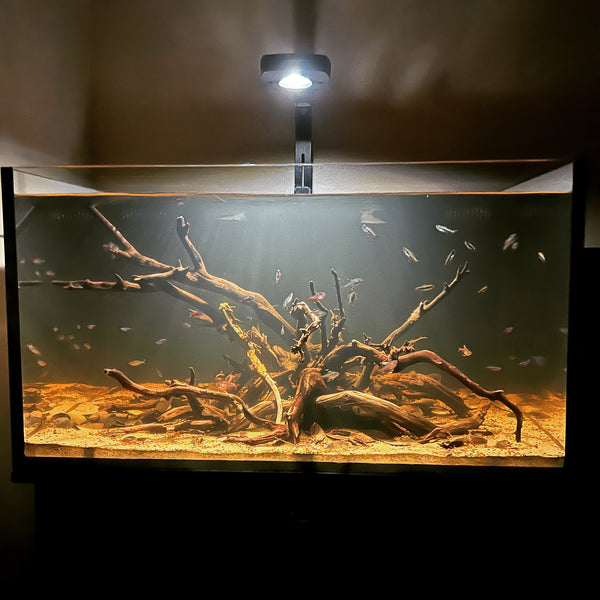
Tank mates would be larger characins, like Headstanders, and maybe a big shoal of fishes like Emperor Tetras or other laterally compressed, “non-bite-sized” Tetras. Oh, and maybe a few smaller cichlids. Simple, easy, and “semi-cliched.” But hey, the star of the show, the Black Ghost, is what this is all about, right?
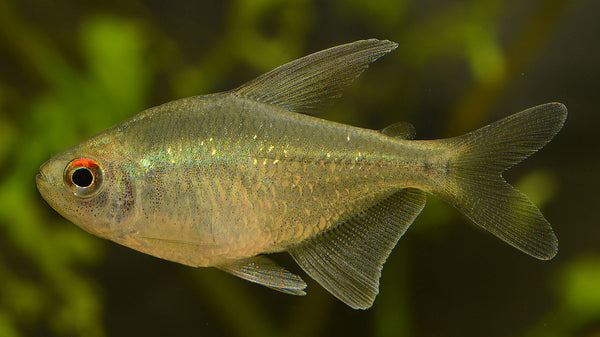
And I’d feed a ton of blackworms and bloodworms. I’d have fat fishes in there.
Yeah, that’s all Ive got this morning. Nothing earth-shattering. Just thinking of the Black Ghost Knifefish.
Again.
So the takeaway here? Is there one? There is a lot of good information out there if you dig for it, and you don’t need to accept what everyone says about a fish as the absolute last word on it.
Oh, and the fact that we gave it sort of “generic” aquarium conditions all of these years, and that those were surprisingly appropriate conditions for the fish based on its natural habitats does not make me bitter at all….Although I think it was just luck, lol.
Yeah. Right.
Stay engaged. Stay relentless. Stay excited.
And Stay Wet.
Scott Fellman
 The Tint
Leave a comment