
It’s fun to experience new things, right? Or, even old things in a new situation! Like, shortly after you start up a new botanical method aquarium, you’re already feeling it…You’re past that initial “What will this look like?” phase, the “Ohh…got the wood arranged just like I wanted!” phase, and now you’re in the “Time to add a few details” phase and to turn the aquarium over to Mother Nature to take it from here.
And that’s exactly the part of the aquarium journey that excites me the most: when I’m in the final few days of “tweaking” a new botanical method aquarium.
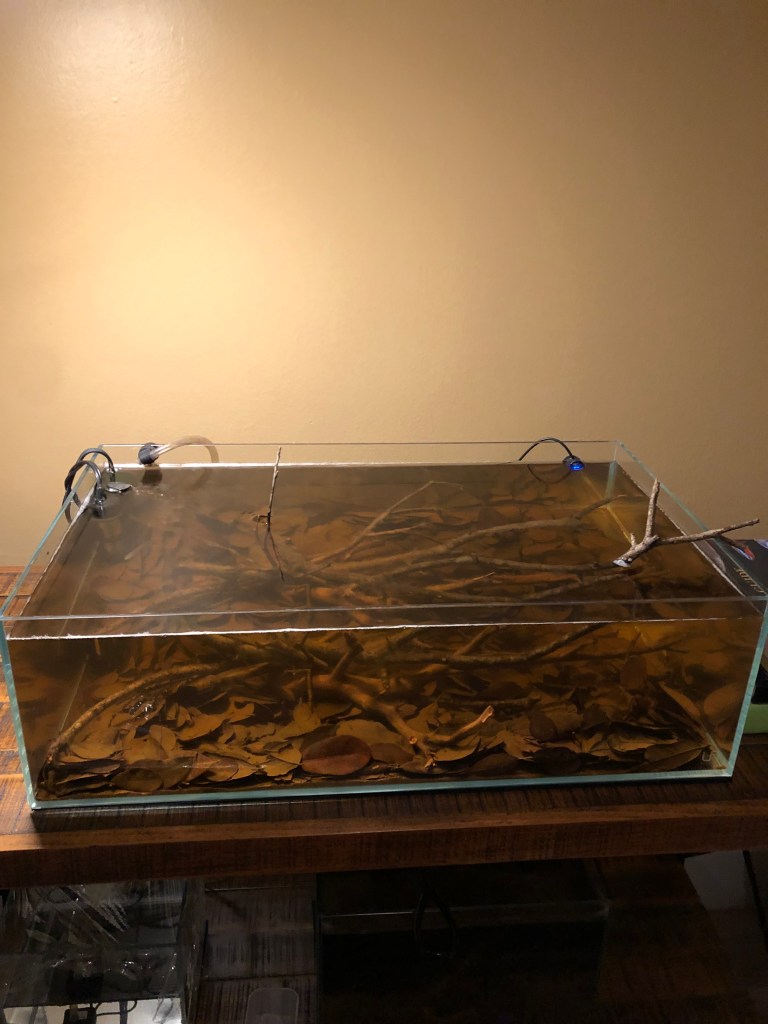
It’s a special time when the botanical materials you’ve added begin the process of decomposing and imparting their chemical components to the water. As they break down, these materials not only add a sort of “softness” to the whole display—they serve to tint the water, create a foraging area for fishes, and just start to blend the various elements together as things progress.
The first fungal growths and biofilms start emerging on the surface of the wood, and the water takes on a very nice, rich brownish tone. The fish seem more relaxed.
Okay, you don’t need a blow-by-blow description of a botanical method aquarium breaking in; however, a lot of you who are new to the process of botanical-method aquariums are probably curious about what happens when a new system starts to evolve.
CYCLING. BIOFILMS. FUNGAL GROWTHS…STARTUP.
Yikes, I forgot about that stuff…
Yeah.
Seems like I’ve had tanks just kind of “set up” for so long, particularly in our tinted-water-and-decomposing-leaf world, that I’ve kind of forgotten about the stuff that happens in brightly-lit tanks for it a bit. That part when all of your good work looks like…well, you get it– as it’s covered with that familiar “patina” of biofilms, while the tank goes through its nutrient cycling phase.
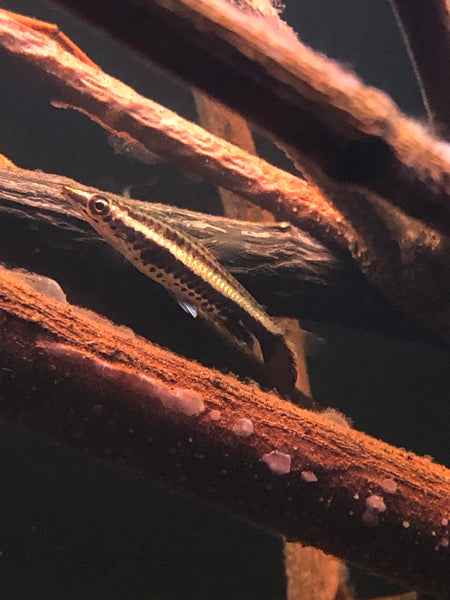
The part where every hobbyist, experienced or otherwise, has those lingering doubts; asks questions- goes through the “mental gymnastics” to try to cope: “Do I have enough flow?” “Was my source water quality any good?” “Is it my light?” “When does this shit go away?” “It DOES go away. I know it’s just a phase.” Right? “Yeah, it goes away?” “When?” “It WILL go away. Right?”
I mean, it’s common with every new tank, really.
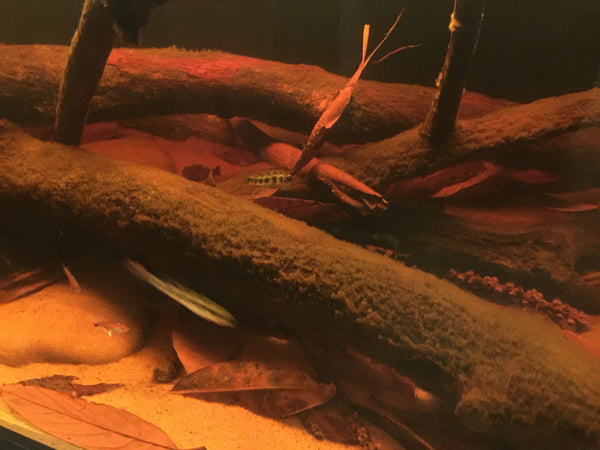
The waiting.
The “not being able to visualize a “completed tank thing”…Patience-testing stuff. Stuff which I- “Mr. Tinted-water-biofilms-and-decomposing-leaves-and-botanicals-guy”- am pretty much hardened to by now, as are most of you.
Accepting a totally different look. Not worrying about “phases” or the ephemeral nature of some things in my aquarium.
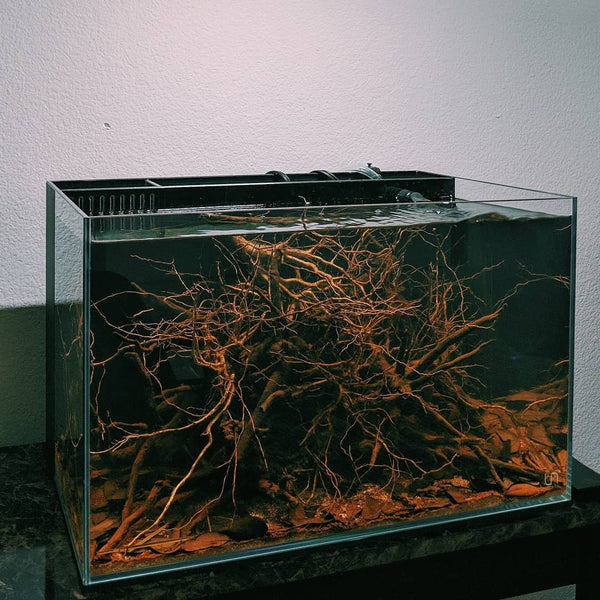
Yet, like anyone who sets up an aquarium, I admit that I still occasionally get those little doubts in the dim (tinted?) recesses of my mind now and then- the product of decades of doing fish stuff, yet wondering if THIS is the one time when things WON’T work out as expected…
I mean, it’s one of those rites of passage that we all go through when we set up aquariums, right? The early doubts. The questioning of ourselves. The reviewing of fundamental procedure and practice. Maybe the need to reach out to the community to gain reassurance.
It’s normal. It’s often inevitable. We’re social creatures.
The point of this piece is not about algae or nitrites, or biofilms on botanicals, per se. It’s about the mind setthat we bring to the table when we experience such things. The “biofilm” phases brings out familiar feelings…Feelings that perhaps make us uncomfortable because we realize that, despite all of our planning and knowledge and forethought- we are not entirely in control.
Nature is.
She calls the shots. These “phases” in new tanks are hers to execute. We just have to accept, understand, and wait them out patiently—perhaps even learning to appreciate and understand them to the point where they simply become “rungs on a ladder”—trail markers, if you will—on the journey to our aquarium’s ultimate destination.
We hand off the aquarium to Her…
And She runs with it!
She’s done it for eons in the wild, creating beautiful, functional habitats that inspire us beyond anything we could ever hope to achieve. We need to relax and have a little faith that she’ll do similar deeds in our little glass boxes- if we allow her to.
So, what exactly happens in the early days of a botanical-method aquarium?
Well, for one thing, the water will gradually start to tint up…
Now, I admit that this is perhaps one of the most variable and unpredictable aesthetic aspects of these types of aquariums. Many factors, ranging from what kind (and how much) chemical filtration media you use, what types (and how much again!) of botanical materials you’re using, and others, impact this. Recently, I’ve heard a lot of pretty good observation-based information from experienced plant enthusiasts that some plants take up tannins as they grow. Interesting, huh?
Stuff changes. The botanicals themselves begin to physically break down,
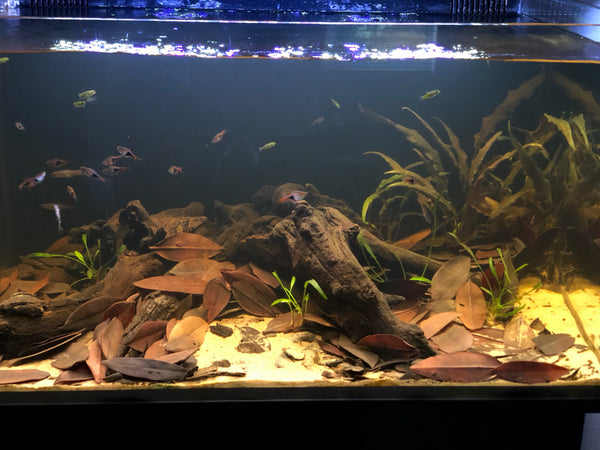
I personally feel that botanical method aquariums always look better after a few weeks, or even months of operation. When they’re new, and the leaves and botanicals are crisp, intact, and fresh-looking, it may have a nice “artistic” appearance- but not necessarily “natural” in the sense that it doesn’t look established and alive.
The real magic takes place weeks later.
The whole environment of a more established botanical method aquarium looks substantially different after a few weeks. While the water gradually darkens, those biofilms appear…it just looks more “earthy”, mysterious, and alive.
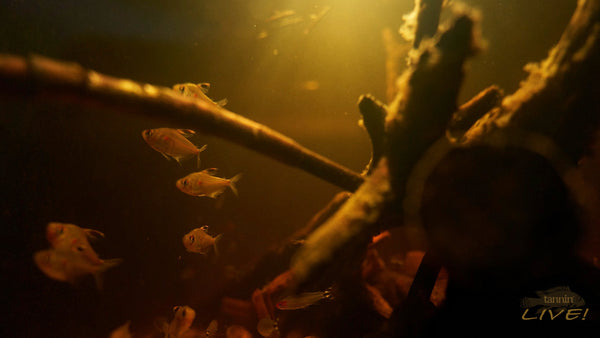
It’s “Wabi-Sabi” again.
Something that’s been on my mind a lot lately.
In its most simplistic and literal form, the Japanese philosophy of “Wabi Sabi” is an acceptance and contemplation of imperfection, constant flux, and impermanence of all things.
This is a very interesting philosophy, one that has been embraced in aquascaping circles by none other than the late, great Takashi Amano, who preferred that a planted aquarium is in constant flux, and that one needs to contemplate, embrace, and enjoy the sweet sadness of the transience of life.
Many of Amano’s greatest works embraced this philosophy and evolved over time as various plants would alternately thrive, spread, and decline, re-working and reconfiguring the aquascape with minimal human intervention. Each phase of the aquascape’s existence brought new beauty and joy to those who would observe them.
Yet, in today’s contest-scape driven, break-down-the-tank-after-the-show world, this philosophy of appreciating change by Nature over time seems to have been tossed aside as we move on to the next ‘scape.
Sure, this may fit our lifestyle and interest, but it denies Nature her chance to shine, IMHO. There is something amazing about this process which we should enjoy at every stage.
We’ve forgotten about celebrating the process. The journey.
Remember, how your aquairum looks on day one is far different than it will appear on day 7, 15, or 167, for that matter…
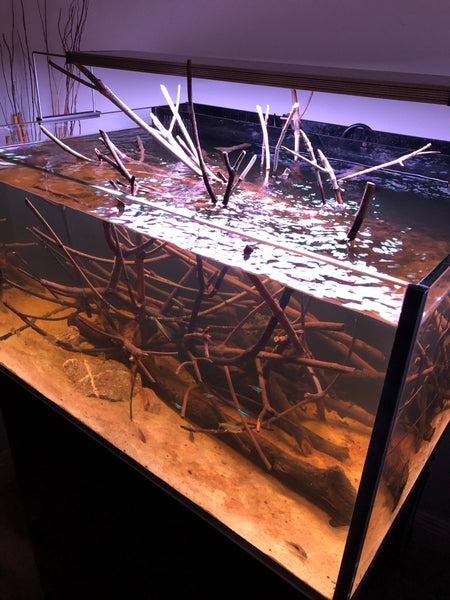
In a very real sense, the establishment of a new botanical method aquarium is a time of discovery- and a realization that not all natural things are permanent. They change, degrade, and transform.
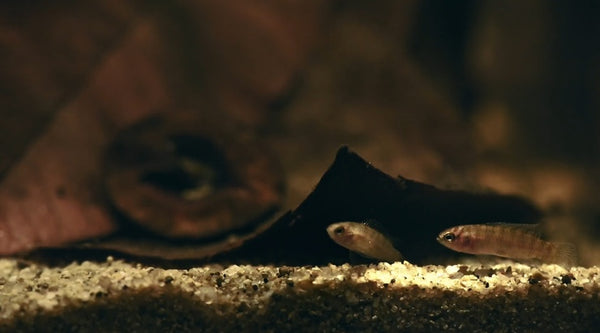
With this realization, remember that leaves and botanical materials are simply not permanent additions to our ‘scapes, and if we wish to enjoy them in their more “intact” forms, we will need to replace them as they start to break down.
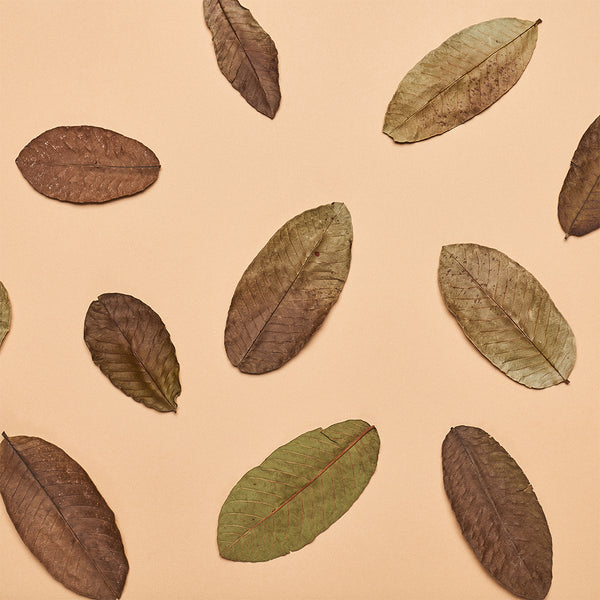
Much like flowers in a garden, leaves will have a period of time where they are in all their glory, followed by the gradual, inevitable encroachment of biological decomposition. At this phase, you may opt to leave them in the aquarium to enrich the environment further and offer a new aesthetic, or you can remove and replace them with fresh leaves and botanicals.
This very much replicates the process that occurs in nature, when materials from the surrounding terrestrial habitat fall into the waters, doesn’t it?
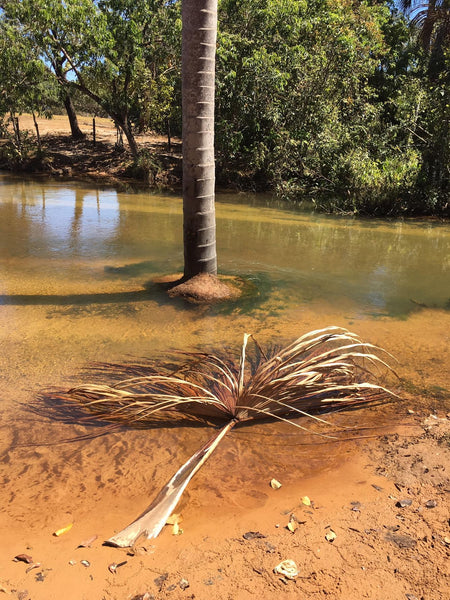
It does.
Now, this idea of breaking in and cycling aquariums has been understood, analyzed, and studied since the dawn of modern aquarium keeping. Sure, there might be a dozen different variations of the sequences and details, but essentially it’s all the same.
The phases that I am interested in, for the context of this discussion, are the ones which seem to occur long after an aquarium is cycled, “broken-in”, and otherwise well-established- specifically in the context of this botanical-style aquarium we play with.
These more “mature” phases are fascinating to me. These represent the aquarium at a point of ecological “maturity”, when the biological processes that are so crucial are stable and well-established.
Without going into any one of the dozens of aspects of a “mature” aquarium’s definition, let’s just say it’s a system that you’re not on edge about every day, and leave it at that!
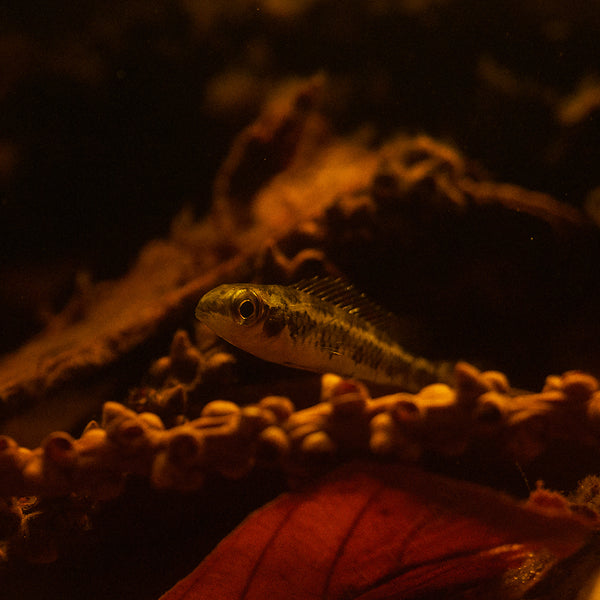
Of course, an aquarium that utilizes botanicals as a good part of its hardscape follows a set of phases, too. And I’ve found that once a botanical-style aquarium (blackwater or brackish) hits that sort of “stable mode,” it’s just that—stable. You won’t see wildly fluctuating pH, nitrates, phosphates, etc. To a certain degree, the aquarium has achieved some sort of “biological equilibrium.”
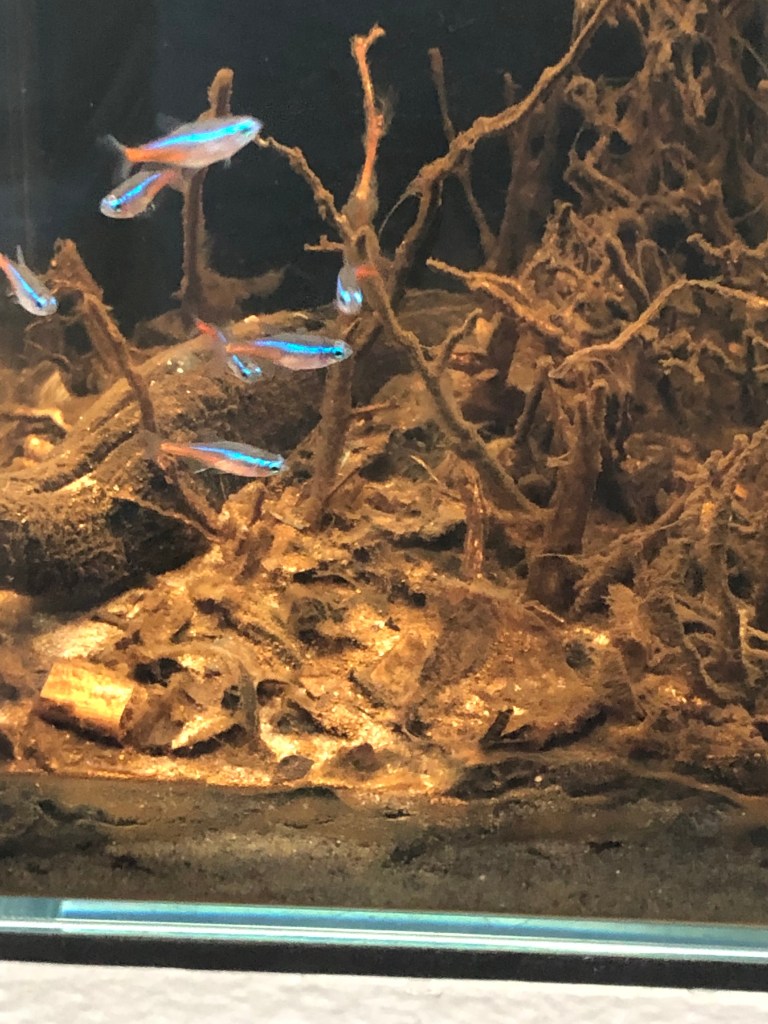
Now, one thing that’s unique about the botanical-method approach is that we tend to accept the idea of decomposing materials accumulating in our systems. We understand that they act, to a certain extent, as “fuel” for the micro and macrofauna that reside in the aquarium.
I have long held the belief that if you decide to let the botanicals remain in your aquarium to break down and decompose completely, you shouldn’t change course by suddenly removing the material all at once.
Why?
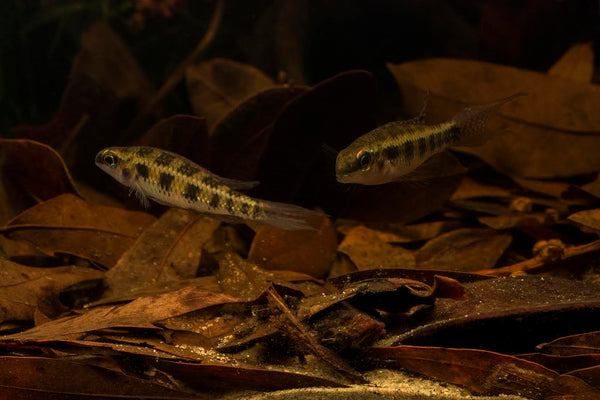
Well, I think my theory is steeped in the mindset that you’ve created a little ecosystem, and if you start removing a significant source of someone’s food (or for that matter, their home!), there is bound to be a net loss of biota, and this could lead to a disruption of the very biological processes that we aim to foster.
Okay, it’s a theory.
But I think I might be on to something, maybe?
The botanical-method aquarium (like any aquarium, of course) as a little “microcosm”, with processes and life forms dependent upon each other for food, shelter, and other aspects of their existence. And I really believe that the environment and microbial/fungal population of life forms of this type of aquarium, because it relies on botanical materials (leaves, seed pods, etc.) for colonization sites, food, and environmental is greatly influenced by the variety and type of materials present
Just like in natural aquatic ecosystems…
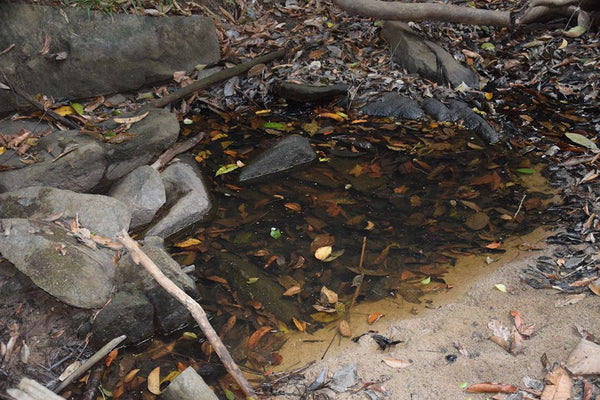
The botanical materials are a real “base” for the little microcosm we create.
And of course, by virtue of the fact that they contain other compounds, like tannins, humic substances, lignin, etc., they also serve to influence the water chemistry of the aquarium, the extent to which is dictated by a number of other things, including the “starting point” of the source water used to fill the tank.
So, in short, I think the presence of botanicals in our aquariums is multifaceted, highly influential, and of extreme importance for the stability, ecological balance, and efficiency of the tank. As a new system establishes itself, the biological processes adapt to the quantity and types of materials present—the nitrogen cycle and other nutrient-processing capabilities evolve over time.
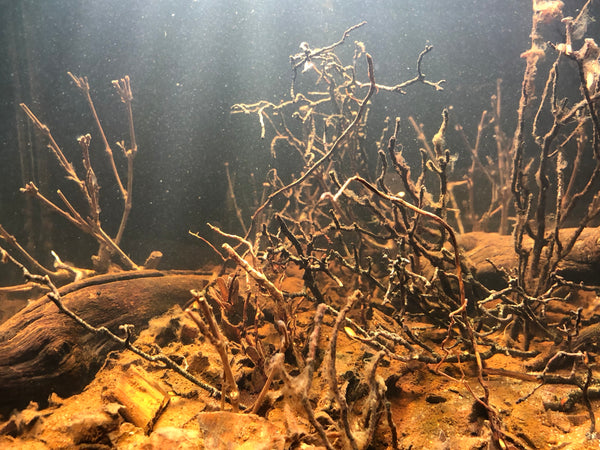
And then there is that other tangential theory I’ve played with in my head for a while—and unfortunately, not being a scientist, I have no way of testing it.
I can’t help but wonder if a layer of materials such as leaves performs some degree of denitrification, much as a deep sand bed might in a reef aquarium. I mean, you have a matrix in which microorganisms, fungi, and small crustaceans can grow, feed, and multiply. And conditions within a layer of leaves might approximate those found within a layer of fine sand, including possible aerobic zones, void spaces, etc…
Could this be?
Could a bed of leaves and botanicals be the equivalent of a deep sand bed for denitrification and other nutrient-utilization processes? I think it’s a possibility. I know that there have been some studies of natural deep leaf litter beds and theories that postulate about them performing such functions, as well as influencing the pH of their surrounding waters via the process of fermentation.
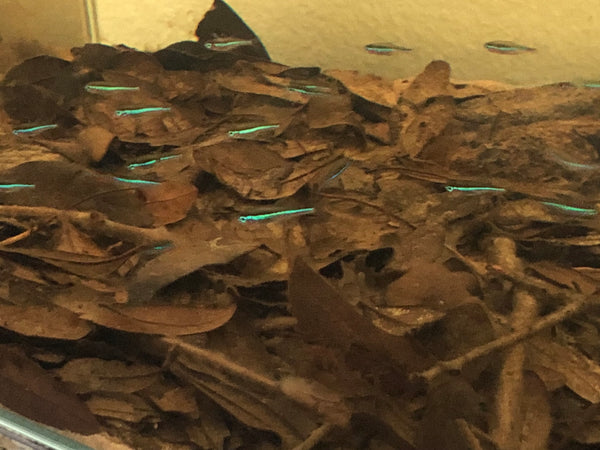
There’s a lot there for a knowledgable and ambitious hobbyist/scientist to work with.
Of course, on the most simple scale, we as hobbyists can test parts of the theory for ourselves…I can fall back on my couple of decades of playing with these tanks and personally never have had wildly fluctuating environmental parameters, high nitrates, etc.
I just haven’t...despite what seems like it should be something that goes with the territory: I mean, we keep tanks with decomposing leaves- something that would freak out a lot of hobbyists who haven’t made the “mental shifts” that we have!
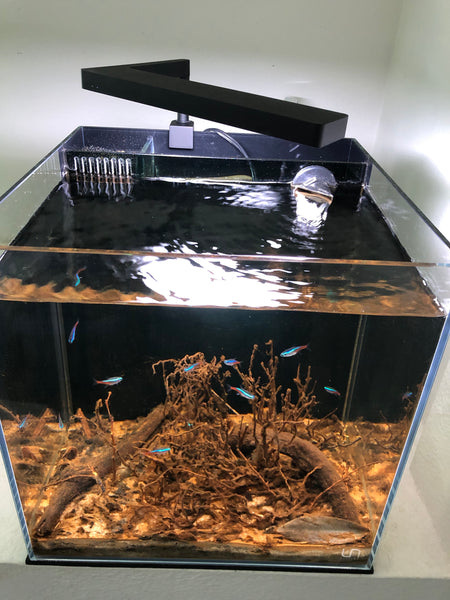
This interesting process—this journey—is one of the most fascinating and engrossing aspects of the botanical-style aquarium. A journey that starts with a somewhat predictable progression and unfolds in a manner dictated by Nature, with a pace and ultimate outcome that only She knows.
If we allow her to do it.
It can be a bit unnerving—ceding so much control to Nature. However, the rewards can be fantastic.
Strap in for the journey…It’s a fun one! Hand your aquarium off to Nature and enjoy the ride!
Stay patient. Stay bold. Stay curious. Stay observant. Stay resourceful…
And Stay Wet.
Scott Fellman


Leave a Reply