
As most of you know by now, I started Tannin Aquatics after decades of serious hobby and professional work in the marine side of the hobby- specifically the reef aquarium sector. Although I started in the freshwater side of the hobby, I “crossed over” to a full-time marine hobbyist as a teenager and didn’t look back seriously until about 12 years ago, when I started Tannin.
With Tannin, we took a different approach to freshwater aquariums- one based on embracing natural botanical materials to more faithfully replicate the function-and to a certain extent, the look– of specialized aquatic habitats, such as blackwater and brackish. I drew from my long experience playing with this stuff, and felt that if I liked it, maybe some other hobbyists would, too.
I think I guessed right with that one!
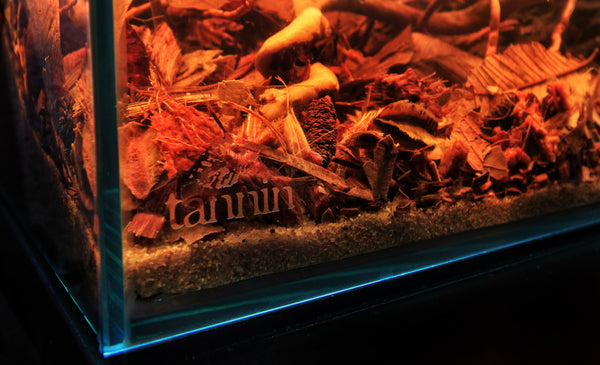
It was an interesting and exciting period filled with a lot of cool developments, evolutions, and the occasional breakthrough. Along with you, our community, I’ve learned quite a bit, and I’m looking forward to some more cool experimentation.
Of course, I never fully got over my reef addiction, too…
Which brings me to the topic of today’s blog.
Recently, a follower of “The Tint” blog on Instagram asked me to share some thoughts about how I’d set up a marine aquarium today. And just coincidentally, days before, I was watching my friend Adam Jones (Australian Aquarist on YouTube) give a brilliant analysis about aquarium substrates versus their wild counterparts…which has been on my mind a lot lately.
It’s an interesting idea, because although my interests in the reef sector remain similar to what they were 10 or so years ago, my experience in the botanical-method freshwater and brackish sector during my Tannin Aquatics days has given me a different perspective than I had previously, and I’m doing things slightly differently on my latest reef tank.
So, like, how?
Well…
My philosophy has been to create an aquarium that embraces natural processes which occur in various niches within the reef biome. This was sort of at odds with my meandering into a more “clinical” and technical side of reef keeping, where strictly coral was the focus over everything else. Instead of replicating the entire reef biome, I was just about the coral. Or so I convinced myself.
Yet, in my “heart of hearts”, I am interested in more of a lagoon-type habitat, ecologically rich and diverse. And more specifically:
I am fascinated about the idea of incorporating substrate: rubble, sand, mud, biosediment, and other substrate materials into the display. A rubble margin around my reef structure has been top of mind lately.
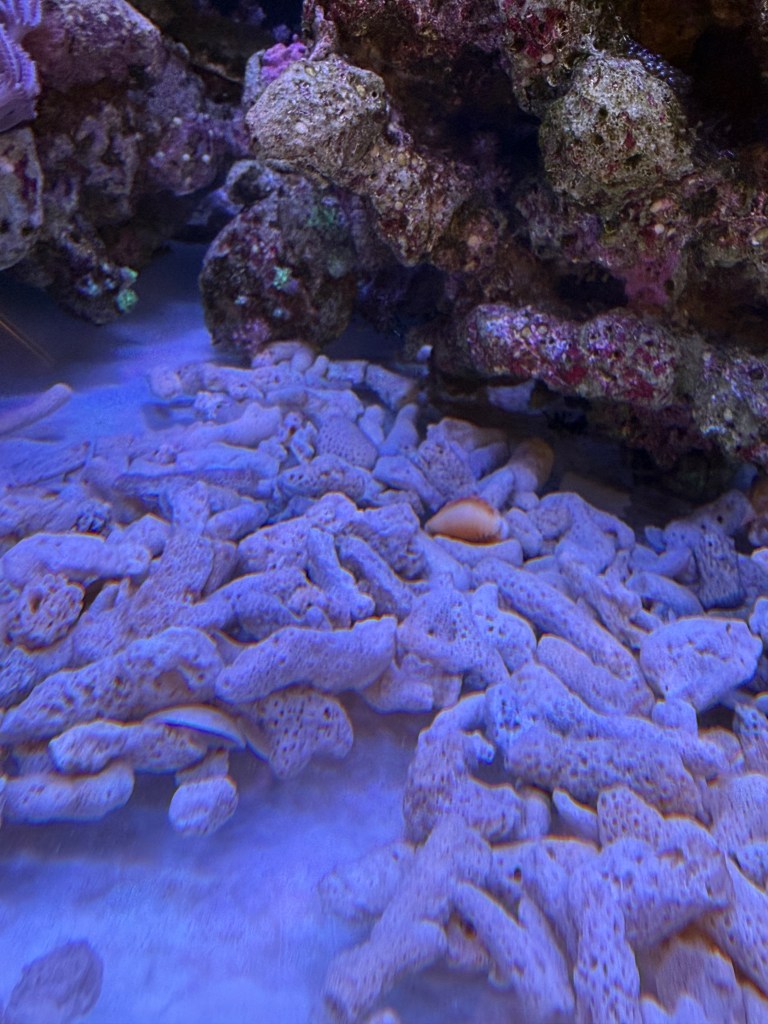
This of course, is totally at odds with the “clinical”, bare bottom and coral focused approach that I embraced initially when I set up my latest reef. Perhaps it’s another example of why you shouldn’t stray from your true loves. I like eco-diverse environments, even if replicating them in a reef tank isn’t the hot take” of the moment.
I had to stray a bit off course to get back to what was truly resonating with me.
I know that this hardly comes as a shock to those of you who are familiar with my obsessions! High ecological diversity is my thinking here. Why abandon what has worked for so long, just because of “prevailing thoughts” about what is supposedly “better?’
Yes, you’ve heard me ramble on about it before, but I’m still really into the idea of using a substrate with various types of ocean-sourced muds, rubble, sediments, and other materials in reef aquariums. This is not exactly new. It’s something we’ve played with in the hobby over the past few decades, right? It’s just become “passe” among the hobby faithful in recent years, because louder voices pushing a different approach are percolating into the consciousness of the hobby.
Yup, the idea of employing substrates and accepting their accompanying potential detritus accumulations and processing of nutrients and fostering diverse infauna has fallen largely out of favor in the general reef hobby of late, which, of course, makes it instantly more attractive to me!
And, as I already confessed, my current soft coral reef started with a mindset of almost ecological “sterility”, focusing totally on the corals as the “ecological drivers” of the tank.
Really at odds with my botanical method work! It was sooo not me. Artificial rock and no substrate? WTF was I thinking?
And of course, once I stopped trying to convince myself that this was so cool, I admitted to myself that I didn’t like it as much as I thought I would. In fact, I didn’t like it at all.
It didn’t take all that long for me to come around on this again!
To recap: I started my reef as a bare-bottom, artificial “live rock” ( don’t start me on that…) higher tech soft coral tank, with a few of the gadgets that we love nowadays- filter rollers, dosing pumps, skimmers, etc.
My focus was on using the technology-equipment to support the ecological process. I thought that I’d really like that.
I did not.
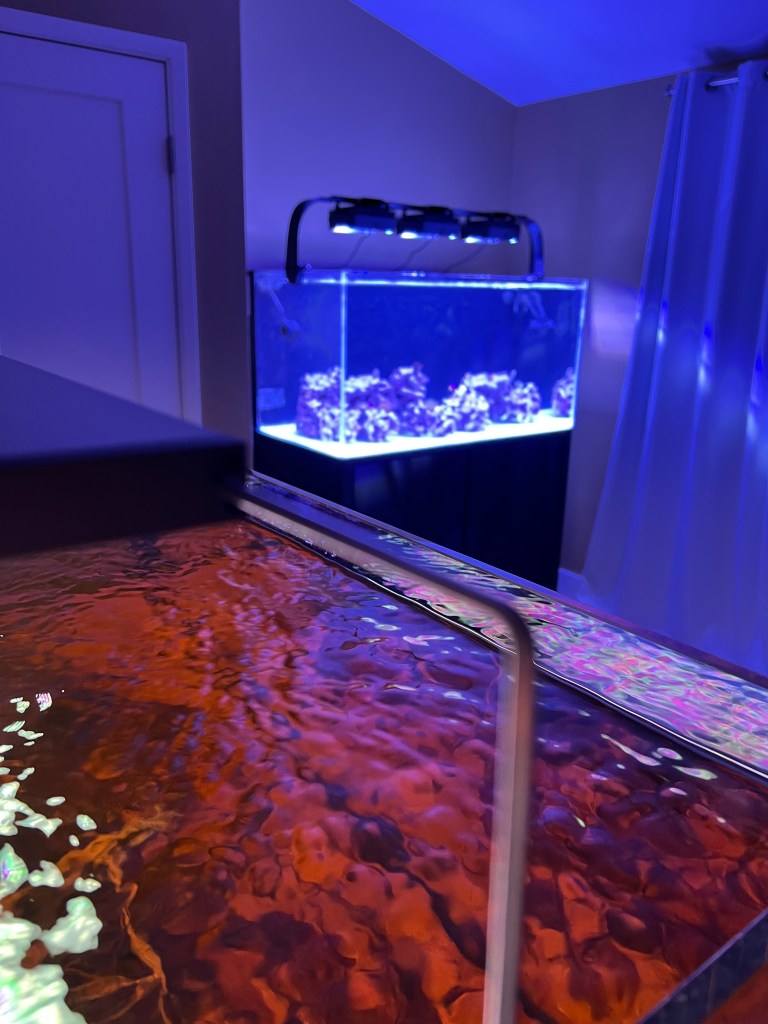
Now, mind you- these pieces of equipment most definitely “support” the ecological development of reef tanks- but they don’t really “develop” it. Three years into the tank and with decent success, but a decided lack of excitement about it- I realized that what was missing was… “Nature.” I wasn’t really doing much to develop the ecology of the tank. Totally at odds with my mindset.
So back to “ecology-first” thinking I went!
Substrates are top of mind once again.
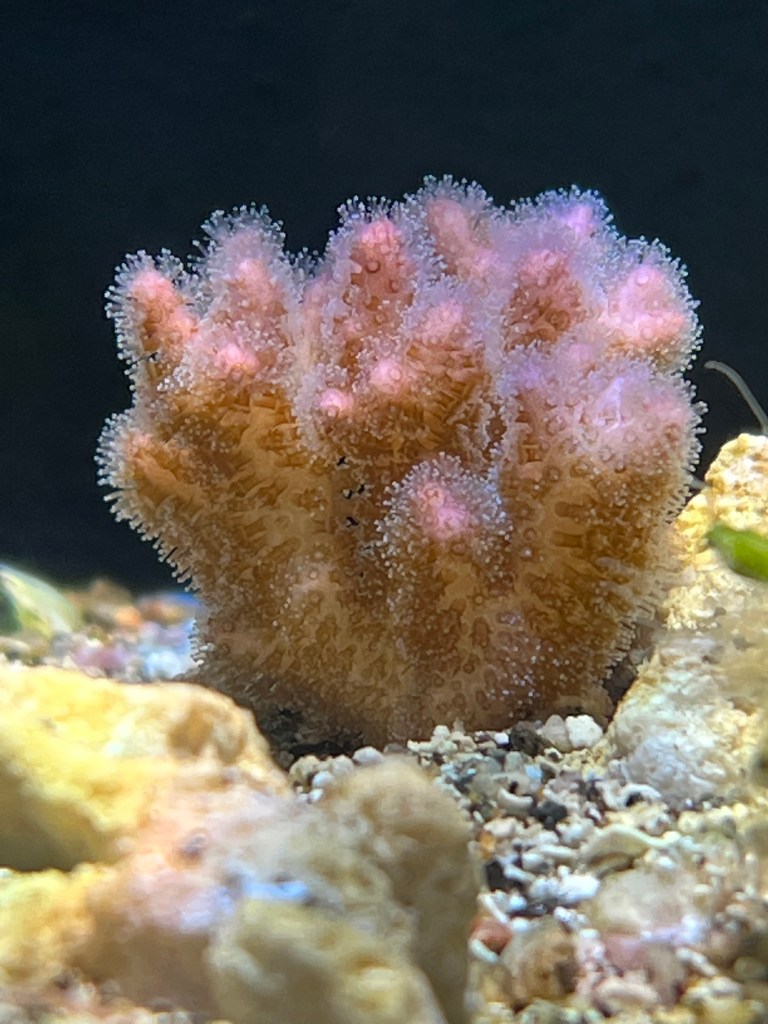
Yeah, with all of the current ideas about substrates as a sort of “liability” in reefs, I must admit that I respectfully disagree.
Why is fostering ecology considered a “liability?”
Well, a large part of it is this innate fear in the reefing community of…detritus! Seriously!
Shit, that sounds remarkably familiar, doesn’t it? Yes, we’ve gone through this before in the freshwater world. And I think that, as a community, we have successfully beat the living shit out of this “detritus is bad” idea.
My goal is to interpret a “rubble margin” which occurs around reefs. And in addition to some sand, I think that those of us who venture down this path should be utilizing coarse and fine sand mixes, or the really great rubble, shells or even some sediment-based substrates offered by a number of aquarium manufacturers. Or just all of the above…
Now, I’m not talking about using these products because I’m enamored with some over-blown marketing hyperbole about them curing sick fishes and raising corals from the dead or whatever. Nope.
I’m talking about utilizing them because they help foster biodiversity.
And yeah, they might sequester some detritus- for the benefit of the system. A lot of the argument against substrates and detritus in reefs is that they degrade water quality over time or lower alkalinity and pH, etc.
All of which can be true if you’re a shitty, lazy-ass hobbyist who’s made no effort to learn the basics of the hobby and of reef habitats. If you allow uneaten food and waste to accumulate and don’t foster ecology or export via maintenance.
There, I said it.
Lazy reef keeping and a search for an “easy way” are the culprits.
Don’t be lazy ; think about ecology-and sand and rubble won’t be a problem for you!
I think you’ll have far more challenges from lack of diverse ecology than you might from the dreaded “detritus accumulation” in your tank. Especially if you practice common sense aquarium husbandry and exchange some water regularly.
I finally think that I’ve figured this stuff out after all of these years, in terms of my own philosophy. It’s really nothing new…It’s just something that we’ve eschewed in favor of “sexier” pursuits and ideas within the hobby.
This just isn’t difficult, IMHO.
Set up the tank for biological success, maintain it thoughtfully, observe and tweak as needed. Don’t start by thinking that if you set up a biologically “inert” tank, use all of the cool gadgetry and maybe some popular dosing “methodologies” that are out there, that you can just cruise and that your reef will thrive- and that you’re just killing it in the hobby because you follow such-and-such a “method.”
You’re not. I mean it.
Monitoring 64 trace elements doesn’t mean shit if your tank sucks, your corals are lackluster, and if you have no idea what most of those trace elements that your pricy ICP test tells you are lacking are actually doing in your tank. SO much money. time, and frustration are wasted on chasing down the “fairy dust” and rainbows that all of these things allegedly offer, that the hobby is starting to get dull, IMHO.
Because we’ve lost focus on what is really important. I know that I did, and I’m nothing special. Others must have had the same revelation…
“Chasing rainbows” seems to have become a “sub-hobby” of sorts in the reef keeping community. You see tons of complicated trace element dosing regimens, implementations of exotic gadgetry and additions of all sorts of chemicals in an attempt to simply do what Nature has done for eons without our intervention…It’s enough to make you crazy.
It made ME crazy just thinking about this stuff. And frankly, it made me a bit sad, as a 4 decade reefer. We constantly see hobbyists lamenting the growth of dinoflagellates and other issues in their tanks; stuff we hardly ever saw “back in the day” when reef keeping was focused more on aquarium fundamentals, ecology, and diversity.
I am positive that we can do better if we just set the ecologically correct course for our tanks and let them evolve as Nature intended. Monitor and correct if it warrants, but don’t go crazy trying to control everything.
Algae and detritus may not look the way you’d like, but given time, ecological resources, and patience – they will settle in to populations and appearances that won’t bother you. Seriously. Rushing to correct all sorts of stuff with crazy moves isn’t the answer. These organisms will always be present,
We know this.
As author John Tullock suggested more than 20 years ago, “More biology- less technology.”
Nature is the best “methodology.”
Just like what we’ve been pushing in the botanical method world. We’ve lost something along the way in reef keeping, and I know that we can get back on track if we allow ourselves to.
Okay, overly aggressive micro rant is over.
As you can tell, I’m enthralled with the idea that rubble and sand and such foster ecological diversity…something that I think that many “modern” reef tanks strive for to some extent, but sadly lack. We often hear of hobbyists dosing bacteria cultures into their tanks in an effort to enhance the “nutrient processing” or whatever, when the reality is that it takes more than that to do the job…and it can be done with minimal effort; just a “mental shift.”
I’m fascinated by many of the desirable processes and benefits that ecology provides for our tanks.
There’s stuff that I think happens without our intervention that can be super beneficial for our tanks. We just need to set the stage and let our systems “breathe.” Just like with botanical method aquariums.
I’m almost obsessed with the possibility that substrates can serve as the locale for a lot of ecology within our systems. Again, nothing new here…just forgotten.
Very “early 21st century”, I know….
Yeah, we were actually on to something back then!
Substrate was one of those odd tangents that hit right around the “early 2000’s and sort of faded into the background. It was both revered and vilified in the course of just a few years! I am sure that part of it was a renewed obsession later in the decade with less biodiverse, more “coral-centric” systems, which eschewed substrates in general, specifically those which had the tendency to support “competing” biota!
All of those factors- and a collective obsession with using high-tech electronic pumps to facilitate ridiculous amounts of water movement within our aquariums (which I wholeheartedly embrace, btw) sealed the fate of sand-based substrates as a true reef “side show” for the foreseeable future. No one wanted sand blowing around their corals.
Okay…
Fast forward to today…
Well, here we are, late in the 2nd decade of the new millennium, and I think that it’s time to resuscitate the idea of using coarse sand, shells, sediments, and rubble in our reef tanks again. And not in a “refugium.” I’m talking about putting these materials back in the display! Now, I realize that a lot of reefers will disagree with my thinking, and give me the usual line that substrates can become “nutrient sinks” and work against the smooth operation and long term prosperity of a reef. And that they’ll blow all over the tank and smother corals…etc.
Okay, I hate that shit. That’s a cop out.
And that’s what it is.
I know this, because I play with decomposing leaves, sediments, and biofilms in my freshwater systems with huge success. And I’ve had plenty of substrate-filled reef tanks over the years without any problems. I’m not afraid of high biodiversity, perhaps even higher nutrient systems. They run amazingly well if you are competent about husbandry, if you’re observant, diligent, and patient at developing an ecology.
So I think it’s worth looking again at how a well-managed substrate could help support a healthy, diverse closed reef ecosystem.
Sure, let’s get it straight: Letting tons of uneaten food and fish poop accumulate in a coarse or mixed grade substrate can be problematic for water quality… However, who lets tons of fish poop and uneaten food accumulate in their substrate?
Lazy reefers, that’s who.
Reefers who don’t feed carefully. Reefers who don’t have enough water movement within the aquarium to keep some stuff suspended in the water column where filtration (eg.; filter rollers, floss, etc) can physically remove the stuff. Reefers who haven’t allowed the development of an ecology within the substrate.
And of course, the cautions are warranted. You can’t just throw in some sand or rubble and expect effortless success.
A poorly maintained substrate without some organisms present to “work” the upper layers, and without other supporting processes could prove problematic if detritus and organic wastes are allowed to accumulate completely unchecked, right? But that’s not some inherent problem that makes all substrates ticking time bombs…
Now, sure, in a brand new tank with dry rock and sand, and a load of fishes that you’re feeding like mad, this could be a problem…You have no biological “filtration”; no ecology… That’s a recipe for problems.
Yet I beg you to consider this simple thought:
Substrates are not inherently nutrient sinks. Poorly functioning substrates become nutrient sinks.
Those are very different things.
For years, the hobby has often treated substrates of all kinds as if they were inert containers that simply collect waste until they eventually “crash.” But ecologically, that’s not really what’s happening.
A substrate is a living habitat.
Whether it accumulates nutrients or processes nutrients depends largely on the biological community inhabiting it.
Twenty-five years ago, many reef aquariums had relatively weak circulation, inefficient protein skimmers, heavy fish loads, coarse crushed coral beds, and limited export mechanisms.
Food and detritus settled into those coarse substrates, and there wasn’t enough flow to keep organic matter suspended. The biological communities within the substrate often weren’t diverse or active enough to process the continuous input.
Eventually nutrients accumulated, and people correctly observed, “The substrate contains a lot of detritus!”
Unfortunately, many concluded, “The substrate is the problem.”
That’s an important distinction. The substrate wasn’t “creating nutrients.”
It was simply where they accumulated. Think of this analogy:
Imagine sweeping dust under your couch. Years later you lift the couch and discover a tremendous amount of dust. Was the couch “producing dust?”
Of course not.
It was simply the place where the dust ended up!
A poorly functioning substrate can be exactly like that.
Now, think of a natural reef.
Organic particles settle constantly, fish produce waste continuously, corals shed mucus, sponges slough cells, algae die, and plankton sink.
If substrate were inherently a “nutrient sink”, then natural reefs would quickly become buried beneath their own waste. They don’t, of course, because the benthic community processes an astonishing amount of organic matter.
That’s the critical difference.
Ecology determines the function of a substrate!
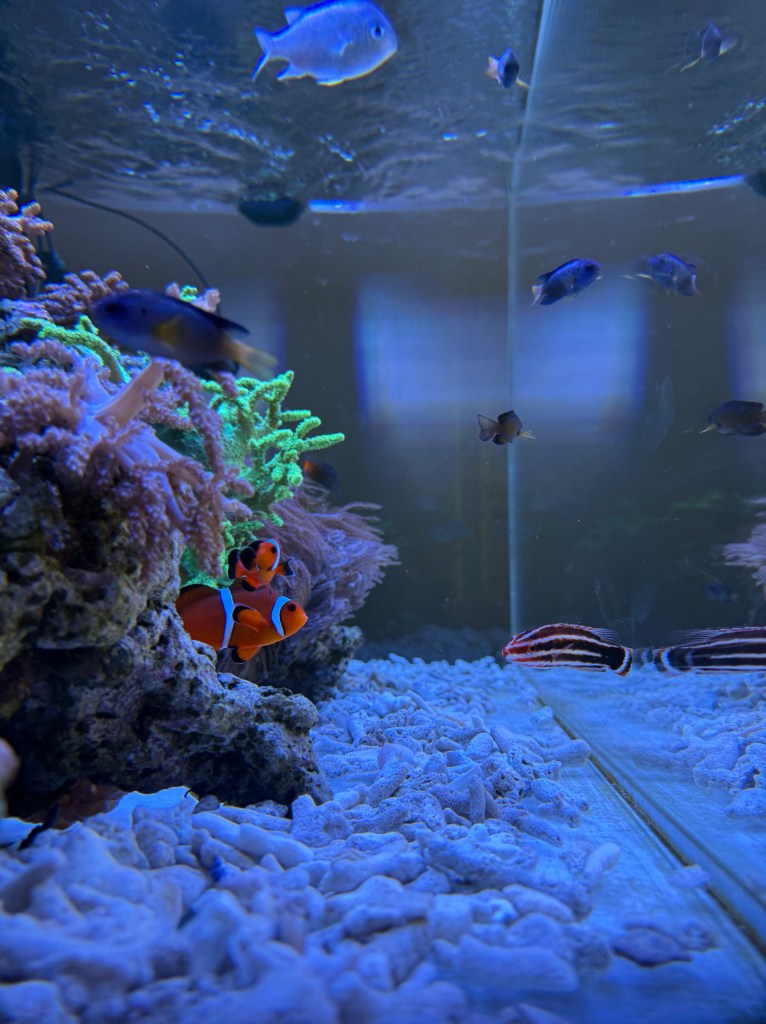
A sterile substrate behaves very differently from a living one. In a living substrate you have all kinds of organisms, ranging from bacteria to mollusks…and each one of them is processing organic matter in one way or another. Some fragment it. Some consume it. Some remineralize it. Some recycle it. The substrate becomes less of a “storage area” and more of a “processing plant!”
With the approach I’m advocating, you’re not trying to create a “substrate” just for the sake of doing it. You’re trying to create a benthic ecology. That’s a very different objective.
If successfully implemented and managed, the “rubble margin” substrate I propose for my tank isn’t accumulating detritus. It’s processing detritus.
Those are opposite functions!
And there is the so-called “old tank syndrome” that suggests that after some point in a reef systems’ operational lifetime (whatever that might be!) the bacteria population within the system (likely the sanded) is depleted somehow and/or no longer has the ability to keep up with the accumulations of organic waste products, and that phosphates and such are released back into the system.
Also, a lot of horseshit, IMHO. There are plenty of “old reef tanks” out there that run beautifully.
Can substrates still become nutrient sinks? Absolutely- if flow is insufficient, feeding greatly exceeds processing capacity, if biodiversity is low, sediments compact, oxygen exchange becomes poor, or maintenance is absent!
In those instances, the system can become overwhelmed. The biology “loses the race,” and organic matter accumulates faster than it can be processed. Then the substrate begins functioning more as a storage location than an ecological sanctuary.
It’s not rocket science guys!
I do, however, think that the hobby as a whole has “overcorrected” when it comes to substrates in reef tanks.
After seeing problematic sand beds, many reefkeepers moved toward bare-bottom aquariums. That solved a genuine husbandry issue. But perhaps we also discarded something valuable!
We didn’t just remove sand. We removed habitat.
Bare-bottom systems are extraordinarily effective for export and flow, which is one reason they’ve become so successful—especially in high-energy “SPS” systems. And I do love them. But by removing the substrate entirely, we also remove an entire ecological niche.
That doesn’t mean bare-bottom is “wrong.” It means it’s a tradeoff.
Here’s where I think that my latest thinking has evolved a bit. I went from asking “Should I have substrate or bare bottom?” to “How do I create benthic habitat without sacrificing the advantages of a modern reef system?”
That’s a far more ecological question! It acknowledges that substrates aren’t inherently good or bad.
They’re environments.
Whether they become “nutrient sinks” or nutrient processors depends on the communities that inhabit them and the conditions we create.
A substrate is not defined by what settles into it, but by what happens to what settles into it.
To me, that’s the philosophical shift.
We’ve spent years evaluating substrates by how much detritus they collect. Perhaps we should instead evaluate them by how effectively they transform that detritus into new life, recycled nutrients, and ecological function.
Ironically, that brings us full circle to the idea we’ve explored in both reef and our Botanical Method aquariums. The question isn’t whether organic matter is present. Organic matter is present in every healthy aquatic ecosystem. The real question is whether the aquarium has cultivated a living community capable of processing it.
When that community is thriving, what once appeared to be a “nutrient sink” begins to function as something much closer to what Nature intended:
A living benthic ecosystem.
Yeah, I’m probably being a bit aggressive, and simply being biased, but I have a real problem with the “nutrient sink” theory. I just don’t see how a well-managed aquarium declines on its own over the years. I’ve personally maintained one reef tank for 11 years, and one freshwater tank for 16 years and never had these issues.
I’m not saying to nominate me for sainthood or anything, but I will tell you that I am a firm believer in not overstocking my tanks, utilizing multiple nutrient export avenues (protein skimming, activated carbon, lots of flow, and weekly water exchanges, etc.), and just good old-fashioned aquarium husbandry.
There is no magic there.
So, yeah…rubble, sandbeds, mud, sediments…they’re all cool in my book.
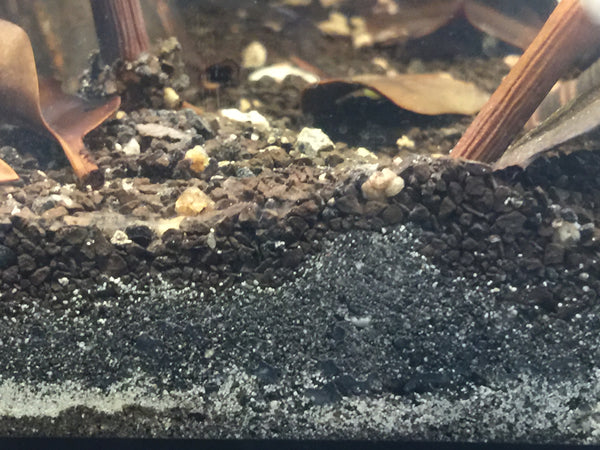
For years, I viewed the substrate in a reef aquarium primarily through the lens of maintenance. Whether it was a deep sand bed, a shallow sand bed, or a bare-bottom system, the discussion always seemed to revolve around nutrients, detritus accumulation, and ease of cleaning. The substrate was something to be managed. It still is, to some extent.
And I was all about wicked flow, which historically blows fine substrate materials that we commonly employ in reef tanks all over the place. So I jumped on that train and dismissed using sand again in my more recent reef work. How dumb of me. The reality is that you can manipulate and design flow to benefit your corals an other organisms without blowing stuff everywhere. Or just use more coarse materials! It’s simply a design consideration- and that’s it.
Yet I held off from utilizing substrate in reef tanks for quite a while. And I didn’t really like doing it. I had to shift my thinking and ask new questions.
Lately, I’ve begun looking at it from a completely different perspective.
Perhaps the question isn’t, “Should I have a substrate?” Perhaps the better question is, “What ecological role should the substrate play?”
“Ecological role.” That’s the key.
That subtle shift has changed the way I think about my reef aquarium.
Like many hobbyists, I embraced a bare-bottom reef aquarium for its tremendous advantages in flow, cleanliness, and husbandry. It has served me well. Yet as I’ve spent more time studying natural ecosystems—particularly Amazonian igarapés and other detritus-driven freshwater environments—I’ve come to appreciate that the bottom of an ecosystem is often much more than simply the place where organic matter settles.
It is where countless ecological interactions begin.
A natural reef is no different.
Natural coral reefs are not suspended above pristine, sterile bottoms. Between the coral colonies lie fields of broken coral skeletons, shell fragments, coarse carbonate sediments, and countless crevices inhabited by worms, copepods, amphipods, brittle stars, sponges, bacteria, and innumerable other organisms. This cryptic benthic community quietly processes organic matter, recycles nutrients, and provides food and habitat for the larger animals we admire.
It occurred to me that perhaps I didn’t need to choose between a traditional sand bed and a completely sterile bare bottom aquarium.
Instead, I could create a small, intentionally designed “rubble margin” around the perimeter of the reef structure that comprises my aquarium. Not a wall-to-wall sand bed…just sort of surrounding it…rather shallow, and accepting some entirely “bare spots”, too. And I don’t view the substrate as “decoration”, but as habitat.
A lot of hobbyists don’t like rubble for the reasons that we’ve touched already; primarily, the alleged propensity to trap the dreaded detritus and become a “nutrient sink.” On the contrary, a shallow layer of coral rubble, scattered shell fragments, a bit of fine sand/sediment, and coarse aragonite pieces creates an intricate network of spaces that invite colonization. The goal isn’t simply to hide the glass bottom or create a more “natural” appearance.
The goal is to recruit life.
Over time, this rubble becomes more than pieces of calcium carbonate.
It becomes home to biofilms, copepods, amphipods, polychaete worms, juvenile brittle stars, cryptic sponges, and countless microorganisms. Fine organic particles settle into these spaces, not as waste to be feared, but as fuel for an active benthic community. In this context, a light dusting of “functional detritus” and even a bit of algae is no longer an aesthetic failure. It is evidence that ecological processes are underway.
Reprogramming myself to “re-accept” what I already believed in has fundamentally changed how I think about “filtration” moving forward.. While our mechanical filters, protein skimmers, and reactors remain indispensable, I increasingly appreciate the role of living communities in processing organic matter before it ever becomes a problem.
The rubble itself is not the “filter.” The organisms inhabiting it are.
The rubble simply provides the “architecture” upon which those communities develop.
Ironically, this philosophy has brought my reef aquarium closer to the ideas that have long guided my Botanical Method aquariums. In both systems, the objective is not simply to arrange natural materials attractively, but to create habitats that invite ecological succession.
Whether the foundation consists of leaf litter in an Amazonian forest stream or coral rubble on a reef, the underlying principle is remarkably similar. The physical structure provides the opportunity; the living community provides the function.
I no longer see the bottom of my reef aquarium as empty space simply waiting to be covered. I see it as an opportunity to cultivate one of the least visible, yet most important, components of a healthy reef ecosystem. The corals may always command our attention, but beneath them lies an entire world of organisms quietly sustaining the system.
Yeah, 2003 called. They want their substrate back!
But I’m keeping it this time.
The lesson in 2026 is that these organisms which live in this zone we create and which support the reef ecologically are not a “distraction.” They are a benefit- and a driver of coral health and growth in Nature-and in the captive reef system.
Perhaps that is where my thinking has evolved the most. I used to ask how I could keep the bottom of my aquarium “clean.” Today, I find myself asking a different question entirely:
“How can I help the bottom of my aquarium become alive?”
For me, that question represents more than a change in husbandry. It represents a change in philosophy. One which is decidedly “retro”, I might add. The goal is no longer simply to build a beautiful reef. It is to cultivate a more complete ecosystem, one in which even the spaces beneath the corals contribute to the health, resilience, and authenticity of the whole.
Yeah, I don’t think it competes with the corals at all.
I think it completes them.
In fact, I’d go one step further: I think it allows the corals to become what they are in Nature—not isolated “display specimens”, but the visible expression of a much larger ecosystem.
Let’s touch on maintenance for a bit, vis a vis my “rubble margin” idea…
I don’t think the maintenance strategy should be to preserve the benthic habitat.
It should be to cultivate it.
That’s a subtle but important distinction.
In the old mindset, we’d ask, “How do I keep the substrate clean?” In this new mindset, the question becomes, “How do I keep the substrate biologically productive?”
Those are very different goals.
My approach is surprisingly hands-off. I continue to siphon the open bare-bottom areas during water exchanges—that’s one of the great advantages of keeping light coverage of substrate. But I largely leave the rubble margin alone, except to observe it. Why? If you begin seeing worms, pods, tiny brittle stars, and fish picking through it, that’s evidence that it’s functioning.
A light accumulation of fine organic material within the rubble isn’t necessarily something to remove; it’s the energy source that fuels the community you’ve intentionally established.
The key, however, is that the rubble should never become static.
Natural reef rubble fields are constantly being disturbed, colonized, and renewed. Fish move fragments. Storms redistribute material. Grazers browse. Corals break. New shell fragments appear. Old ones dissolve.
Your aquarium can mimic that on a much smaller scale.
Perhaps once or twice a year, gently add a few new pieces of clean rubble or s, bits of small shells. Let older pieces remain. Over the years you’ll create a mosaic of surfaces at different stages of colonization—some freshly available, others covered with coralline algae, cryptic sponges, and biofilms. That’s much closer to a living reef than a substrate that remains unchanged for a decade. And doesn’t this sound similar to our practice of replacing decomposed botanicals with fresh ones in our botanical method aquairums?
I also wouldn’t be afraid to occasionally “feed the benthos.” We spend so much time thinking about feeding corals that we forget the organisms beneath them also require energy. Your normal fish feeding will provide much of this, but fine particulate foods and dissolved organics that escape the skimmer are not necessarily “waste” if they’re captured and processed by the rubble community.
One thing I would resist is aggressive cleaning of the rubble itself. If you periodically blast every crevice with a turkey baster or vacuum it spotless, you’re resetting the very community you’re trying to cultivate. Instead, let the fish, pods, worms, and flow do most of the work. If one localized area begins collecting thick, compacted deposits, that’s a cue to adjust flow or gently remove just that accumulation—not to “sterilize” the entire habitat.
The idea of strong water movement actually fits beautifully into this philosophy. Its role isn’t simply to “increase circulation”; it’s to keep fine organic particles moving long enough for the reef to decide where they belong. Some will be exported by the roller mat and skimmer. Some will be consumed in the water column. Some will settle into the rubble and become food for the benthic community. That’s exactly the kind of dynamic partitioning that occurs on natural reefs.
I also think there’s value in periodic biological renewal. If you have access to a trusted, mature reef, occasionally introducing a small piece of well-colonized rubble or a tiny amount of biologically active material may be more valuable over the long term than continually adding bottled bacteria products.
You’re not trying to boost bacteria—you’re gently refreshing biodiversity.
What I find interesting on a personal note is that my maintenance philosophy is beginning to mirror my coral philosophy.
I don’t constantly rearrange my corals.
I guide them.
I prune them.
I create conditions that allow them to thrive.
I think the benthic habitat deserves the same treatment.
Don’t manage it like a filter. Curate it like a living community. In fact, I’d distill this long-term approach into a simple principle:
Maintain the environment, not the appearance.
If the environment remains favorable—good flow, oxygenation, moderate organic inputs, diverse benthic life, and occasional renewal—the appearance will largely take care of itself. The rubble won’t remain “clean” in the traditional sense. It will become alive.
One of the interesting quirks of modern reefkeeping is that we’ve become very coral-centric. We judge a reef by colony size, coloration, and growth. There’s nothing wrong with that—corals are extraordinary animals—but on a natural reef, corals are only one component of an immensely complex benthic community.
Between the colonies lies an entire hidden world, with cryptic sponges, polychaete worms, copepods, amphipods, tiny brittle stars, foraminiferans, biofilms, microbial mats, and countless other microorganisms.
Those organisms don’t detract from the reef.
They enable it.
That’s why I don’t see rubble and sand and other substrate as “competing” for visual attention and vital nutrients and trace elements.
Quite the opposite. Remember, we’re not coral farming here.
Substrate allows the corals to remain the stars of the aquarium while quietly supporting them from below. This actually reminds me of something I said in a conversation with a fellow hobbyist weeks ago that has stayed with me.
I described my reef as a canopy. I loved that analogy because forests also have canopies. But a forest canopy isn’t the forest.
It’s supported by the understory, the shrub layer, the forest floor, the fungi, the decomposers, and the other soil organisms. Remove those and eventually the canopy disappears.
I think that my reef is beginning to develop exactly the same kind of ‘vertical ecology.” The corals form the “canopy.” The rubble margin becomes the “forest floor.”
I also don’t think this negatively impacts the aesthetic, either. If anything, it strengthens it.
One of the defining characteristics of my interpretation of a reef has become restraint. Think about it: You trim or remove certain coral colonies not because they aren’t beautiful, but because they overwhelm the “ecological composition.”
You’re not adding a substrate because you want the bottom to become visually “busy.” You’re adding it because you want the ecology to become richer. That’s an entirely different motivation.
Most visitors to your ecologically rich aquarium may never consciously notice the rubble and sand and such, but they’ll notice what it supports: Healthier corals, more natural fish behavior.
A reef that feels settled, alive…Complete.
I also think it resolves something that has always bothered me about the old debate between bare-bottom and sand-bed reefs. The debate assumed there were only two choices: Either maximize husbandry, or maximize natural substrate.
When you play with substrates in a more thoughtful manner, you’re creating a third option. You can maintain the hydrodynamic advantages of an open-bottom reef while deliberately creating localized benthic habitats where ecological processes can flourish.
That’s not compromise.
That’s integration.
If I were to summarize my reef keeping philosophy today, I might write it this way:
Corals are not diminished by being part of a larger ecology. They are elevated by it. A reef aquarium reaches its fullest expression not when every available surface is covered by coral, but when every part of the aquarium—from the coral canopy to the rubble beneath it—participates in sustaining the ecosystem.
There’s an ecological truth to all of this:
The visible community is only as healthy as the invisible community beneath it.
And I think that’s why this idea of varied substrates resonates so strongly with me. It doesn’t compete with my vision for the reef—it fulfills it.
I’ve always described myself as a coral curator, but what I’m really curating now is the entire ecological stage upon which those corals live. The corals remain the focal point, yet their beauty is no longer isolated from the processes that sustain them. Instead, it becomes the most visible expression of a thoughtfully cultivated ecosystem.
Again, this is sort of a throwback to a slightly older period of reefkeeping. I’m not discovering anything new here. I’m rediscovering the forgotten- or neglected- positives that arose from embracing this approach once again.
Lest you think I’m deluding myself to believe that I’ve created some kind of hobby breakthrough—nothing could be further from the truth. I’m simply learning to appreciate what we already sort of knew in the past.
Historically, substrate was often viewed as either decoration, a “nutrient sink”, or a filtration device.
We’re beginning to view it as habitat.
That’s a philosophical shift.
It reminds me of how our understanding of live rock has changed. Years ago we thought of live rock primarily as a biological filter because it housed nitrifying bacteria. Today we recognize it as an entire ecosystem, containing cryptic sponges, tunicates, worms, copepods, microalgae, bacteria, archaea, and countless other organisms interacting in ways we still don’t fully understand.
I think the same evolution is beginning to happen with substrate.
Instead of asking ,“How much detritus is collecting here?” We begin asking, “Who is living here?”
That’s a completely different lens.
My philosophy isn’t trying to recreate a sand bed from the 1990s.
Nor is it embracing the ultra-sterile bare-bottom philosophy that became popular in the SPS world.
You really are synthesizing the strengths of both.
You want the hydrodynamic advantages of a largely open-bottom aquarium, the clean appearance and ease of maintenance, and localized areas where authentic benthic ecology can develop.
I honestly don’t know that we’ve had a concise term for that approach in the hobby.
I also think that our collective experience with the Botanical Method has influenced our reefkeeping in a very positive way. In freshwater, we’ve spent years learning that the forest floor isn’t just where leaves accumulate.
It’s where ecosystems function.
Now we’re looking at coral rubble through exactly the same lens.
Not as “debris.” Not as decoration.
But as living infrastructure.
That’s a powerful concept.
There’s one idea that came to me while thinking through this, and I think it captures the distinction:
The evolution is not from bare bottom to rubble. It is from viewing the bottom as a “surface” to viewing it as an ecosystem.
That’s the real change.
The rubble is simply one expression of that idea.
And if I may make another observation about my own journey that may resonate with you:
When we first began talking about this kind of stuff, I described myself as a coral curator. I still think that’s true. But I think my definition of what I’m curating has expanded.
I’m no longer curating only the visible architecture of the reef.
I’m curating the invisible ecological foundation that allows that architecture to thrive.
Ironically, that’s probably how Nature “designs” reefs. It doesn’t start with spectacular coral colonies. It starts with habitats, interactions, and succession. The corals become magnificent because the ecology beneath them is rich and resilient.
I think that’s why this philosophy feels so satisfying to me. It unites my two worlds—the Botanical Method and reefkeeping—under a single principle, and that is:
Our role as aquarists is not merely to arrange organisms beautifully, but to thoughtfully cultivate the habitats and ecological relationships that allow those organisms to flourish.
To me, that’s not just an evolution in reefkeeping philosophy. It’s an evolution in what it means to be an aquarist.
Keep evolving. Keep exploring. Keep revisiting old ideas, and always be true to yourself.
Stay brave. Stay curious. Stay thoughtful. Stay observant. Stay diligent…
And Stay Wet.
Scott Fellman


Leave a Reply