
I’m only a couple of weeks into establishing a “rubble margin” zone in my reef aquarium at the time of this writing, but Im already seeing some interesting things.
Now, I’m taking you on this journey not because I’ve stumbled upon some groundbreaking idea that no one has ever accomplished. People have been playing with rubble and alternative substrates in reef for years, with varying degrees of what they would call success or perhaps even failure.
I’m taking you on this journey because it might give you the inspiration to re-think your own thoughts on ideas or approaches which you might have dismissed, while perhaps pursuing some different direction that may really not have resonated within you. I’d love to give you that little “nudge” to follow your true “North Star”, even if it involves radical changes to your original plans.
Because doing stuff for the right reasons in the hobby is always so much more satisfying. Admitting that you don’t really like the direction that you took initially is totally fine- even if it goes against the current “trends.”
I know that this little project definitely takes me firmly back outside of current reef aquarium “best practices” and approaches. At a time when others are chasing ICP test results, dosing exotic trace element cocktails, automatically doing pH and alkalinity adjustments, and pouring in bottles of bacteria, I’m going retro and playing with enhanced ecology and substrates like I did in the 1990’s!
My journey involves creating this rubble margin substrate for a specific reason- ecology. And my mindset is perhaps a bit different than what others have done with this stuff in the past. Or perhaps, I’m just a little more accepting of what many might have perceived in the past to be “downsides” to this approach (potential for more detritus accumulation, different aesthetics, etc).
Hell, I’m the guy who loves decomposing leaf litter, biofilms, and detritus, so you know that I’m looking at this from a slightly different angle than many hobbyists- that’s all.
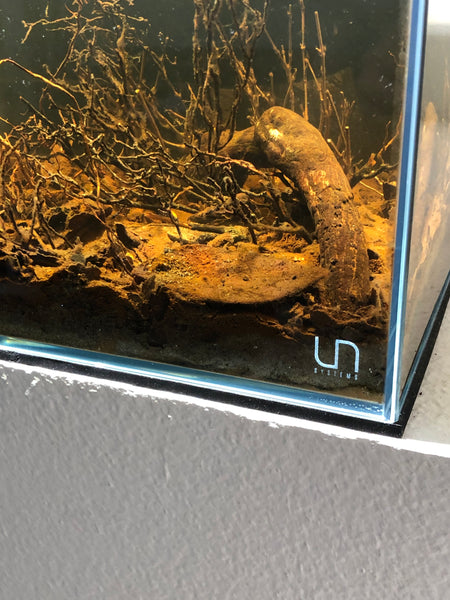
As you recall, this was sort of an “evolution” of my overall reef aquarium philosophy- an acceptance that, after three years, I really didn’t like the direction my reef tank was headed. There was a definite “cognitive dissonance” between my overall aquarium philosophy and the way I was executing my reef. The bare bottom thing is practical and efficient, but I actually started to dislike it- because I felt like it was sterile, “soulless” and ecologically incomplete.
So, I embarked on a journey to recreate one of my favorite natural reef niche habitats- the rubble margin zone. A zone ripe with ecological advantages, interstitial spaces, and enormous potential. The aesthetics are most definitely secondary, but nonetheless interesting to me.
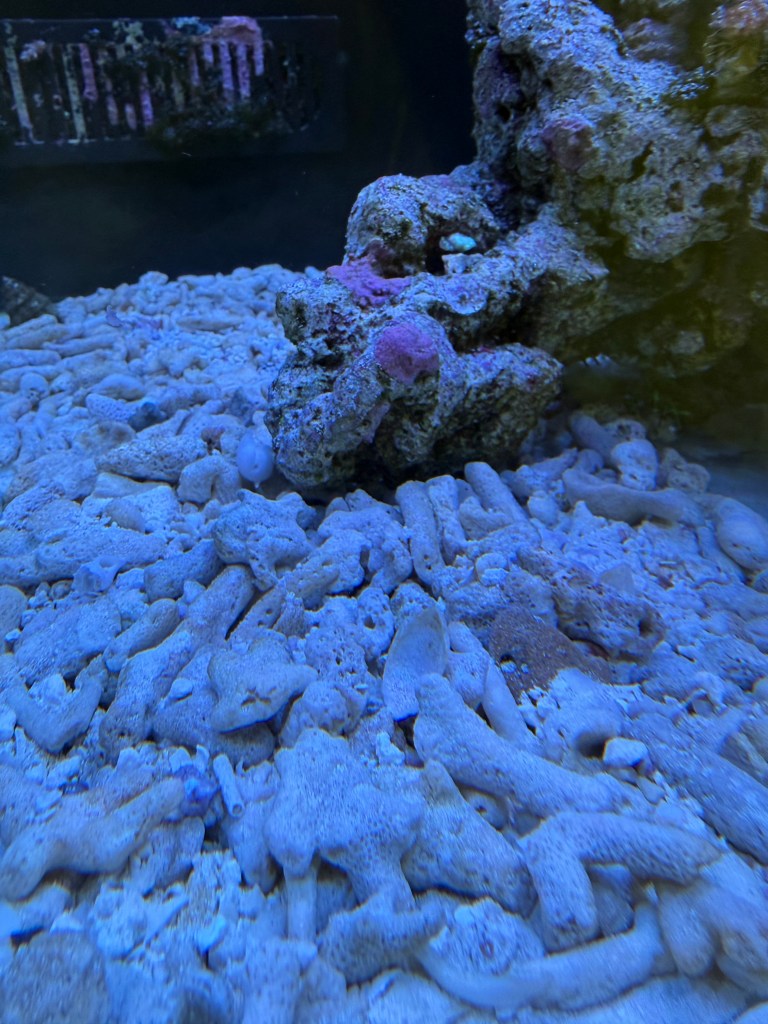
I built up my zone by scattering the substrate materials around the rock structure in my tank. It’s very “uneven” and there are plenty of bare spots. I used a mix of larger rubble, shells, and coarse aragonite with a few handfuls of fine stuff as well. The substrate is very shallow as these things go, and sort of “random.” However, this is the way the habitat appears in the wild, and I believe that the appearance belies its ecological function.
I haven’t really made a “substrate” in the traditional aquarium sense. I’ve created a patchy benthic zone around the reef. And it’s less about creating an “aesthetic feature” than it is about a functional ecological area within a “bare bottom” reef aquairum.
That’s a big distinction.
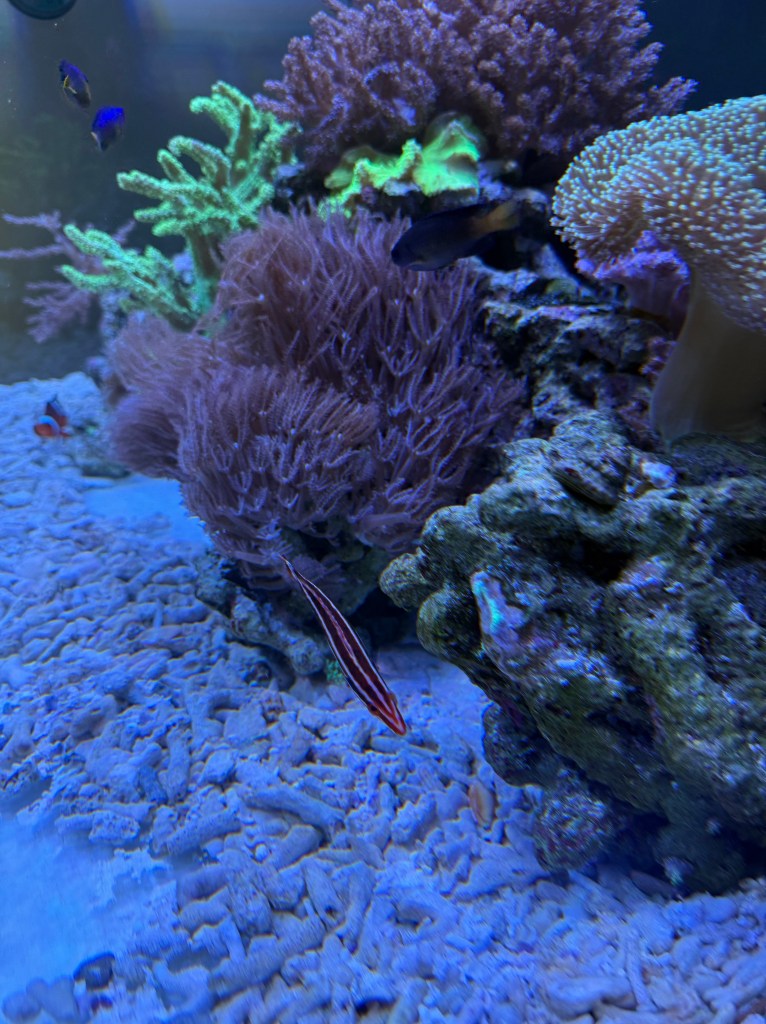
And the fact that my Ctenochaetus tominiensis tang is already investigating it is particularly encouraging. Ctenochaetus are specialized grazers of films and detrital material, so the behavior I’m seeing is exactly the sort of interaction I’d hope this habitat would encourage.
The mixture of large rubble, shell fragments, coarse aragonite, and a little fine material creates something much more interesting than a uniform substrate. I’ve essentially created several “scales” of habitat simultaneously:
Large rubble, which creates larger crevices, shaded spaces, “refugia” for benthic organisms.
Shell fragments, with irregular surfaces and small protected pockets.
Coarse aragonite, to create finer interstitial spaces.
Fine material, which fills some—but importantly, not all—of those spaces and provides a place for organic particles and microorganisms to accumulate. You want your dentirifcaiton and bacterial colonization to take place in the aquairum proper- and rubble facilitates this beautifully.
And then I have bare glass between patches. That is important. Those bare areas preserve the operational advantages of the original bare-bottom philosophy: excellent flow, easy observation, and easy removal of excess detritus if needed. Meanwhile, the scattered patches provide ecological complexity.
That’s my obsession.
It’s almost like I’ve created a series of small “reef-floor islands” rather than installing a conventional sand bed, and the fishes are going to change it! This is perhaps the most exciting part to me. The Ctenochaetus isn’t going to treat the material as a static substrate. As it grazes, investigates, and moves between pieces, it will disturb the surface and redistribute fine organic material.
Other fishes in the tank will pick through the rubble, flow will move the lighter particles, and some material will be exported. Some will settle again, and some will be consumed. And some will disappear into the microbial food web.
In other words, the substrate is going to become dynamic. So, an anti descriptor of my aquarium would be, “A bare-bottom reef with a rubble zone margin.”
I’m taking a very “hands off” approach to this project, too-resisting the temptation to make it look “better” as it develops. If one area becomes a little more heavily accumulated while another becomes almost bare, that’s interesting. We’re watching the animals and hydrodynamics establish their own distribution.
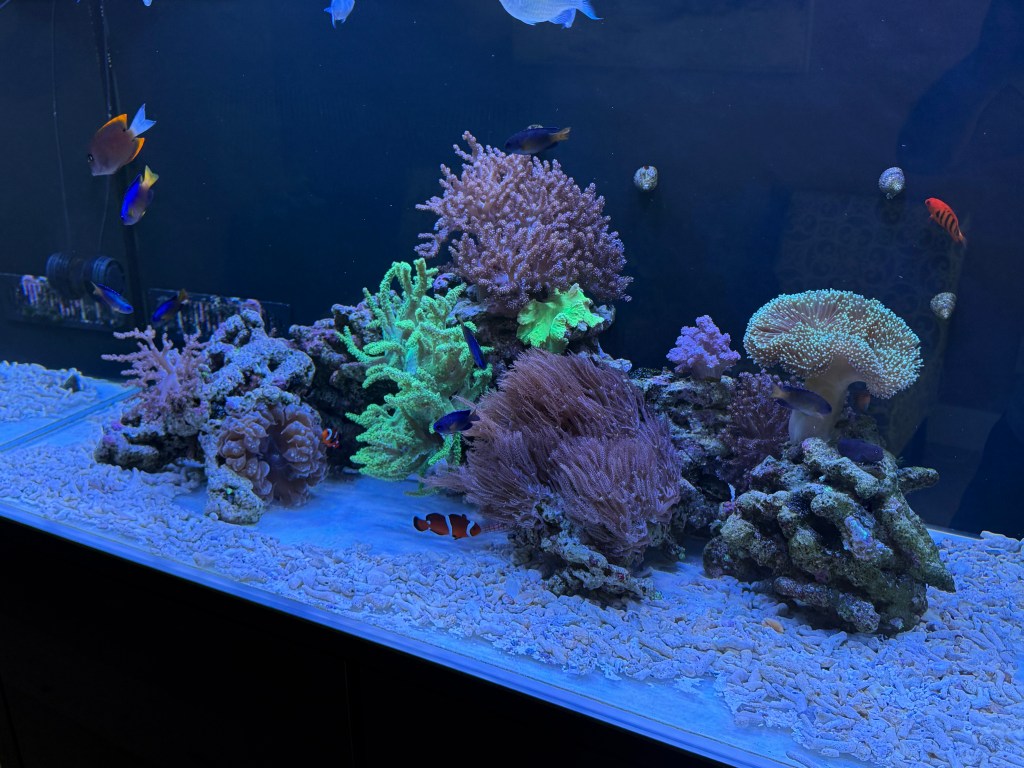
The shallow depth of material (less than 1″) is, I believe, a good choice for this material. A very shallow layer gives you much of the ecological benefit without creating a large anaerobic mass of compacted substrate. And because I’ve deliberately mixed particle sizes, there is plenty of oxygenated interstitial habitat rather than one uniform layer of fine material.
I will especially watch what happens underneath the larger rubble pieces over the next several months. Those shaded surfaces may become disproportionately rich in cryptic life. That’s where I would expect some of the most interesting colonization to occur.
And this is where I think the idea of introducing sump detritus that I’ve been looking at lately becomes particularly relevant. I now have an actual physical habitat capable of receiving and retaining that biological material. A small amount of mature detritus or colonized rubble isn’t simply being dumped onto the aquarium floor—it is being introduced into a network of spaces where organisms can establish themselves.
There’s also something aesthetically satisfying about this, I admit! I’ve spent so much time deliberately creating negative space above the reef. Now I’ve done essentially the same thing below it.
The coral canopy is intentionally open. The benthic zone is intentionally patchy. Neither is trying to occupy every available surface. That feels completely consistent with my evolving philosophy of “curation.”
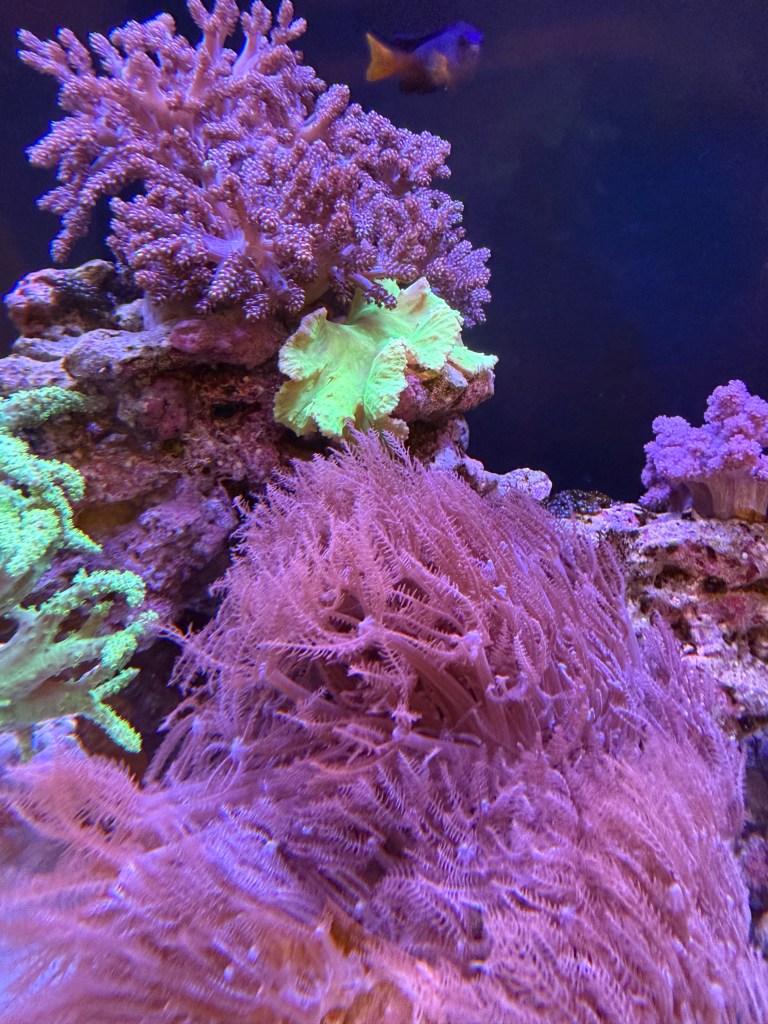
And I think the Ctenochaetus grazing through it may ultimately be one of the most rewarding aspects of the whole experiment. I’m starting to see behaviors that simply weren’t available to the fish when the bottom was bare: Picking, investigating, turning over tiny fragments, hunting among crevices.
That’s the moment when a substrate stops being something you’ve installed and starts becoming something you’ve cultivated.
I’m going to essentially leave it alone now and let the aquarium tell me what it wants to become. Yes, it feels like a dynamic part of the overall reef habitat more than it does a “substrate” in the traditional sense, and I really like that. Now, I may add a few creatures like “Micro Brittle Stars” and perhaps some copepod cultures, but I won’t go too crazy.
I’d think of it as adding functional guilds to the benthic community rather than simply adding “clean-up-crew animals.” Not adding these organisms solely for the purpose of being “scavengers” is liberating.
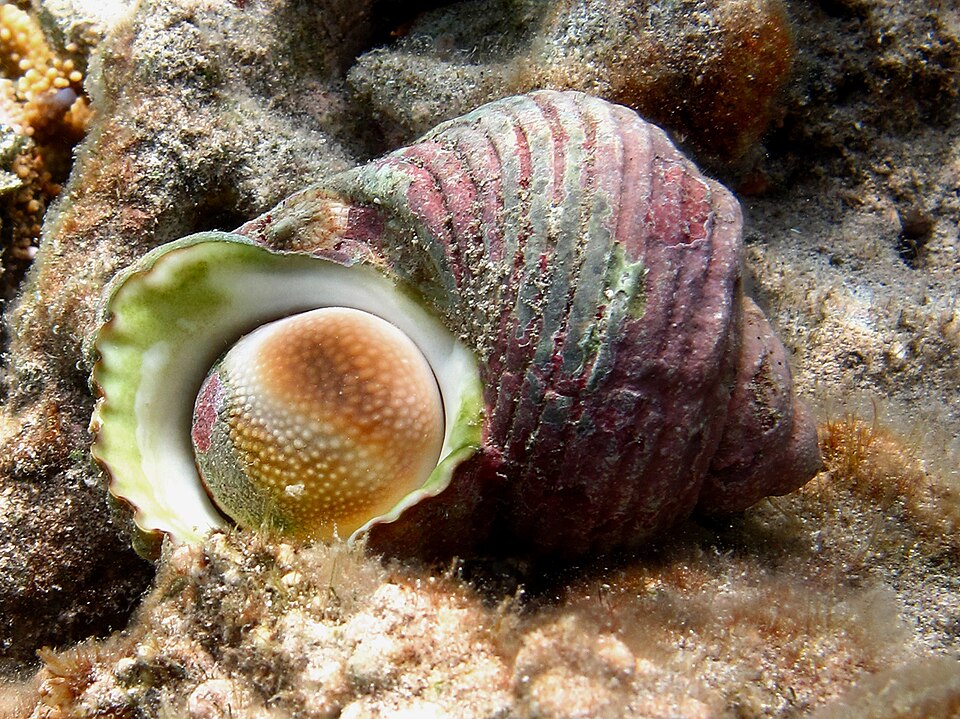
The resident Astrea and Turbo snails are already doing something valuable: they’re interacting with the rubble and grazing its exposed surfaces. But they occupy a very different ecological niche from the tiny organisms that live within and between the substrate particles.
The smaller organisms could make the rubble considerably more biologically interesting. Tiny brittle stars are wonderful inhabitants of rubble because they can occupy spaces that larger grazers simply cannot reach. They can extend their arms into crevices, capture suspended particles, and consume organic material accumulating around the rubble.
They’re not really “cleaners” in the conventional sense. They’re detritivores and suspension feeders living within the benthic architecture. That’s exactly the ecological role I’m trying to establish.
And because they are small, they can potentially establish populations rather than simply being individual animals you occasionally see. Sort of “elastic”, rising to meet the available resources.
Copepods might be even more important. I’m actually prioritizing copepods over additional snails.
A diverse population of harpactoid and other benthic copepods would be extremely well suited to what I’ve created. They inhabit biofilms, rubble surfaces, interstitial spaces, and detrital material, and they provide an important food resource for fishes.
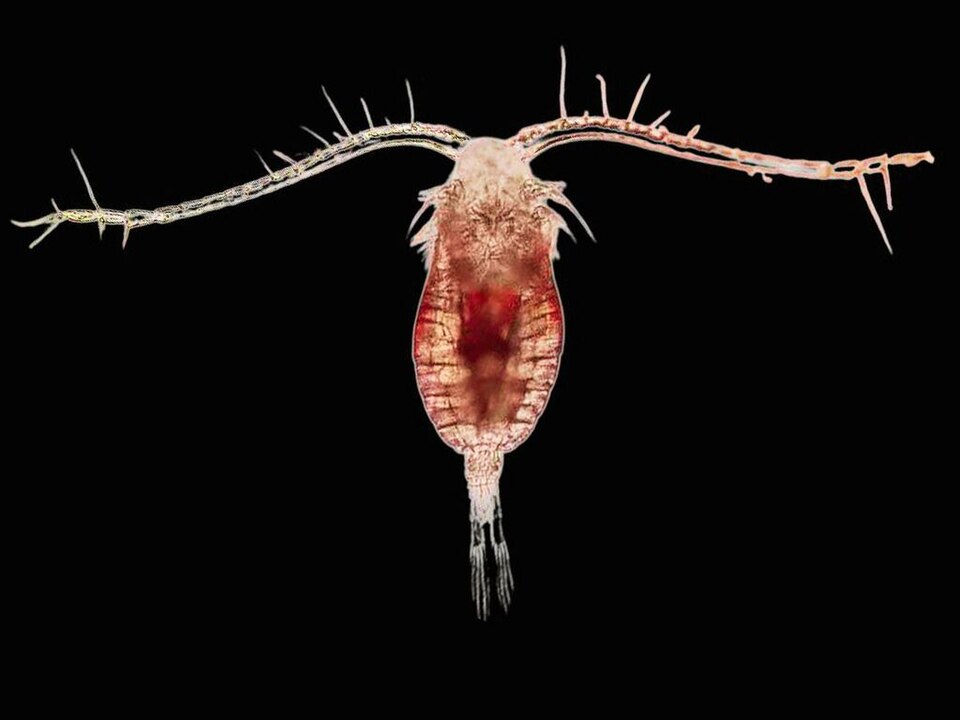
The Ctenochaetus probably isn’t going to consume enormous numbers of them, but other fishes will—and more importantly, the copepods themselves become part of the processing community.
This is where the concept of recruiting a benthic ecology becomes really tangible. You’re essentially establishing different ecological scales: Turbos and larger snails feed on exposed surfaces and larger pieces. Micro-snails graze on small surfaces, crevices, and fine material, and the Micro-brittle stars work the interstitial spaces and underside of rubble.
The copepods feed upon biofilms, particles, within microscopic spaces, while small worms work within and beneath the rubble. Bacteria, fungi, and other microbes work essentially everywhere.
That’s a genuine benthic food web rather than a collection of “clean-up crew.”
And you might have noticed that I’m not going crazy adding more snails. This is the one place where I’m exercising some restraint. Why? Remember, the habitat isn’t actually a sand bed. It’s a rubble field with pockets of fine material.
So I won’t deliberately populate it with a large number of animals that are obligate inhabitants of deep, continuously shifting sand. Some of those species simply won’t find the habitat they evolved to use.
Instead, I’m looking for small, generalist benthic snails that naturally inhabit rubble, shell pieces, and shallow sediments. That distinction matters. I’m trying to recruit animals appropriate to the habitat I’ve created, rather than modifying the habitat to accommodate a particular animal.
And that is very much in keeping with my “curator” philosophy.
I’m also going to avoid adding too many grazers to my system. This may sound strange, given everything we’ve discussed, but I won’t try to maximize the number of organisms.
I’ve already got established Astrea and Turbo snail populations. If the rubble begins developing a nice film and I see my fish actively grazing it, I’m going to let that community establish before adding additional organisms as a “clean-up crew.”
I want grazing pressure, but I also want enough primary production and microbial biomass for the little ecosystem to sustain itself. Sounds familiar? Sort of like our leaf litter beds?
The key is to understand that a benthic habitat with too many grazers can become just as ecologically impoverished as one with too few! That’s why I always cringe when I see vendors offering “cleanup crews” based on certain tank sizes. Most of these “crews” are just way more than what’s needed, and likely many starve because there simply aren’t enough resources to sustain all of them. So just go smaller!
And there’s something I particularly like about micro-brittle stars and copepods. They’re almost invisible. Now, that sounds like a drawback from a conventional aquarium perspective, but I think it’s actually an advantage.
My “coral canopy” remains visually restrained and attractive, while beneath it I’ve created an entire microscopic landscape that most observers won’t even know exists. That’s almost the perfect expression of the philosophy I’ve been developing for some time:
The aquarium doesn’t need to display its ecology. It needs to support it.
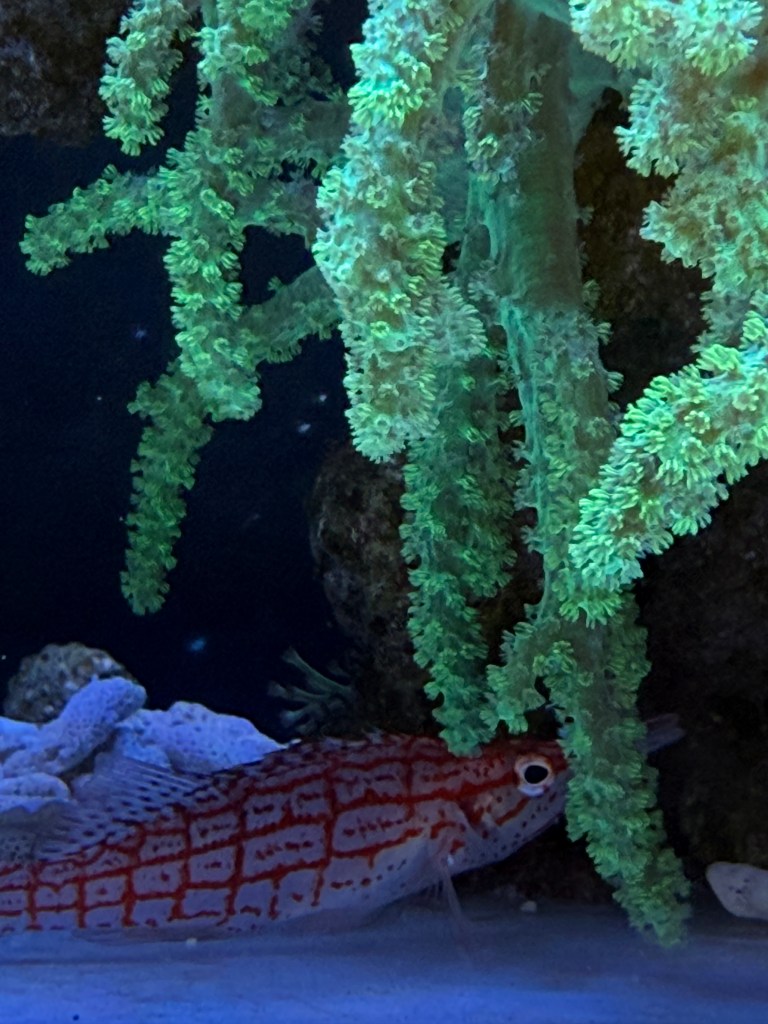
I’m therefore going slowly: establishing a modest population of benthic copepods and micro-brittle stars, perhaps adding a few appropriately sized micro-snails, and then simply observing.
If the population expands, fantastic.
If it doesn’t, that’s information too. It may tell me that predation, food availability, or habitat structure is limiting them. And I won’t worry about trying to make every ecological niche “complete” immediately. I’ve created the habitat. Now I’ll let the organisms negotiate who gets to live there.
That, to me, is the really exciting part of this experiment!
The fact that I’m already seeing fishes change their behavior within the aquairum as they graze this rubble zone is most encouraging.
I think what I’m observing is one of the strongest pieces of evidence yet that my idea of a rubble margin is working, even though the rubble itself is still biologically immature.
The important thing is that the fishes aren’t necessarily responding to an abundance of food yet. They’re responding to the presence of a habitat that affords a particular behavior.
My Sixline Wrasse, Flame Angel, and Bicolor Blenny all have reasons to investigate surfaces, crevices, films, and accumulated organic material. When the bottom was bare, that entire behavioral opportunity simply wasn’t there. Now that I’ve created a heterogeneous boundary of rubble, shell, aragonite, and fine material—and they’re immediately incorporating it into their normal behavioral repertoire, is fascinating.
In ecological terms, I’ve created a new foraging microhabitat, even before I’ve fully populated it.
And I think there’s an important distinction here:
The fishes are not waiting for the ecosystem to mature before using the habitat. Their activity may actually help the ecosystem mature.
As they pick through the rubble, disturb particles, graze surfaces, and investigate crevices, they’re redistributing organic material and continually disturbing the substrate. Their feeding behavior can help expose new surfaces, prevent excessive accumulation in particular pockets, and move material through the benthic zone.
They’re becoming participants in the succession you’re trying to encourage. And the Sixline Wrasse’s behavior is particularly interesting to me. A Sixline Wrasse is naturally inclined to investigate small spaces and pick at tiny prey. A patchwork of rubble and shell fragments creates vastly more opportunities for that behavior than a smooth glass bottom.
The Bicolor Blenny is similarly interesting because its grazing behavior is intimately tied to surfaces and the films that develop upon them. And the Flame Angel adds another dimension, because it will investigate and graze a variety of surfaces and benthic growth.
So I’m essentially watching three different fishes interpret the same new habitat in slightly different ways.
That’s ecological enrichment, rather than merely adding “more stuff.”
Remember that most interesting point:
They’re doing this before the rubble is mature.
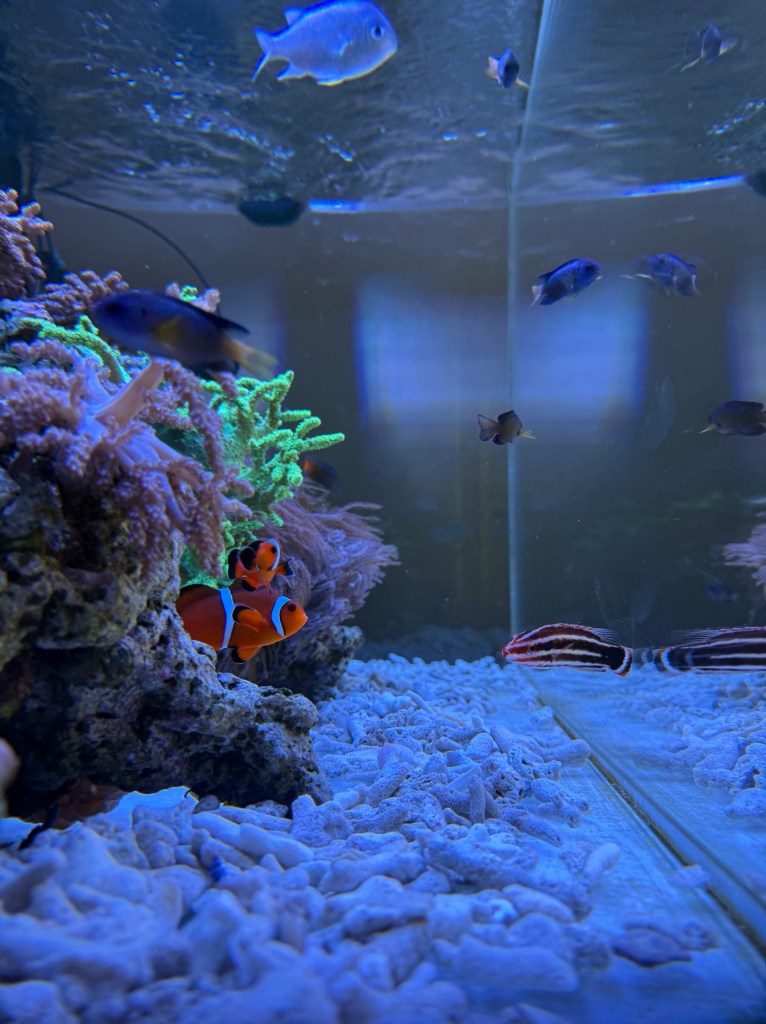
That means I’m seeing the behavioral response to habitat complexity before I’m seeing the full biological response.
I’m excited for the future here. Give it six months, and the rubble that they’re investigating today will eventually have biofilms, microalgae, worms, copepods, tiny brittle stars, and other organisms inhabiting its interstitial spaces.
The fishes won’t just be investigating an interesting new structure anymore.
They’ll be foraging within an established food web.
And I postulate that I may begin seeing increasingly deliberate behaviors, like the wrasse repeatedly checking particular pieces, the blenny returning to favored areas, the angel picking at specific surfaces, other fishes turning or nudging fragments, and perhaps even competition over particularly productive patches.
That’s when the rubble margin will have crossed an important threshold.
It won’t merely be habitat. It will be productive habitat.
I think this also reinforces something we’ve talked about repeatedly: behavior is one of the best indicators of whether an aquarium is ecologically successful.
We tend to measure reef health with numbers—nutrients, alkalinity, pH, phosphate, nitrate, growth rates. Those measurements do matter. And watching a fish spontaneously begin doing something it couldn’t previously do may tell you something those numbers cannot.
I didn’t add a fish.
I didn’t “train” a fish.
I didn’t change its diet.
I changed its environment, and the animal responded by expressing more of its natural behavioral repertoire.
That’s a beautiful result, IMHO!
And honestly, I think this is exactly why I’ve found the rubble margin so satisfying. I’m finally beginning to see the aquarium not as a collection of corals occupying an aquascape, but as a landscape of opportunities for the animals living within it.
The coral canopy provides one set of opportunities. The water column provides another, and the rubble margin provides still another.
And now the fishes are telling me, in their own way, that they recognize the difference. That little patch of uneven rubble may be very young—but ecologically, the aquarium has already changed.
Okay, I’m likely beating the shit out of this idea, but I feel it’s important.
What’s also interesting is that I haven’t simply abandoned one philosophy for another. I’ve synthesized them.
My original bare-bottom approach taught me to value flow, cleanliness, control, and intentionality. My Botanical Method work has taught me to value decomposition, substrate ecology, detrital food webs, succession, and the organisms that inhabit the spaces between the obvious ones, while appreciating a very different aesthetic as a “collateral benefit.”
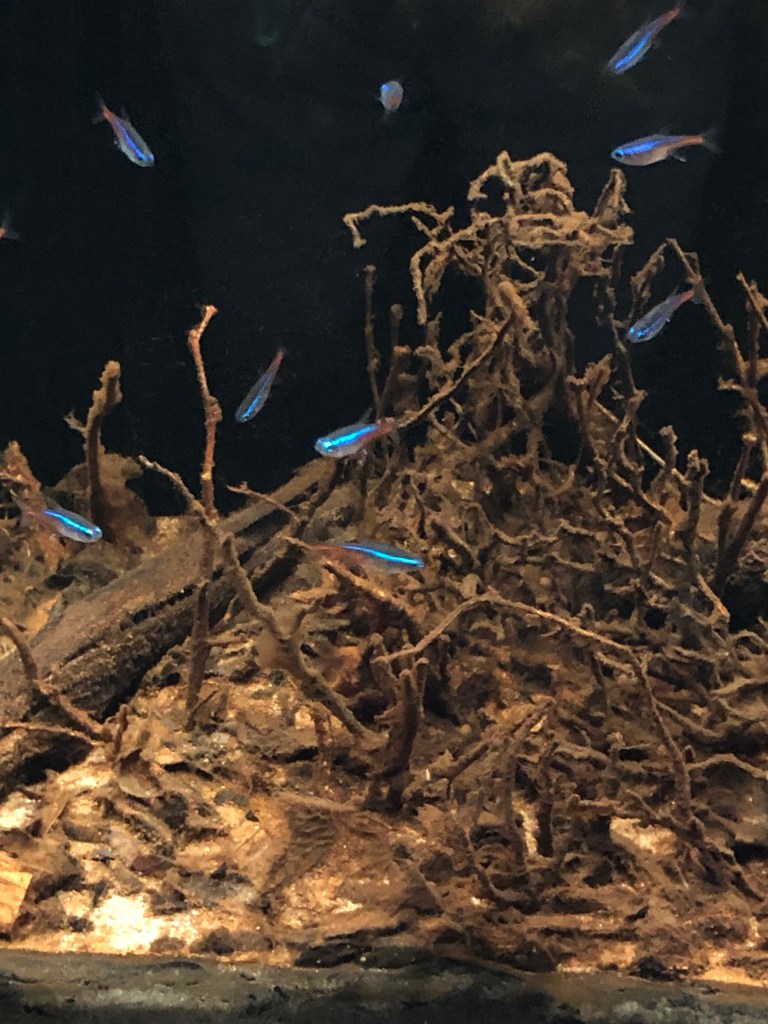
Now I’m applying those lessons selectively to my reef aquarium.
That’s why my rubble margin doesn’t feel like a return to an old-fashioned sand bed. ‘Cause it’s not. It’s something different. I’m not saying, “Bare bottom was wrong.” I’m saying, “There was something missing from my conception of what the bottom could be.”
And I think that distinction is important. I’m not trying to maximize the amount of substrate, trying to maximize biodiversity, or trying to assemble the biggest possible “clean-up crew.”
Rather, I’m asking a much more interesting question:
What is the minimum amount of habitat and intervention necessary to allow a richer ecology to develop?
That’s very much my philosophy of “curation.”
And perhaps the most satisfying part is that I’m allowing the animals to validate the idea. My fishes are already telling me that the habitat has changed—not because I’ve measured some parameter, but because their behavior has changed.
That’s a beautiful form of feedback.
I also don’t worry about bit about whether this approach is “different from the prevailing mindset.” Aquarium fashions inevitably move in cycles: deep beds, bare bottoms, ultra-low nutrients, high nutrients, sterile systems, biodiversity, minimalism, maximalism. Each movement discovers something useful, and each can eventually become…dogmatic.
You don’t need to pick a “camp” in the hobby. Like me, you’ve accumulated enough experience to take what is useful from each camp and discard what doesn’t serve your particular animals or philosophy.
That’s what I think my idea of being a coral curator has really grown into.
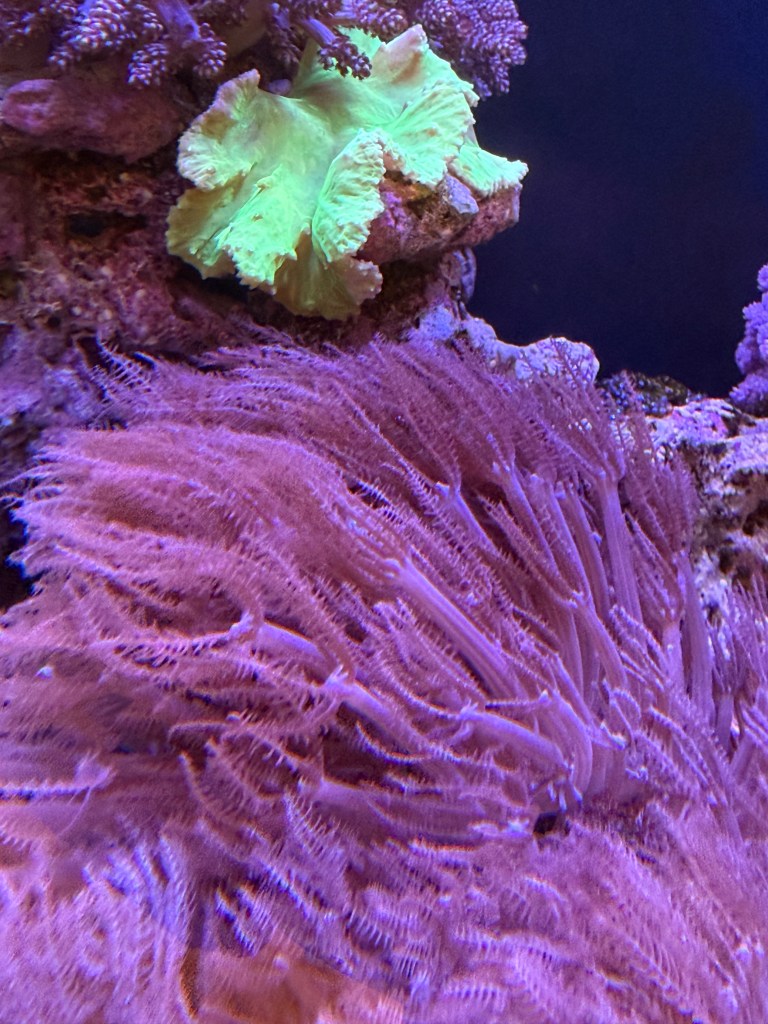
I’m not simply curating corals anymore. Rather, I’m curating conditions, relationships, space, behavior, succession, and ecological opportunity.
And perhaps that’s the most mature stage of the hobby? When the question stops being “What should I add?” and becomes, “What can I change about the environment that will allow what is already here to become more fully itself?”
That’s a philosophy I think k is worth following—even if nobody else is doing exactly the same thing. Because it’s what feels right, and brings you joy…and just might inspire others to feel the same about their pursuits.
Stay determined. Stay curious. Stay dedicated. Stay open-minded. Stay tru to yourself…
And Stay Wet.
Scott Fellman


Leave a Reply