
Our aquariums tell us a lot. They literally speak to us.
They provide feedback.
I’ll give you a very current example of this idea…
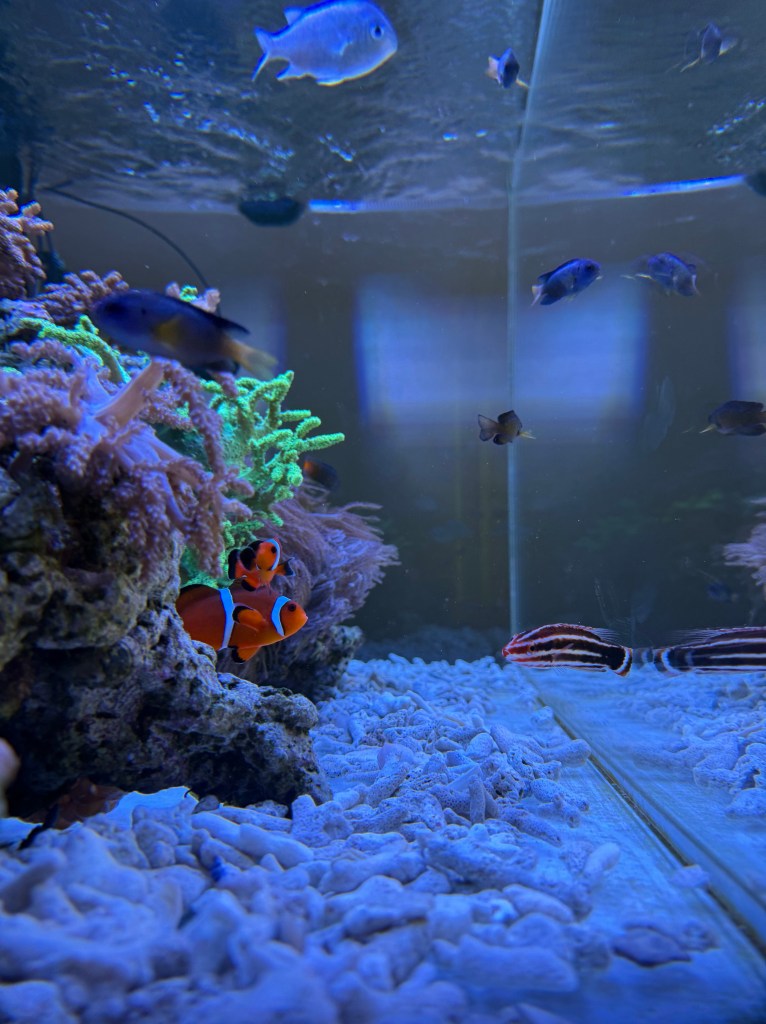
As most of you know, I maintain a heavily-stocked soft coral reef aquarium. It’s well-equipped with some of the latest and greatest gear, and I am a religious water exchange fanatic. Oh, and I feed the shit out of my fishes!
Like most reefers, I run water tests to keep an eye on the trends and “normal operating parameters” for my reef. Typically, my nitrate runs around 20ppm, and phosphate around .90ppm. These are numbers which, in the past, would freak me the fuck out. In fact, that phosphate number would make most “SPS” reefers run for the hills.
But guess what?
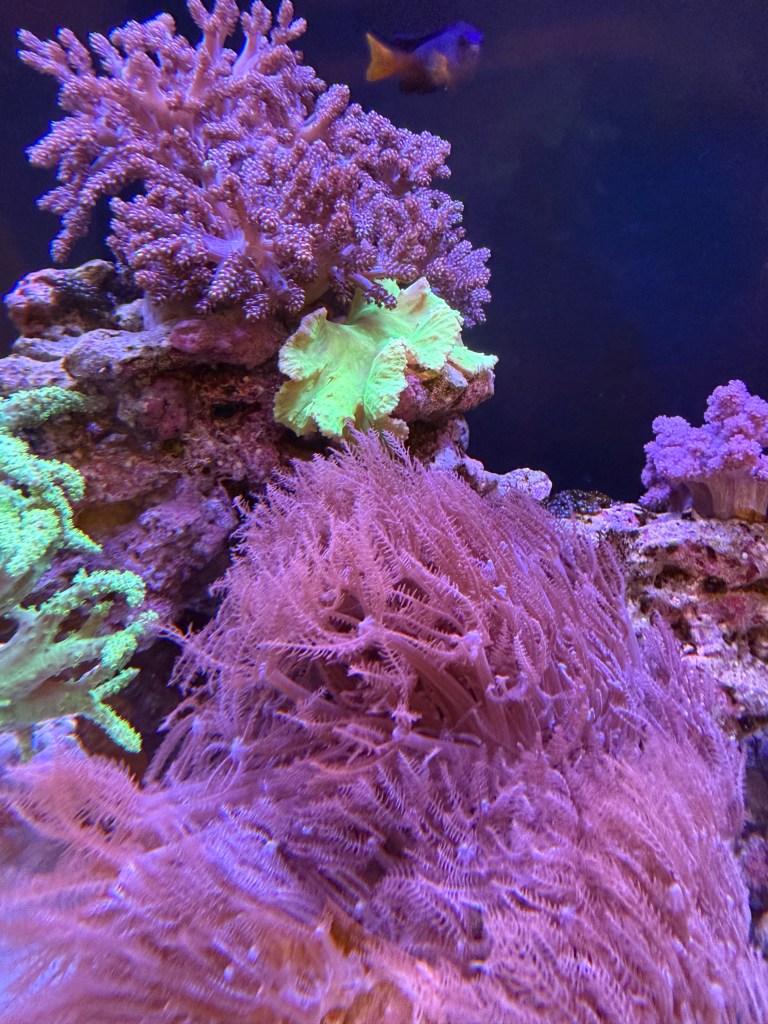
My tank is thriving. There is no nuisance algae, no accumulating detritus or uneaten food, and I have rampant soft coral and “LPS” growth.
The numbers, though…They tell us…something.
In this case, the aquarium is giving me an unusually valuable piece of information: It’s telling me that these nutrient concentrations are currently compatible with a functioning, growing ecosystem.
Feedback.
That’s worth respecting.
And I actually think this is a beautiful example of the philosophy we’ve been discussing a lot lately with our aquariums.
The goal isn’t necessarily to drive our aquariums toward an arbitrary numerical ideal. It’s to understand the relationship between nutrient availability, biological processing, animal health, growth, behavior, and visual condition—and then make small interventions only when the ecosystem tells us they’re necessary.
In other words:
Don’t chase numbers. Watch the ecosystem—and use the number to help you understand what you’re seeing.
Pretty straightforward.
And if you look at the underlying data, it typically tells you more than the numbers do.
Feedback.
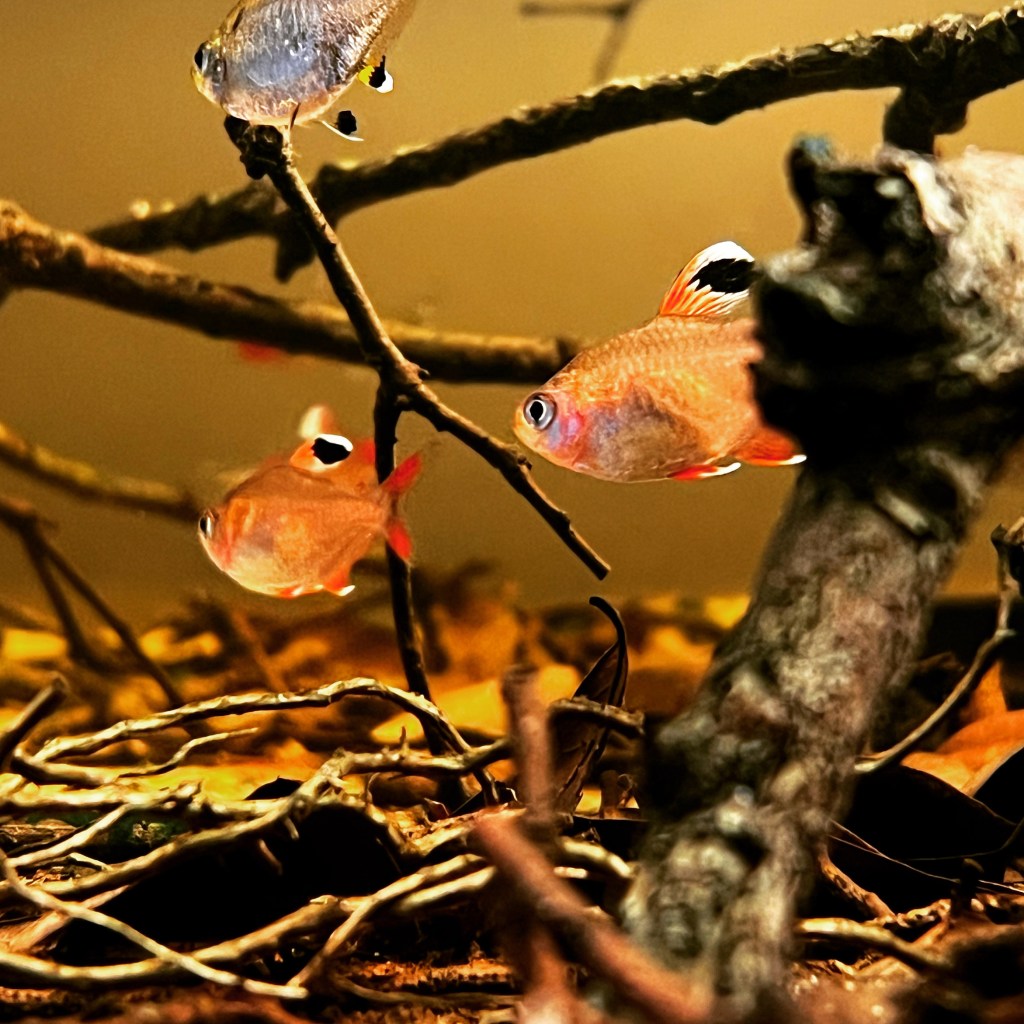
In a heavily stocked reef aquarium, for example- particularly one where fish are fed substantial amounts of food every day, there is going to be a substantial and continuous nutrient flux. Food goes in, fish assimilate some of it, metabolism produces waste, bacteria and other organisms process organic matter, and some nutrients ultimately accumulate faster than the system exports them.
A nitrate reading around 20 ppm and phosphate around 0.9 ppm can therefore be understood as a signature of the system’s “nutrient budget“, rather than evidence that the aquarium is “malfunctioning.”
The fish are healthy. The corals are growing. There is no nuisance algae. The system looks good.
That’s enormously useful information, isn’t it? It actually tells us more than raw numbers do.
And here is an interesting data point:
As I mentioned, I feed a lot. and I am careful how I feed, rinsing the food before feeding. I’m not adding tons of food that goes uneaten into the aquarium, mind you. I’m feeding deliberately, and the fish consume all of it. But of course, even perfectly consumed food doesn’t make its nutrients “disappear.” The fish incorporate those nutrients into biomass and then return a portion through respiration, excretion, mucus, feces, etc.
In other words, feeding the fish is also feeding the ecosystem.
That’s an ecological data point.
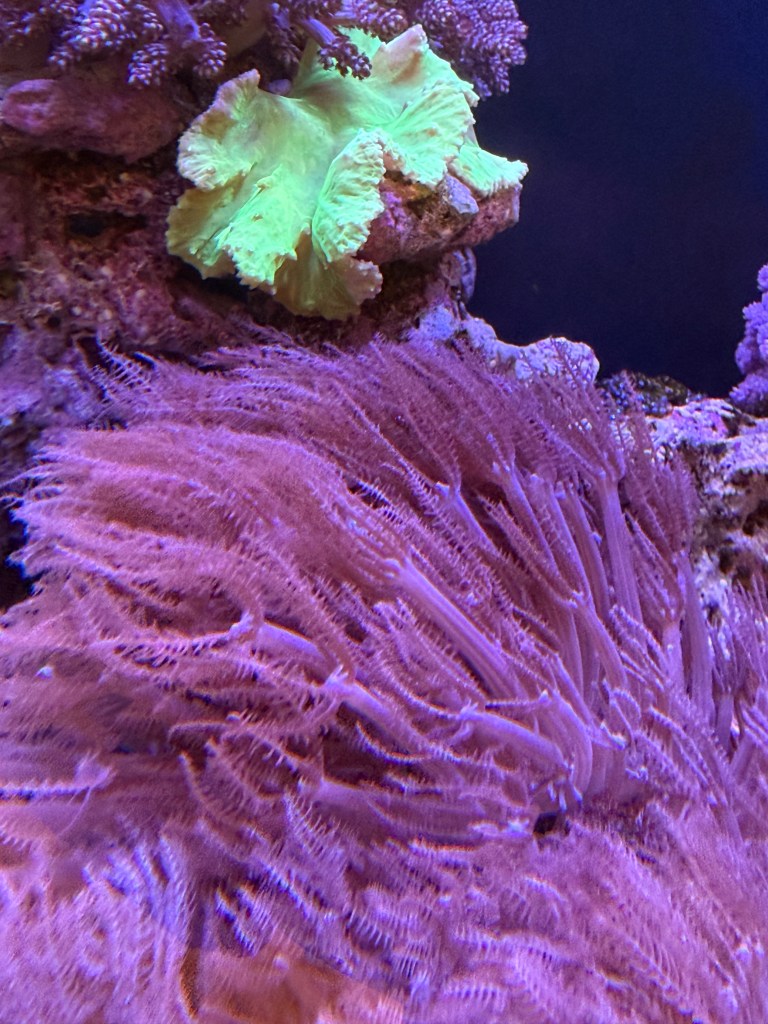
And my tank has a tremendous amount of biological infrastructure processing that material: Coral surfaces, rock, rubble, microbial communities, filter media, the water column itself, as well as all of the organisms living within that benthic margin.
So I wouldn’t simply look at my phosphate reading and say, “Something is wrong.” I’d say, “Interesting. This is where this particular ecosystem currently sits.”
There is one distinction I’d keep in mind: “normal for this aquarium” doesn’t necessarily mean “optimal indefinitely.”
I don’t kid myself.
I’m nothing if not a realist when it comes to long-term aquarium husbandry. What works right now could always prove problematic down the line. That’s just the reality of keeping aquariums long-term.
It’s a continuous process.
A phosphate concentration of ~0.90 ppm is considerably higher than what many reef aquarists deliberately maintain, and what I’ve maintained in a lot of tanks in the past, so obviously I’ll continue watching the trajectory. If it continues to remain stable for months while the aquarium continues to perform beautifully, that’s a very different situation from going from 0.90ppm to 1.2ppm to 1.8 ppm, etc, accompanied by declining coral health and increasing algae growth.
That’s feedback.
And that gets right back to my philosophy.
The number is data, not a “verdict.”
We need to take it and interpret it, not just freak the fuck out when we see a number that sounds “bad” to us.
I’d actually find it more concerning if I had nitrate and phosphate numbers that looked “textbook perfect” while the fishes were thin, the corals were declining, the benthic community was impoverished, and if I was constantly manipulating the system to keep those numbers there.
My aquarium is telling me something much more interesting:
“This is what a heavily fed, heavily populated, biologically mature reef looks like when its nutrient inputs and processing capacity have reached an equilibrium.”
Feedback.
I’m inclined to continue to watch it and enjoy it, rather than “fix” it. Besides, what needs “fixing?” A number?
And let’s look at a few things here.
This system is not simply running on the edge. It’s thoughtfully equipped. This was a deliberate decision I made when I designed the tank. I have several independent layers of stability operating simultaneously.
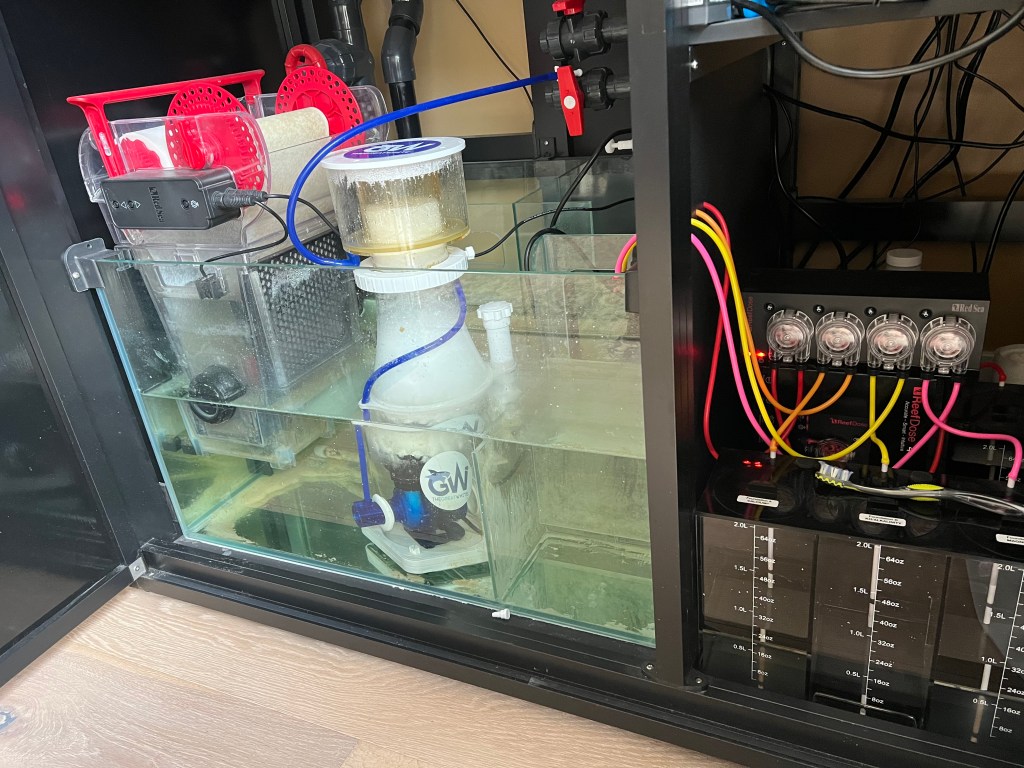
My aquarium is equipped with a Red Sea “Reef Mat 1200” filter roller. This device accepts incoming water from the tank and pulls out sold waste onto a roll of nylon filter materials, sort of like a filter sock, but it is outside of the water, so it doesn’t break down. The filter roller provides consistent mechanical export of particulate organic matter before it can accumulate and decompose in the system.
I also have a very capable protein skimmer, which removes dissolved organics from the water. A well-tuned protein skimmer continuously removes dissolved and colloidal organic material, providing another pathway for export.
And then there is the coral population I have.
Rapidly growing soft corals are themselves substantial “biological consumers.” They’re taking up nutrients and incorporating them into living biomass, and my periodic “pruning” subsequently exports some of that material.
The rubble/benthic margin that I recently added serves as an another processing “facility”, rather than simply leaving the bottom as a sterile surface. Microbial and meiofaunal communities can intercept and transform organic matter there. The large, maturing biological surfaces within the rock and the rubble margin provide enormous habitat for microbial processing.
And importantly, my fish and corals are thriving, which tells me that the system is supporting a substantial biological load rather than merely tolerating it.
That’s a very different situation from a heavily stocked aquarium in which nutrients are accumulating because there simply isn’t enough biological or mechanical processing capacity.
That’s feedback, too, right?
I particularly like the fact that my soft corals are growing rapidly.
Why? Well, growth is one of the most interesting pieces of information we can get from an aquarium, because it represents nutrients actually being converted into biomass. My Sinularia, Sarcophyton, etc. aren’t merely surviving in the nutrient environment—they’re using it.
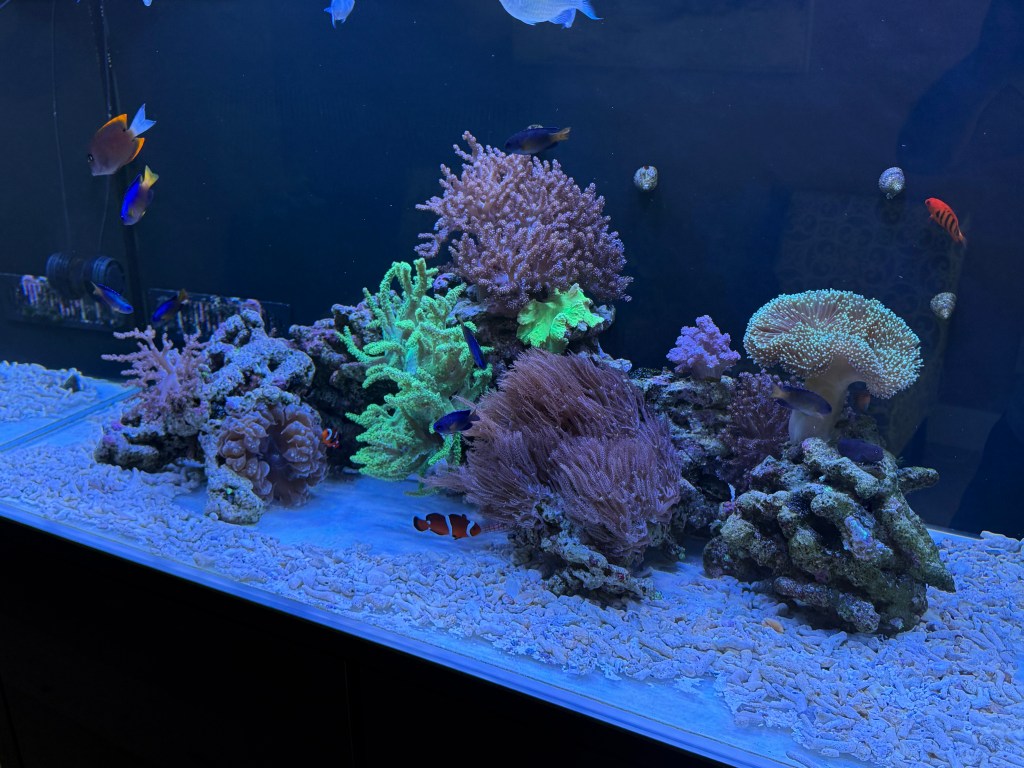
And then I’m periodically removing coral biomass through pruning. That’s a legitimate form of nutrient export that is sometimes overlooked because we don’t think of coral husbandry as “filtration.”
So I’d characterize my current situation this way: The aquarium has a high nutrient throughput, but it also has substantial capacity to process that throughput.
That’s why I’m perfectly comfortable with my instinct to leave things alone for now. The important thing is that I have multiple “safety nets” rather than one magic piece of equipment. If one pathway becomes slightly less efficient, the others continue functioning. That’s much closer to “ecological resilience” than simply maintaining an impressive number on a test kit in my book!
And there’s something particularly satisfying about that, given the direction I’ve been taking this aquarium. It follows a philosophy that I’ve had for years now of setting the stage for Nature to do the work. I’ve moved away from thinking “How do I get the numbers to look right?” toward “How do I build an ecosystem capable of handling what I’m asking of it?”
It sounds like the latter is working.
Besides, chasing numbers sucks.
Now, I’m not advocating ignoring your tank. In my case, I’ll keep testing, observing, and pruning the corals when appropriate—yet otherwise let the reef continue becoming what it “wants” to become.
Feedback, again.
Any aquarium that we set up provides “feedback” to you, the hobbyist- all of the time.
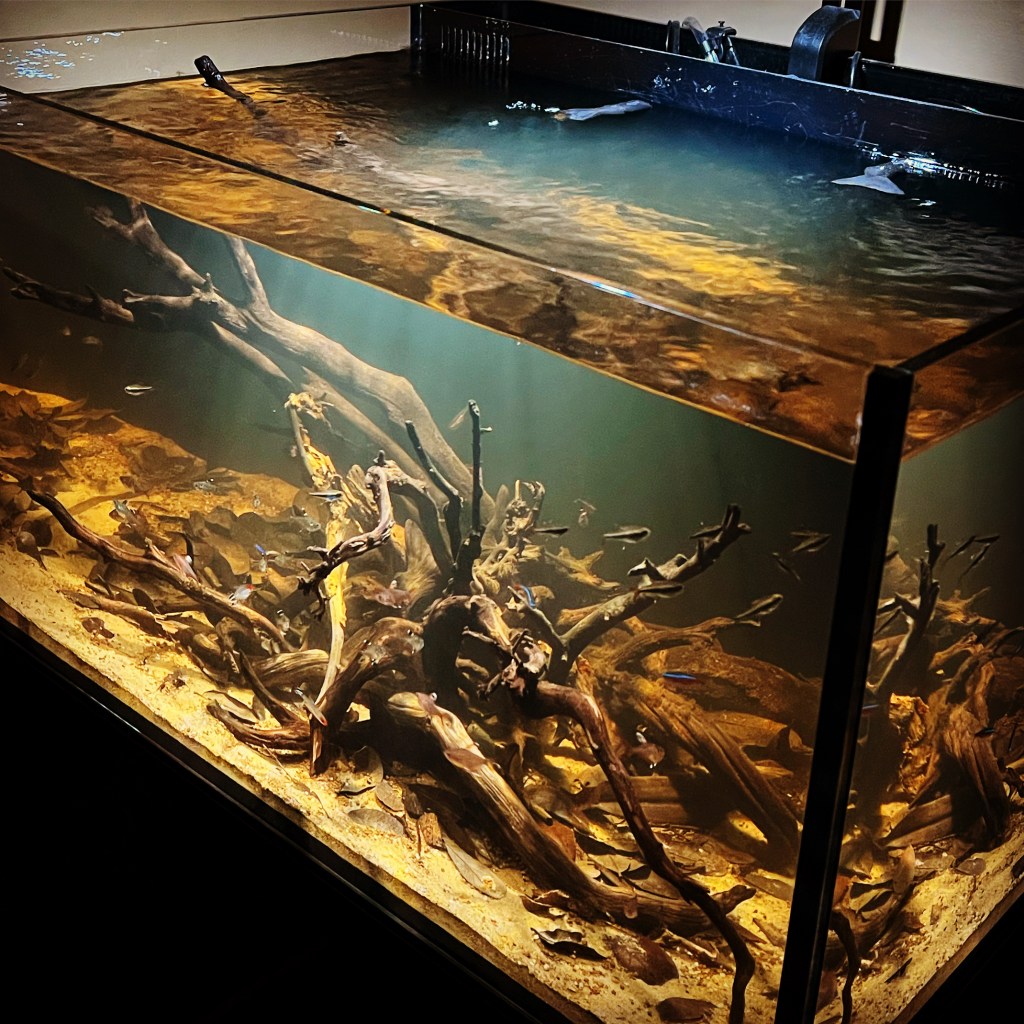
This is an important concept which many of us have embraced- knowingly or unknowingly- for years. Of course, the aquarium isn’t a “closed feedback loop” in the strict ecological sense. It is an “open, managed ecosystem with feedbacks.”
What makes the concept so useful to us is that you don’t establish the aquarium once and then impose a permanent definition of “correct.” You establish initial conditions—livestock, food input, flow, light, substrate, leaves, rock, rubble, filtration, water chemistry—and then the organisms respond to those conditions.
Those responses, in turn, change the conditions.
In the example of my reef tank, the corals grow and alter the physical structure of the reef, while the fishes consume food and redistribute nutrients in the system. Microbes process organic matter throughout the aquarium, while the rubble develops its own community. Coral growth changes flow patterns, pruning removes accumulated biomass, and the filter roller and skimmer alter the rate of export.
And then I observe the resulting system which develops.
That observation becomes…”feedback.”
If the fish are thriving, corals are growing, the benthic community is developing, there is no nuisance algae, and the water chem remains stable, the ecosystem is effectively telling you that “these conditions are working.”
And importantly, what constitutes “working” is specific to that ecosystem.
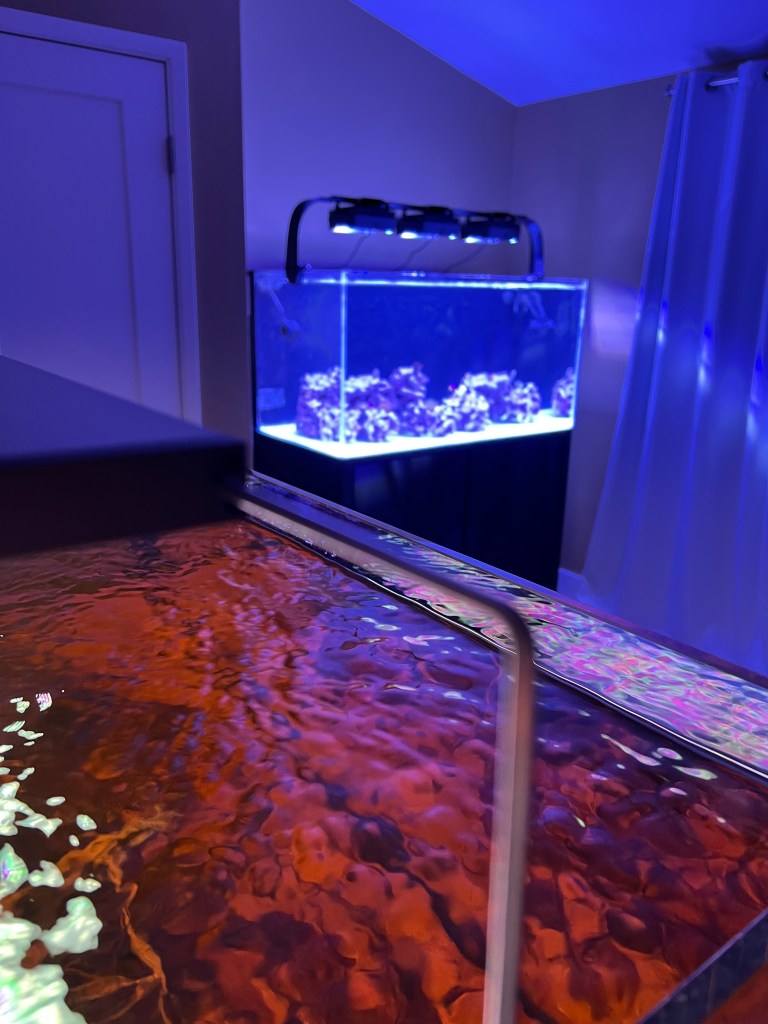
That’s where I think my earlier observation about the nutrient numbers becomes particularly interesting. A nitrate concentration of 20 ppm or phosphate of 0.9 ppm doesn’t exist in isolation. It exists within a particular ecological context. My aquarium is effectively establishing its own baseline.
If we fast-forward to six months from now, perhaps the coral biomass has doubled, the rubble is more heavily colonized, and my nutrient readings have changed. That isn’t necessarily a “failure” of the original system. It simply represents the ecosystem moving into another state—and providing me with new information about its current equilibrium.
Feedback!
This concept is very close to the distinction between maintaining a state and guiding a trajectory. The traditional aquarium mindset tends to say, “Set your parameters, maintain the parameters, and correct deviations.”
My approach is more like, “Establish the initial conditions , observe the responses, interpret the feedback, and make measured adjustments. Observe again.”
And that creates something that, in my opinion, is rather beautiful: The aquarium literally “participates” in its own husbandry.
Yeah, think about this…
You aren’t the sole “director” of what happens next in your aquarium. You provide the initial conditions and constraints, but the organisms collectively determine much of the subsequent trajectory!
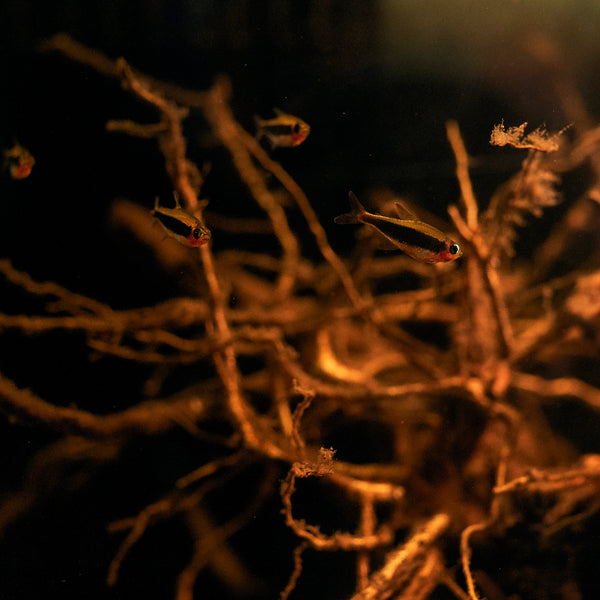
That’s also why I think my description of the aquarist as a “curator” fits so well. A curator doesn’t manufacture every detail of an exhibit. They establish the conditions under which something can develop, decide what belongs, remove what has become excessive, and continually interpret what is happening.
In that sense, our test kits, coral growth, fish behavior, detritus patterns, algae—or lack thereof—and even the changing appearance of the our aquariums are all “feedback channels.”
The most mature form of aquarium husbandry (reef, botanical method, planted, or otherwise) may therefore be less about asking, “What should my aquarium’s numbers be?” and more about asking,“What is my aquarium telling me about itself?”
That describes a fundamentally different relationship with our aquariums. And I think it’s very much where our philosophy has been heading.
My reef- like all of my tanks- provides me with all sorts of feedback…some of it about the system, and some of it about myself.
Listen to your aquarium. It will tell you all sorts of things.
Stay observant. Stay curious. Stay thoughtful. Stay engaged…
And Stay Wet.
Scott Fellman
 The Tint
Leave a comment